Unknown's avatar

About drlynrobinson

Academic, Londoner. She/Her

Videogames as Cultural Heritage

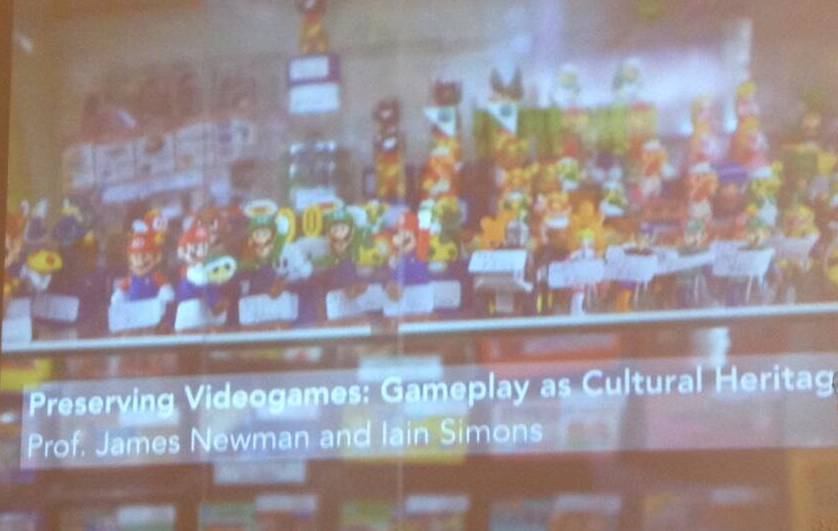
videogamesAn engaging seminar at the Daiwa Foundation on 3/6/14, allowed games experts and enthusiasts James Newman and Iain Simons to treat us to an entertaining and thought provoking romp through the history of videogames. Their relaxed style kept our attention for around 90 minutes, which still wasn’t really enough time to cover all aspects of the questions ‘are videogames a part of cultural heritage, and if so, should they be preserved?’

The intuitive answer would seem to be ‘yes, of course’, but it is interesting to consider some of the evidence for why. A slide of Super Mario (1985) and Sonic the Hedgehog (1991) instantly transported many of the audience back in time; game imagery has the ability to evoke strong memories of place, music and feelings, perhaps akin to the power of smell. We could then, consider the preservation of out-dated games purely for nostalgia, but historic games also offer us a record of technology at a given point in time, an insight into what was considered a ‘game’ from a socio-cultural perspective, and material from which to predict future trends.

Irrespective of the reasons for preserving the games, there are problems with this. There is no legal deposit in the UK for videogames, and thus no systematic policy or funding (one consideration is that an archiving initiative should come from the industry rather than the state). Games archives require space for the accompanying technological platforms, which demand an increasing amount of conservation to combat the unavoidable decay (bitrot), as plastics become brittle and powdery, and circuit boards return, like all of us, to dust. Rewriting games into the current age so that they function on modern technology is a plausible solution, but not one appreciated by either games lovers or historians, as the authenticity experience of playing the game is lost.

Our speakers were both involved in setting up the National Videogame Archive, within the National Media Museum at Bradford.

A comparison of the videogames industry in the UK with that in Japan, showed us that serious game playing is very serious in Japan. Here, even the range of literature found in bookstores is wider than that found in the UK. Pictures from a six storey games emporium in Tokyo convinced us that historic games are fantastically popular, although interestingly, the players of archaic games were from the same youngish demographic as those of up-to-the-minute productions. The profitability of this type of venture clearly works out despite the outlay for space and maintenance.

I was left with the thought that games *are* part of our cultural heritage, and something very much worth preserving. From the perspective of library and information science, games can be regarded as documents; they can be studied from a variety of angles, in the same way books can within the context of ‘book history’.

Worth further thought is whether we are preserving the physical game alone, so that future players can have a go in a different time, or whether we are including the preservation of the experience of a player at a given moment. Watching a video clip of expert players in Japan, it was evident that understanding how it feels to play is a compelling quest, likewise we could explore the symbiotic movements of two or more people playing the same game. There is though, the question of how to record the feelings of the players, and what sort of measures we use to interpret any meaning to the record.

If we consider that future documents will embrace immersive, multisensory and participative experiences, then videogames are undoubtedly of concern to those of us within LIS. Serious leisure people, it has to be done.
Spaces for learning

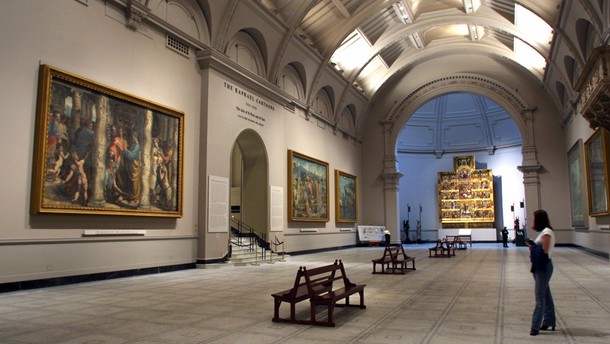
Raphael Gallery at the V&A

Room 48a: The Raphael Gallery at the V&A

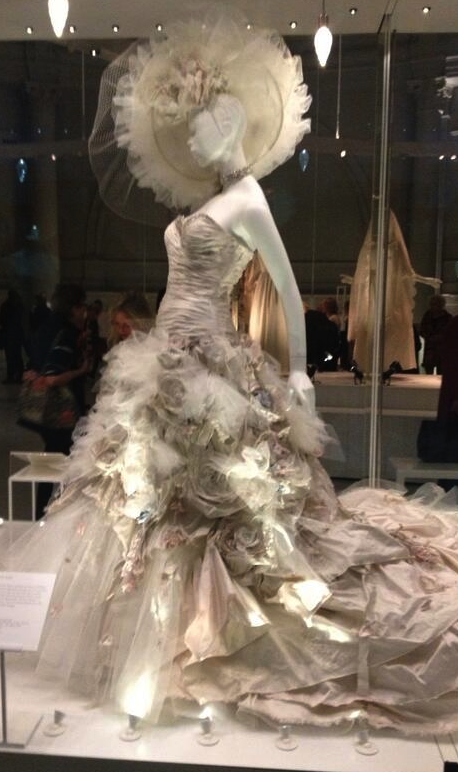
Ludi (@ludiprice) and I attended the preview of Wedding Dresses 1775-2014, currently showing at the V&A. The exhibition is gorgeous, so do go if you can, but what stuck me was not so much the dresses as the feeling whilst we were gazing at them, wandering around in the darkish space, watching all the videos and learning all the time. Why isn’t going to university quite like that? Why are the spaces not so conducive to engaging with material? It could be the cost – I admired the videos playing silently in the recesses of the fabulous domed ceiling about us; Ludi agreed: “.. but we need a dome …”, although I am not sure that cost is everything. The classrooms at City are undergoing an expensive refit – with a theme that reminds me of the barbie doll furniture I used to play with as a child, reinterpreted in 21st century windowless bunkers. What is taught in these rooms and what is learnt? I hope nobody thought to consider these questions, but I have a suspicion that, depressingly, this is a considered, contemporary vision of learning space.

We left the wedding dresses and wandered into the Raphael Gallery (shown above). “The game is,” I explained, “to come here just before closing time, and wait until you are the last person in the room – then for a few moments, in this calm, cathedral like space, all the Raphael paintings here exist just for you…”.

When we ask students to pay £9,000 a year to study face-to-face, we should be confident that we can at least offer a physical space which instills a feeling of timelessness, inspiration, connection with others and above all, a desire to learn.

What spaces say to each of us is subjective, and often personal. But there are spaces which many of us, collectively feel inspired by. Spaces which encourage us to pay attention, to realise that something interesting and important is being communicated. Spaces which objectively promote not just the learning process, but the desire to learn. They are somewhat elusive in today’s educational landscape however.

.. obligatory wedding dress ..

Stunning contemporary dress from Ian Stuart Bride (http://www.ianstuart-bride.com/)

My name is Lynxi … I am an academic

What is a LIS degree? This question is a favourite concern to me as director of a postgraduate LIS programme (#citylis). Surrounded by rocketing costs for the professional masters, piled on top of hiked-up undergraduate fees and set in the midst of global economic uncertainty, there is the very real question of why anyone would choose to enrol on a face-to-face taught course instead of learning on the job.

Leaving aside for the moment, the choice of which subjects should be presented in the classroom, our slant at #citylis has always been on an academic focus, emphasizing the theoretical principles underlying professional practice.

Unsurprisingly, we face the occasional suggestion that it might be better to teach more about what people actually do in the workplace. This latter approach has always seemed short sighted to me. Skills I used in the workplace 5 years ago are already sliding from dinner party conversation (command line searching anyone?) and I am constantly being reminded that what employers value most are those harder-to-quantify skills, which start with ‘excellent oral and written communication’ and run through to the pinnacle of ‘flexible thinker’.

Whilst it is difficult to find an agreed upon definition of  ‘flexible thinking’, let alone ensure its presence in the curriculum, it is unlikely to emerge from a purely vocational based course. Our belief is that thinking skills develop from academic study. That is to say, if you want to learn to think, practice thinking.

But there is more to a successful career than being able to pronounce on theory. It is important to show how theoretical principles can be used to deliver results in the workplace. Here again, practice is the key, and to this end we augment our research based content with practical examples delivered by leading practitioners. This blended approach has received two welcome validations recently. The first by Andrew Preater (@preater) comes in his concise blog posting Reflections on the LIS Professional Qualification where he writes:

Personally I do not think the LIS masters should be vocational training to provide specific practical knowledge to do library work.

Rather I see the value in masters-level education of providing enough theory and knowledge of general principles that a library worker can bridge the gap between theoretical understanding and practical understanding developed in our professional practice.

The second comes from Diane Pennington, speaking at a Symposium organized by McGill University’s iSchool, (reported in InsideASIS&T Oct/Nov 2013, 40(1) p 16) who argued against divisions in the curriculum between those intent on a vocational career, and those aiming for PhD study.

All of this should be obvious, but the situation often seems a little hopeless to those of us who are constantly called upon to justify the existence of our cross-disciplinary, academic curriculum in terms of immediate job skills and learning outcomes. It is good to stand back and remind ourselves of the bigger picture. In our academic approach, we are laying the foundations of resilience and adaptability that will support a life-long career, rather than just a first position.