Introduction
There is never less to read – only more. I sometimes use those historical quotes in my lectures which show how famous people throughout time also felt they lived with too much information, and that our concerns about there just being too many books are hardly new. I offer the usual advice of the need to be selective, and emphasise that the ability to choose reading materials is a fundamental skill for the information worker. I would go further, and argue that it is a fundamental skill for all – but already I am veering off into the waters of information literacy, when all I want to do is to say something brief and informative about background reading for library and information science.
This post is for those of you who are joining one of our LIS masters courses this September, or those who are interested in learning a bit more about library and information science as a subject. I don’t mind if you are going to study LIS at a different institution – these personal recommendations should still work.
The most important book
Obviously our own “Introduction to Information Science”. I am a shamelessselfpromoter, and will often wear sequins to get attention. But, the book has emerged from around 60 (combined!) years of thinking and writing about information science; what it is, how it relates to library science (and other related subjects), its main components, protagonists, its past, present and future, and how it can be presented within the context of an academic masters course.
Neither DB nor myself imagine our book to be the last word in information science. It is not the first either! Rather we set out a contemporary landscape, and signpost many other resources and references. Since we signed off on the text, vowing ‘never again etc.’, we have thought of far more to add – there may be a second edition – but at least for the forthcoming academic year this will do for starters. The chapters do not correspond exactly with modules offered on the City courses – there are more modules than topics we cover. The content (listed below) does however, reflect what we believe to be the current core of Library and Information Science, and it should therefore be of interest to anyone who, for whatever reason, finds themselves concerned with LIS:
1: What is information science? Disciplines and professions
2: History of information: the story of documents
3: Philosophies and paradigms of information science
4: Basic concepts of information science
5: Domain analysis
6: Information organisation
7: Information technologies: creation, dissemination and retrieval
8: Informetrics
9: Information behaviour
10: Communicating information: changing contexts
11: Information society
12: Information management and policy
13: Digital literacy
14: Information science research: what and how?
15: The future of the information sciences
I should add that we are privileged to have a collection of forewords to the book, all written by internationally famous LIS professionals, and obviously friends of ours.
Other background reading
I am often asked to recommend background reading, or ‘summer reading’. I love making these suggestions as it gives me a chance to enthuse about things I have read in the past, or just come across recently. I enthused about James Gleick’s “ The Information” for about a year before it was published.
My short-list of four for this summer is shown below – although I am always changing my mind according to what comes to my attention. Ours is not a dull subject, nor one that is short of lovely new volumes. I have a lot of books. I think one of the key attractions of LIS for me is that information communication spans each and every subject, so there is usually something tempting, even if you are into cult fanfiction and rarely step away from Archive of Our Own. The task here is to be brief yet inclusive – although anyone else will give you a different selection. And you are completely free to undertake your own voyage around the catalogues and byways to fit your own intellectual preferences once you get started.
I haven’t included journals, conferences, great bloggers or folks to stalk on twitter – wait until you get the course reading lists for those.
- Briggs A and Burke P (2009). A Social History of the Media: from Gutenberg to the Internet. 3rd Edition. Polity: Cambridge.
This will get you thinking about how information communication works in society, and its tenacious relationship with publishing.
- Chowdhury G G et al. (2008). Librarianship: an introduction. Facet: London.
This is the book to start with if you would like to compare our view of LIS with another one. Gobinda Chowdhury is an excellent writer of textbooks and you can add anything of his to your bookshelf with confidence.
- Floridi L (2010). Information: a very short introduction. OUP: Oxford.
The philosophy of information informs our decisions and work with the field of library and information science. This book is the best introduction to the concept that I have read.
The ‘very short introduction’ series from OUP is addictive and it is likely that you will come away with a small collection. Here is another:
- Ince D (2011). The Computer: a very short introduction. OUP: Oxford.
If you are nervous about having to understand how a computer works – this will reassure you – and this is more than enough for now. Remember, computers are pervasive. There is nowhere to hide from technology, especially in LIS.
Do you want more? My collection on LibraryThing
There is always more. If you are joining us in just over a month then you can simply wait for your reading lists and lecture notes, but if you are impatient and greedy for books then you may wish to take a look at my LIS collection on LibraryThing.
http://www.librarything.com/catalog/lynrobinson and http://www.librarything.com/profile/lynrobinson
LibraryThing is an application which allows you to create a catalogue for your own personal use, or perhaps for a small business, library or information unit. It is also ‘social’, in that it allows you to connect with like minded souls in a variety of ways; you can share your catalogue with others, you can in turn share theirs, and find out for example, more about a particular work, who has also added it to their collection, how to order a copy, swap a copy, discuss a copy etc. There is plenty of information on the LibraryThing website, so I won’t reproduce it all here, and indeed, although I would never want to live without my personal catalogue, I have to say I probably don’t use as many features as I could.
The link to my profile on LibraryThing above, takes you to a page explaining the background to my collection – i.e. that it contains the LIS books I am familiar with and use. I tag those which I use in class, so if you are in the right frame of mind, you can search for a course code to see what’s coming up … I list the course codes in my profile.
(Limit course-code searches to the comments field if you understand field limiting)
When using the search function, remember to enter terms into the lower box, to search my catalogue, rather than the upper box, which searches the whole LibraryThing universe.
Try also searching for “library-science” or “information-science” (limit to the tag field if you know what this means). This will bring up some relevant books to fill in your free time.
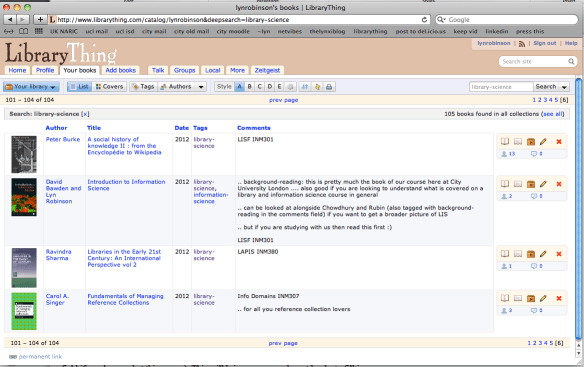
The catalogue is again a personal view of LIS – other documentalists will have a different selection – but many of the books will be found in any good LIS collection.
I started out with the intention of creating a LIS catalogue to accompany the modules which I teach – but then the addiction took hold and I began to add all the other books in my house. This is an ongoing pursuit. If you like book-stalking, you can browse through all my other stuff – but there is no need to if all you want is a masters in library science.


 Dr Lyn Robinson