Unknown's avatar

About drlynrobinson

Academic, Londoner. She/Her

Fashion Digital Memories, IUAV, Venice, May 22-23 2017

Fashion Digital Memories

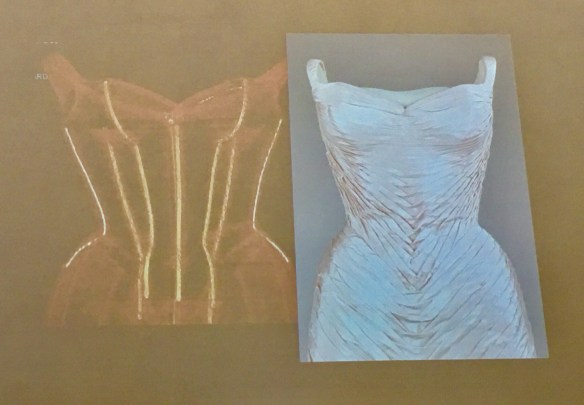
X-ray imaging. Slide shown by Tim Long, @Fashion_Curator, Fashion Digital Memories, 22-23 May, Venice. Photo by @lynrobinson cc-by

I was lucky enough to be able to attend Fashion Digital Memories 2017, the Europeana Fashion Symposium 2017 organised by the Europeana Fashion International Association in collaboration with Università IUAV di Venezia and The New School – Parsons Paris. The Symposium explored the ways in which fashion archives are experimenting with, and utilising, digital technologies to enhance the record and the reader/visitor experience.

The presentations reminded us of websites which furnish the reader with rotatable, high-definition images of garments, contextual video, and text descriptions, but also showcased more innovate technologies such as those using X-ray images, which provide additional ways to explore and interpret fashion items, and which also stand as new forms of art in themselves.

The three main protagonists of the conference seemed to be (1) fashion house archives (e.g. Versace), (2) academic institutions (eg London College of Fashion, Humboldt University) and (3) significant national collections (eg MoMa, Museum of London, V&A).

Especially interesting was the keynote given by Tim Long (@Fashion_Curator), from the Museum of London. Tim outlined some of the innovative projects he was involved with, which moved beyond collecting and conservation, to explore the boundaries of fashion heritage. The role of digital recording in stimulating new ideas, innovation and creativity was paramount. The challenges inherent in capturing both material and immaterial memories was raised.

Sadly, LIS was represented only through the archive profession, although much of the material dealt with core LIS issues: how to classify items, how to use a consistent vocabulary/terminology for description, what facets are appropriate for the subject, what kind of metadata is useful, how best to use linked data, and how to make digital materials available for both experts and casual users.

There was also an emphasis on UX – in particular the idea that, for casual museum/gallery visitors entertainment must come first, and information can follow for those interested. The tendency of information professionals to want to make all their material available up front should be resisted – it should be there for those who need it, but for most people a sample of exciting/pleasing material will be enough. Experiences and encounters with archive/museum materials should be ‘delightful’. The essential need for any material to be designed for mobile technology was also emphasised, and parallels could readily be drawn with the library world; readers/visitors/audiences have high expectations borne from multimedia, snippeted and mobile informational encounters.

This is often at odds with the scholarly approach taken by traditional academics, librarians, curators and archivists. There is a contemporary need however, to make collections viable financially, and culturally available and of interest to the widest possible number of people.

Also mentioned was use of standard vocabularies – Iconclass, Getty Art and Architecture Thesaurus, Getty Index of Names, OCLC’s Virtual International Authority File for names. The limitations of these vocabularies for fashion was evident. Research detailed some attempts to extend them, eg adding multilingual fashion terms to AAT, but there was also a tendency to invent local vocabularies.

Fashion clearly has a strong facet structure, though expressed slightly differently, e.g. form/shape/pattern and form/material/pattern

Video guides to collection items, on YouTube, are popular. These may be best without audio, using simple captions – so that they can be accessed anywhere when audio may not be acceptable without headphones, which helps those who first language is not English

Kate Bethune (@BethuneKate) from the Victoria and Albert Museum described the wide use of digital technologies in the recent Alexander McQueen exhibition, Savage Beauty, including digital storytelling, digital ‘cabinet of curiosities’ Pepper’s Ghost and immersive sound.

Newer use of digital technologies included x-ray imaging followed by digital enhancement, deep zoom imaging,  digital garment creation from digital pattern pieces, inclusion of digital artworks (especially for preservation/reconstruction), and outreach via social media.

Overall, I thought about documents and documentation. Specifically, the similarities between attempts to document fashion with attempts to document performance. Why are we documenting, and who for? What is missing from our record?

Somewhat surprisingly, none of the presentations reference VR/AR, which seems an area which could offer much to the realms of archiving and documentation in general, and perhaps fashion, specifically.

I wondered if garmets, and their associated archives, could benefit conceptually from Buckland’s documentation theory – if we think of ‘document’ very broadly (i.e. the item of clothing as a document), we can consider firstly the physical attributes of the garment, and then subsequently, our personal interpretation or understanding of/from the garment as a document, and finally the socio-cultural meaning and impact of the garment.

There is more to fashion than looking good.

A wonderful symposium. Many thanks to organisers and sponsors.: “Europeana Fashion International Association in collaboration with Università IUAV di Venezia and The New School – Parsons Paris. The event was co-funded by the European Commission within the Connecting Europe Facility (CEF) Programme.”

Further Reading:

Buckland, M. (2017). Information and Society. MIT Press.

Europeana Fashion

Long, TA. (2015) Charles James, Designer in Detail, V & A publishing.

Memories from ‘Fashion Digital Memories’ – Europeana Fashion Symposium 2017

Robinson, L (2017). Storify of Fashion Digital Memories.

Van Hooland, S and Verborgh, R (2014). Linked Data for Libraries, Archives and Museums. Facet.
 

Over the Threshold

mat collishaw thresholds

Mat Collishaw: Thresholds [https://www.somersethouse.org.uk/whats-on/mat-collishaw-thresholds]

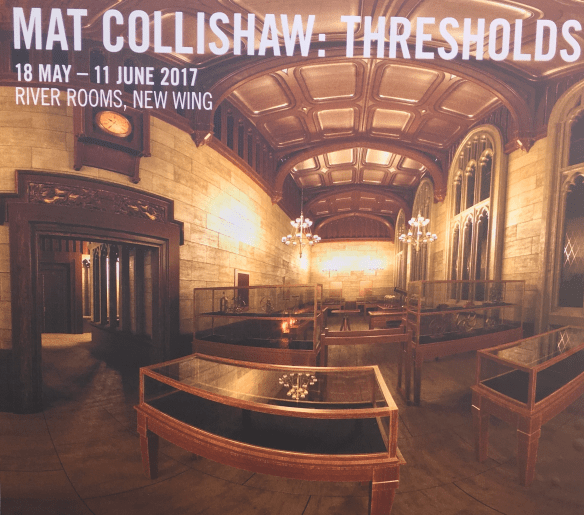
Today I experienced my first 6 minutes of immersive, interactive virtual reality (VR), at Thresholds, Mat Collishaw’s artistic interpretation of William Henry Fox Talbot’s first photography exhibition in 1839.

“Using the latest in VR technology, Thresholds will restage one of the earliest exhibitions of photography in 1839, when British scientist William Henry Fox Talbot first presented his photographic prints to the public at King Edward’s School, Birmingham.”

This differed from my previous encounters with VR, which have used Google Cardboard apps. Whereas Cardboard offers a 360 degree visual experience, the sense of presence, or immersion in the unreal world is limited; whilst it is possible to look around at everything filmed by the camera/generated by the app, it is not possible to interact with or impact upon the scripted world.

There is an often-overlooked difference between 360-degree video and virtual reality, in that the latter offers opportunity for participation in a simulated world, alongside a fuller sense of immersion or presence in the simulation. VR requires more computer processing power, hence its association with head mounted displays and earphones (HMDs) connected to a computer, rather than a viewer holding a smartphone against the eyes.

I have, nonetheless, enjoyed Google Cardboard apps immensely, although after today these charming worlds will seem a bit tame.

Thresholds then, employs sophisticated technology to simulate an environment in which the viewer can walk around freely, and in which there is some further sense of presence afforded by the ability to see the hands as orange clouds, by holding them up in front of the headset (there was a short, second or two, time-lag until the ‘hands’ appeared). The virtual hands could interact with documents in cabinets within the environment; swiping at a document caused it to ‘leap’ out so that it could be examined more closely. This did not work for me however, although I managed to summon up one leap, the document pretty much smacked me in the face and then scurried swiftly back to its place in the cabinet. ( I felt a bit like Ron Weasley in Harry Potter, when the spell simply doesn’t work for him..) Further swipes, tried on all the other documents, were ineffective. On querying this with one of the technicians, I was told it was likely to be my bad swiping technique.

There are clearly implications for libraries/archives/museums here however. The short briefing given before we entered the environment, recounted that archivists had been consulted in the design of the program; this type of simulation could allow anyone, anywhere, to examine virtual renderings of rare, fragile documents, at a time and place convenient to them, personally (assuming good swiping technique).

I found the alloted six minutes too short. I really wanted to stay in this unreal world, which although somewhat cartoon-like, was delightful. I dutifully noted features mentioned to us in the briefing – the mice scampering across the floor, the cobwebs in the crevices, the moths fluttering around the lamps and the swirling smog outside the virtual windows. The sounds of the 1839 rioters seemed a bit remote, but I remember hearing them. The fireplace emitted real heat, although to me, the flames appeared as bright green. The background sound of the clock, shown above the entrance, ticking, was somehow comforting.

I didn’t like the heavy headset. We were warned to make sure the contraption was comfortable before we entered the simulation, but even though my apparel seemed comfortable to begin with, I soon felt the need to readjust the way the visor sat against my eyes. I felt I had made the headset too tight, in order to stop it slipping. I soon felt it was pulling at my lower eyelids, and consequently, my vision seemed a little blurry.

Other participants appeared in the simulation as white ghosts, to avoid collisions – there was another time-lag effect here as people appeared (to me) to be either stationary, or to move at lightening speed to another postition.

Another participant asked about glasses – the headsets don’t adjust for vision impairment, and in a short demonstration such as this, I would agree this is a bit too much to hope for. However, vision correction is something that VR designers should think about, as wearing glasses under a headset is annoying and uncomfortable.

I haven’t commented on the exhibition itself; the artist Mat Collishaw did not set out to recreate the original event, but to create something new, based upon original likenesses, documents, and archival materials. I don’t think it matters that we don’t have enough knowledge about the original exhibition to recreate it exactly. We are in a different time now, and the artist’s creative connection with the past was certainly enough to spark interest in the history of photography, and indeed the social context in which photographic developments occurred.

There are parallels in this virtual recreation of Fox Talbot’s first photography exhibition, with attempts to recreate performances from archival documents. Notably, to what extent it is ever possible to recreate an event, or an occasion of any sort? Our DocPerform project considers this question, along with the more fundamental issues of how we define and record documents, and how we approach the processes of documentation. What can technologies such as VR offer in documenting performance?

Leaving the conceptual questions of documentation aside, technology itself raises issues. How can we remove the interface? The face visor is clumsy. It reminds even those of us who are more than willing to jump into virtual worlds, that we have something physical and uncomfortable stuck to our face. How could we improve the design of VR systems? Contact lenses perhaps? Some other small, un-noticeable brain-computer interface?

Further, a more immersive environment could be encouraged by enhanced use of sound, and by employing technologies to replicate smell and touch.

But no matter. Mat Collishaw (@matcollishaw) is to be contragulated on this fabulous installation. Look at what is there. And look at what we see through the headset. It’s not bad.

*Read CityLIS student @adafrobinson ‘s account of the Thresholds exhibition! Thresholds and Time Travel.

LIS PhD Idea: ‘In Search of Understanding’

The School of Mathematics, Computer Science and Engineering at City, University of London is offering 5 doctoral scholarships for research students who wish to start in September 2017. The School is inviting applications for the scholarships, to be received by May 19th 2017.

The Centre for Information Science would like to put forward a candidate for the project described below, and we would be pleased to hear from potential research students. If you think you would like to work in this growing and important area of library & information science, please drop me a line [lyn@city.ac.uk].

The project is outlined as a suggestion, which can be further developed to reflect the individual interests of the researcher.

We would also be interested to hear from applicants who have alternative funding, or who are able to pay fees and support themselves.

More information can be found on the School webpage.

***

In Search of Understanding

Purpose

The promotion of understanding, as opposed to simply the providing of information or the sharing of knowledge, has gained increased recognition in the past three years as an objective for library and information science (LIS), particularly in the context of concerns about the so-called the post-factual society. But how this can be done remains unclear, particularly when the nature of ‘understanding’ itself remains vague.

Within the information sciences, commentators have put forward an informal view of understanding as a special kind of knowledge, lying on a spectrum between knowledge and wisdom. More formal analysis within LIS has usually invoked hermeneutic philosophy in general, and Gadamer and Heidegger in particular, in discussing understanding, but this has not yet led to helpful insights for the discipline, still less to improvements in design of systems and services. David Bawden and Lyn Robinson (2016a, 2016b) have put forward the outline of a concept of understanding for LIS based on Luciano Floridi’s Philosophy of Information (PI). The aim of this project is to more fully develop this idea so as to provide a firmly grounded concept of understanding, which may be used establish the place of LIS in the contemporary information environment, and to improve practice.

Project

The project will have three main phases:

  1. Conceptual analysis

This will involve: (a) a content analysis of the literature of all relevant disciplines, including but not limited to LIS, information systems and communications/media studies, to establish the meaning and significance of understanding; (b) philosophical analysis, focusing on situating understanding within the PI framework; (c) analysis of publicly available information systems, to establish the extent to which any promote understanding

  1. Expert analysis

This will involve: (a) a Delphi study of LIS academics and reflective practitioners, on the concept of understanding for LIS; (b) a series of in-depth interviews with scholars from a variety of fields, for the same purpose; (c) a critical incident study, to identify examples of information systems (in the broadest sense) enhancing understanding

  1. Conceptual design

This will involve the outline design of an information system (or systems) which would have the explicit aim of helping its users improve their understanding of a topic or issue, rather than just providing them with information about it

Impact

The project will have both academic and practical impact. Academically, it will help to establish the conceptual and theoretical framework for the LIS discipline, in particular enhancing its philosophical foundations. This in turn will affect disciplinary syllabi. Practically, it will pave the way towards a new generation of information systems, focused on understanding rather than information and knowledge. This in turn should provide some amelioration for the problems of the post-factual society.

Supervisors

The supervisors will be Prof David Bawden and Dr Lyn Robinson. Prof Luciano Floridi (Oxford Internet Institute) has agreed to act advisor.

Student

Applicants for this studentship need to have: a good degree in a relevant subject (e.g. LIS, information systems, philosophy, communications and media studies, publishing); demonstrable ability for conceptual analysis and evaluation of information; demonstrable ability in communication and dissemination of information (through, e.g. publication of papers or blog posts)

Dissemination

At least three papers will be published in major journals of relevant subject areas (e.g. Journal the Association for Information Science and Technology, Journal of Documentation, Social Epistemology), and at least one paper presented at a major conference (e.g. the Conceptions of Library and Information Science (CoLIS) conference). A close of project meeting would be held at the university, in conjunction with a professional association such as CILIP, to publicis the results. A project blog, supplemented by Twitter, will promote and share the on-going progress of the project. Interim results and data sets will be made available in the City University Repository, and in the external Humanities Commons repository.

References

Bawden, D. and Robinson, L. (2016a), Information and the gaining of understanding, Journal of Information Science, 42(3), 294-299

D Bawden and L Robinson (2016b), “A different kind of knowing”: speculations on understanding in light of the Philosophy of Information. Paper presented at the 9th CoLIS (Conceptions of Library and Information Science) conference, Uppsala, June 25 2016. Open access version in the Humanities Commons at http://dx.doi.org/10.17613/M65046