Unknown's avatar

About drlynrobinson

Academic, Londoner. She/Her

Fanfiction in the Library

LR:LP title slide #fsn2016

Image of title slide, created by @ludiprice

Here is a brief synopsis of the paper which @ludiprice and I presented at the Fan Studies Network Conference, University of East Anglia, 25th-26th June 2016. We are hoping to publish the full paper in the conference proceedings. Further information about the conference can be found on the Fanstudies Network site, and on Twitter #fsn2016 .

In our 20 min session, we outlined and discussed the results of a small study that aimed to take a snapshot of the extent to which libraries within the UK collect fanfiction, and to gain some insight into the reasons behind this.

The study is part of a wider investigation into the information behaviour of cult-media fans. The first two stages of this three-part research project are described in:

Price L  and Robinson L (2016). “Being in a knowledge space”: information behaviour of cult media fan communities. Journal of Information Science (in press). http://openaccess.city.ac.uk/14906/

Background

The question of fanfiction in the library arose from a somewhat anecdotal feeling that general knowledge of, and interest in, fanworks has increased significantly over the past five years. This time period is notable to us as the timeframe during which we have discussed and collaborated on communication of fanworks. Over this time, there has been an increase in reporting of fanwork related news and issues in the media, doubtless fuelled by the encroaching of a previously niche domain into mainstream concerns including copyright and publishing, media industry interest, education, and policy development.

Additionally, conversations with Library School masters students over the years revealed increasing awareness of, and active participation in fandom, although we have no hard data to enable us to compare cohort awareness and involvement over the past 5 years.

Despite the expanding reportage, discussion and engagement with fanworks, collections and collection policies for fanfiction, perhaps the most notable subset of fanworks, within memory institutions in the UK seemed scant, although we were aware of  notable zine collections in the US, and the zine/fanzine collections at the London College of Communication, and at the British Library.

In order to gather some empirical evidence about the extent to which fanfiction is considered by the library and information (LIS) sector, we carried out a small investigation comprising a literature review, examination of a sample of collection policies, and a survey of members of our Library School cohort.

Findings

Our survey of both the LIS and fanstudies literature found very little on the generic concepts of collecting fanfiction, confirming our view that formal collection of fanfiction, let alone fanworks, is somehow overlooked by the mainstream LIS sector, and that there is little dialog between the LIS discipline and the community associated with fanworks. We did find some papers concerned with the specific zine collections that we were aware of, (Sandy Hereld, University of Iowa) and we also encountered reference to the ‘anti-collection’, where archives and collections are maintained by those outside the main memory institutions; in this case, the fans themselves. Indeed, fans do an excellent job of collecting and organising fanworks; some collections, such as Archive of Our Own rival professional digital archives. Nonetheless, most such collections rely on ad hoc funding and resources, often personal, and can disappear overnight.

The literature gave us several indications as to why fanfiction is largely ignored by libraries:

  • Not proper books
  • Does not fit library processes
    • No ISBN
    • No standard metadata
    • Not available through standard acquisition processes
  • Concerns about intellectual property

Nonetheless, despite the lack of representation of fanfiction collecting or collections in either the LIS or fanstudies literature, there was evidence that libraries are showing an increasing interest in catering for fans as library users: recommending sources and examples of fanfiction, using fanfiction as literary instruction, and running in-house fan events.

Examination of a representative sample of of UK library collection policy documents confirmed what we found from the literature, that fanfiction is not formally collected. The main fan-related collections in libraries are fanzines.

In order to understand the reasons behind this paradoxical situation, where there is a noticeable body of work and interest in fanfiction, and yet a limited interest from the LIS community, we invited our current library school students, and alumni to complete a short, online questionnaire. The idea here being that our cohort represents the next generation of library and information professionals, and their views on fanfiction would therefore be likely to be representative of future collection policy.

The survey showed that although 88% of the 25 respondents had heard of fanfiction before joining the course, and 59% read or had read fanfiction, only 52% felt that memory institutions such as libraries should collect fanfiction.

Thus, despite a high awareness and engagement with fanfiction, opinion on its value as cultural heritage was mixed. Reasons for this correlated with the reasons ascertained from the literature review. One participant suggested:

 I’m torn on the subject. On the one hand it is an important cultural institution at this point, and provides wonderful insight for those studying fanworks, feminism, LGBT issues among other subjects. On the other hand, part of the reason fanfiction is so diverse and weird and sprawling is its inherent illegality and not-for-profit status.

Conclusions

There are no national plans or policies for the collection of fanfiction within the UK. At institutional level, some collections of fanzines exist, but the limited collection, indexing, archiving and preservation of a wider selection of works leaves a black hole in our cultural heritage. Fanfiction, and indeed all fanworks, instantiate a significant body of creative talent across a wide variety of disciplines including art, creating writing, poetry and music. The technical skills needed to create fanworks can be considerable, involving sound, video, animation and a high degree of internet, web and social media savvy. It is perhaps worth considering whether more should be done to comprehend the scope of fanworks, and to at least understand what we are not collecting.

The issues associated with collection of fanfiction and fanworks are inarguably complex. The body of work is enormous, and institutions are pressed for resources. Funding for this type of research and practice is minimal to non-existent. There are not just digital works to consider, many works exist only in printed, analogue format, often in limited quantities.

Two main areas for further investigation arise from this study.

First is the set of questions regarding copyright and publishing. Although fanworks are challenging restrictive limitations on creativity, distribution, and commercial activity, little seems to be changing in reality, and the issues surrounding the rights of canonical authors are important and valid.

Secondly, is the question of how we define documents. Although memory institutions include analogue and digital media, such as images, audio and video, in addition to printed documents in their collections, the rapid escalation of digital resource formats is challenging how we define a ‘document’, and hence what we collect. Many fanworks are multimodal texts, and others can include art installations, performance art and performances. The increasing availability of technologies associated with virtual and augmented reality offer yet more possible media formats for fanworks. The question is not only should we collect and preserve these works, but how.

The initial question of fanfiction in libraries is deceptively simple, and not one which will be answered by either the LIS or fanstudies disciplines alone. We suggest that it is a conversation that we should have together.

FSN2016

Photos by @lynrobinson cc-by


Student Research at #citylis

The summer term, from May – September, is our research period. This is when our students undertake what is regarded by many as the most exciting part of the masters course, the independent research project, or dissertation. The dissertation is regarded by employers as the definitive way in which new LIS professionals can demonstrate their individual skills and expertise; the completed project not only functions as a showcase for expertise within a given area, but demonstrates research competence, commitment, insight, creativity, determination and resilience. All of which are characteristics which underpin successful employment in today’s workplace, alongside excellence in communication.

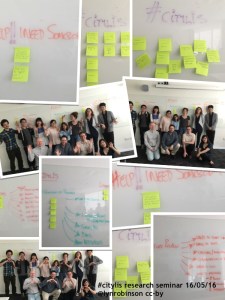
Research Seminar 16:05:16As a precursor to the main research phase for 2016, we added an additional research workshop to the #citylis agenda. This session was designed to put students at ease, allowing everyone to be able to discuss any remaining doubts or concerns before starting their research. Those in their second year of the masters course, or those studying full time had already put together their research proposals, and this seminar provided a forum for discussion/feedback. Some first year students also joined the group, keen to get a head start on their research, and also to catch up with friends and ideas!
#citylis positions itself at the forefront of library and information science. LIS aims to organise and preserve the record of humankind, making it available to all. To do this in the 21st century, we reach beyond traditional library roles, and beyond traditional definitions of information, documents and collections. We anticipate the changes and challenges thrown up by the digital information society. We constantly examine our understanding of documentation, and strive to put forward ways in which we can interact with the information communication chain to promote our ultimate goal of information use for the purposes of understanding.

The research topics chosen by our current students reflect the broad, contemporary nature of library and information science; library services for minority groups, area studies, the impact of makerspaces, the impact of AI on information organisation and retrieval, and how computers are changing the way we think, and thus the consequences for information services.

Concepts of documents, collections and metadata are considered and challenged, alongside the impact of technology on provision of access to theological literature, music, art, videogames and materials.

As always, #citylis students are encouraged to process what they learn reflectively, by sharing their progress via social media. Posts relating to our work on Twitter are tagged #citylis.

#citylis offers a full, 10 session, core module on Research Methods to all our students, as preparation for the disseration, and in anticipation of a future career which fully embraces both the application of and contribution to research. A sample of previous dissertation titles undertaken by #citylis students supervised by me can be seen here:

If you would like to study with #citylis, come to one of our open evenings, or email me [l.robinson@city.ac.uk] to arrange a time to chat.

#HASlibcamp: a health and science library & information unconference

HASlibcamp

#HASlibcamp 2016 hosted by #citylis: photo by @lynrobinson cc-by

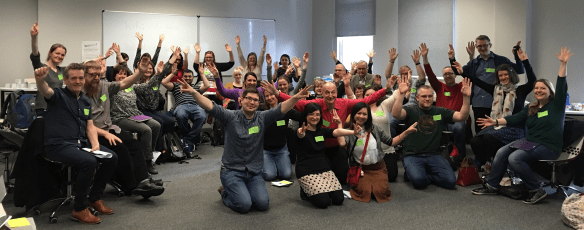
On 23rd April 2016, #citylis was delighted to host HASlibcamp, an unconference for health and science library information professionals. The day provided a unique, informal forum where over 40 colleagues from public, academic, NHS, charity and other library and information services came together to discuss current issues and catch up with each other. I was especially pleased to see so many #citylis former and current students at the event.

I am a huge fan of unconferences. The benefit to attendees of being able to suggest issues to discuss (pitch a session), rather than being faced with a ready-made agenda is enormous, especially for new professionals, and for anyone who feels their ideas and opinions get overlooked in times of management frenzy. Even for more established professionals, there is always much to learn by listening to what is of current interest amongst colleagues. From the point of view of a course director, I felt very lucky to be treated to such up-to-date ideas, which will certainly help with our quest for innovative content at #citylis!

This is not to say that conferences with fixed agendas are a bad thing in any way, but that the unconference format offers a great compliment to more formal outlets for professional conversations. In a session led by Gary Green (@ggnewed), on how public libraries can support health and well being, participants observed that there was not currently a forum where public library practitioners could meet with NHS or other health library staff to share good practice. A possible role for @CILIPHLG?

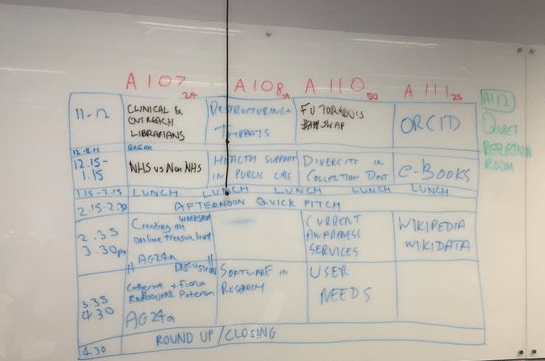
At HASlibcamp, I think we were able to accommodate all the sessions that were pitched, and I would certainly recommend that unconference organisers allow for as many physical spaces as possible, so that everyone’s ideas can be accommodated. Sometimes, it can be daunting to suggest or pitch an idea, incase no-one is interested, but the supportive atmosphere at HASlibcamp meant that everyone’s ideas gained an audience. Overall, the approach led to a marvelously diverse range of topics, shown on the image below. This range of topics highlighted the breadth of interests held by health and science LIS professionals, and is a fantastic testimony to the value of a career in LIS.

Session board

Session Board for #HASlibcamp 2016: photo by @lynrobinson cc-by

It occurred to me that in this kind of environment, it was easy to realize that none of us are the only person to face particular concerns –the feeling of not being alone is a significant factor in raising morale, and at a time when most LIS services face negative news about cuts in funding, de-skilling of staff members and devaluing of the qualified professional, this is very important.

Medical Information Resources

I have a longstanding interest in health and medical information, and I pitched a session on the ‘future’ of medical information resources. My focus was on ‘human documents’ or the quantified self. What does the proliferation of apps collating human data mean for LIS professionals? My wonderful colleague Ka-Ming Pang (@AgentK23) had the brilliant idea of talking about App Swap (#Appswap) – where libraries encourage sharing and exchange of ideas on health and medical related apps. We decided to combine our sessions, which resulted in a lively debate on how to stay up-to-date with new apps, understanding and promoting privacy, evaluating apps and the issues of who should recommend apps. Apps are used by many people, including students, and the library is rarely included in the choice of apps, or their evaluation. There is clearly a need for at least a framework of the issues this involves. Medical and healthcare apps collect personal information, and users need to be aware of not only what interpretation of the data means, but also of what happens to the information and who might benefit – insurance companies for example, might be very interested in blood glucose levels, fitness or sexual health indicators. Network security is rarely considered and many app users may be unaware of the amount of personal data that is being ‘leaked’ to third parties. A suggestion of using CASP like indicators to evaluate apps fed into a later session during the day.

[The idea of App Swap originated from the University of Brighton, which uses the same hashtage. Review of apps can be found on the St George’s University of London Library’s Guide to Mobile Resources.]

Sessions were allocated an hour for discussion, and it was a good sign that several sessions overran due to exuberant engagement and interest . Many more aspects could have been discussed and I think that HASlibcamp could have been extended to the whole weekend with no loss of interest. With regard to medical information resources, other topics which could easily have pervaded the whole day included genetic information, big data, neurological data, virtual reality and psychology. A huge field waiting to be explored. I am biased, I know :).

Other Pitches

There were many other topics of interest including diversity (@tashasuri), information literacy, the importance of software as a research output and the issues of adding approprite metadata (@biostew), current awareness, design of library induction session (Pirates!), preservation and access of games, and user needs. Those of you who need more should have joined us (!), but you can check out other blog postings and @HASlibcamp on Twitter.

Ambience

A short but significant mention should go to the amazing food sharing – the input from all attendees who brought food to share cannot be overstated. The food created a party atmosphere – it was great to see so many talented chefs strut their stuff. More. Food is a good thing! The need for a warm and positive atmosphere in the workplace is overlooked these days – this is a bad thing.

photo credit Andy Mabbett @pigsonthewing

Photo by Andy Mabbett @pigsonthewing

Organisers

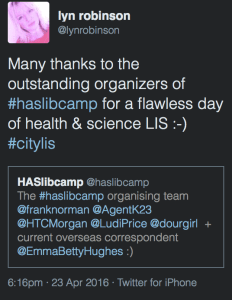
I would like to conclude with a massive thank you to the organizing team who made all this possible – events look like they emerge into the forest like mushrooms – they don’t. This event was down to:

Screen Shot 2016-04-25 at 21.50.46

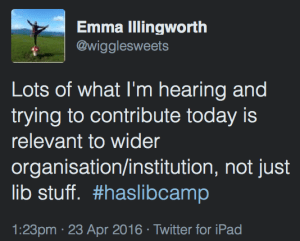
And finally – the value of HASlibcamp:

Screen Shot 2016-04-25 at 16.49.17

Last year #citylis hosted #citymash; you can read about it from Ludi Price (@ludiprice) and Kathryn Drumm (@dourgirl).

Here are more accounts of #HASlibcamp:

Lyn Robinson’s Storify

Emma Illingworth

thelibrarianerrant

Suzanna Bridge

HASlibcamp site list of write-ups and summaries