My name is Lynxi … I am an academic

What is a LIS degree? This question is a favourite concern to me as director of a postgraduate LIS programme (#citylis). Surrounded by rocketing costs for the professional masters, piled on top of hiked-up undergraduate fees and set in the midst of global economic uncertainty, there is the very real question of why anyone would choose to enrol on a face-to-face taught course instead of learning on the job.

Leaving aside for the moment, the choice of which subjects should be presented in the classroom, our slant at #citylis has always been on an academic focus, emphasizing the theoretical principles underlying professional practice.

Unsurprisingly, we face the occasional suggestion that it might be better to teach more about what people actually do in the workplace. This latter approach has always seemed short sighted to me. Skills I used in the workplace 5 years ago are already sliding from dinner party conversation (command line searching anyone?) and I am constantly being reminded that what employers value most are those harder-to-quantify skills, which start with ‘excellent oral and written communication’ and run through to the pinnacle of ‘flexible thinker’.

Whilst it is difficult to find an agreed upon definition of  ‘flexible thinking’, let alone ensure its presence in the curriculum, it is unlikely to emerge from a purely vocational based course. Our belief is that thinking skills develop from academic study. That is to say, if you want to learn to think, practice thinking.

But there is more to a successful career than being able to pronounce on theory. It is important to show how theoretical principles can be used to deliver results in the workplace. Here again, practice is the key, and to this end we augment our research based content with practical examples delivered by leading practitioners. This blended approach has received two welcome validations recently. The first by Andrew Preater (@preater) comes in his concise blog posting Reflections on the LIS Professional Qualification where he writes:

Personally I do not think the LIS masters should be vocational training to provide specific practical knowledge to do library work.

Rather I see the value in masters-level education of providing enough theory and knowledge of general principles that a library worker can bridge the gap between theoretical understanding and practical understanding developed in our professional practice.

The second comes from Diane Pennington, speaking at a Symposium organized by McGill University’s iSchool, (reported in InsideASIS&T Oct/Nov 2013, 40(1) p 16) who argued against divisions in the curriculum between those intent on a vocational career, and those aiming for PhD study.

All of this should be obvious, but the situation often seems a little hopeless to those of us who are constantly called upon to justify the existence of our cross-disciplinary, academic curriculum in terms of immediate job skills and learning outcomes. It is good to stand back and remind ourselves of the bigger picture. In our academic approach, we are laying the foundations of resilience and adaptability that will support a life-long career, rather than just a first position.

Sensing (#immersive) Spaces at the Royal Academy

sensingspaces immersive

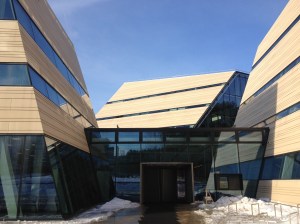
The attractive colours scattered over this construction by architect Diébédo Francis Kéré reminded me of those tiny, coloured sugar balls used to decorate sweets and cakes. A visual feast then, the space was conceived to tempt visitors inside to meet each other as they navigated the narrowing between the two main areas. The multicoloured plastic straws (an industrial echo of real straw used to finish clay buildings in Gando) were provided to entice us to participate in the creation of the space – to leave our own contribution to the installation. There were some fine pieces of straw modelling, and even though I felt a little self-conscious, I wound my purple and pink bendy plastic into a decorative bag to allow a very small part of me to join in the dynamic.

Participation and immersion within architecture and design. Sensing Spaces at the Royal Academy until 6th April 2014.

Old and New, Happy and Sad: Vilnius University Library

Vilnius New University Library 2013

Vilnius University Library, photo by @lynrobinson cc-by

I was both happy and sad last week to attend the opening of the new University Library in Vilnius.

Known as the National Open Access Scholarly Communication and Information Centre, (Library to its friends), the building was formally opened on February 6th in a packed celebration which featured congratulations from the Lithuanian President, Dalia Grybauskaitė, as well as contributions from Director General, Irena Krivienė and the architect Rolandas Palekas. A choir sang and ballerinas flitted about the foyer, echoing the falling snow outside. The reception, originally planned for the evening, was held after the ceremony in the late morning in order to accommodate the President’s schedule. It would have been rude to refuse, so a joyous time was had by all, even if some of the attendees did have to go back to work afterwards. Wandering around the light, airy spaces, catching up with friends and colleagues whom I don’t see very often, I felt happy and privileged to be invited to join in.

Sad however, that my very wonderful friend and colleague, Audronė Glosienė did not live to see this beautiful library; something which she believed in so passionately, and for which she fought so determinedly.

In spite of economic difficulties, new libraries still catch the imagination to the extent that they attract financial backing. This new library was funded partly by the Republic of Lithuania, and party by the European Regional Development Fund. I have also just heard about the new undergraduate library given the go ahead for Leeds University.

Whilst this is excellent news, it is often easier to write about why not to build a library. Why not close them down and use the building for designer flats? The impertinent question dampening all our enthusiasm is “why do we still need physical library spaces in the (digital) 21st century?”

The reasons for this question will seem trite and obvious to anyone remotely interested in library and information science. The world is digital and wireless. We can access pretty much anything we need from wherever we happen to be. On our smartphones, tablets or laptops. Information comes out of the ether and computing is pervasive. Why would we want to go to a specific place to get something we can accessfrom wherever we happen to be?

Furthermore, there are the costs of maintaining a physical collection to consider. Although somewhat offset by the need to preserve digital files, physical documents require care and conservation. And a physical building needs maintenance, cleaning, heating and light.

So why build a physical library space?

This has been answered before in the concept of the library as a 3rd space. Somewhere that is not your home and family, and not your place of work, but rather a place you choose to inhabit – a 3rd choice of space.

A contemporary update on this is easy to get – just ask for a show of hands in answer to the question “would you go to a library?” The resounding response is “yes”. But why? Because the library is a place where it is possible to interact with other people. In our increasingly isolated, digital worlds, that small chance of a conversation is too good to miss. Like real-time, face-to-face lectures, the library offers a chance for social interaction. As a student, if your dormitory is grim, the library is probably also the place you go to soak in a clean, warm bright space too. With added network access and friends. Let us not forget that library and information science is about managing recorded information for human communication. It underpins our civilized society. The death of the library, it seems, has been greatly exaggerated.

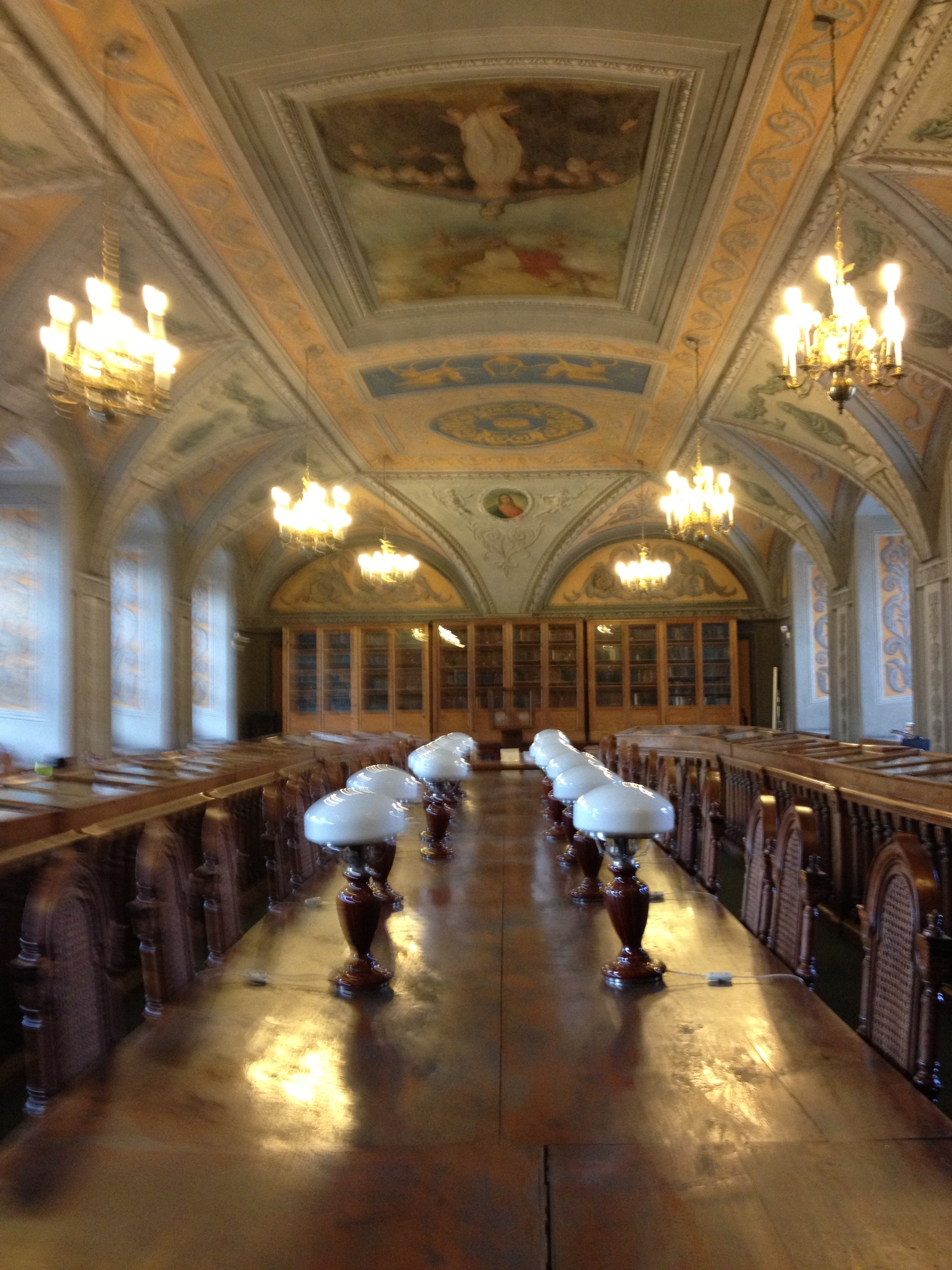
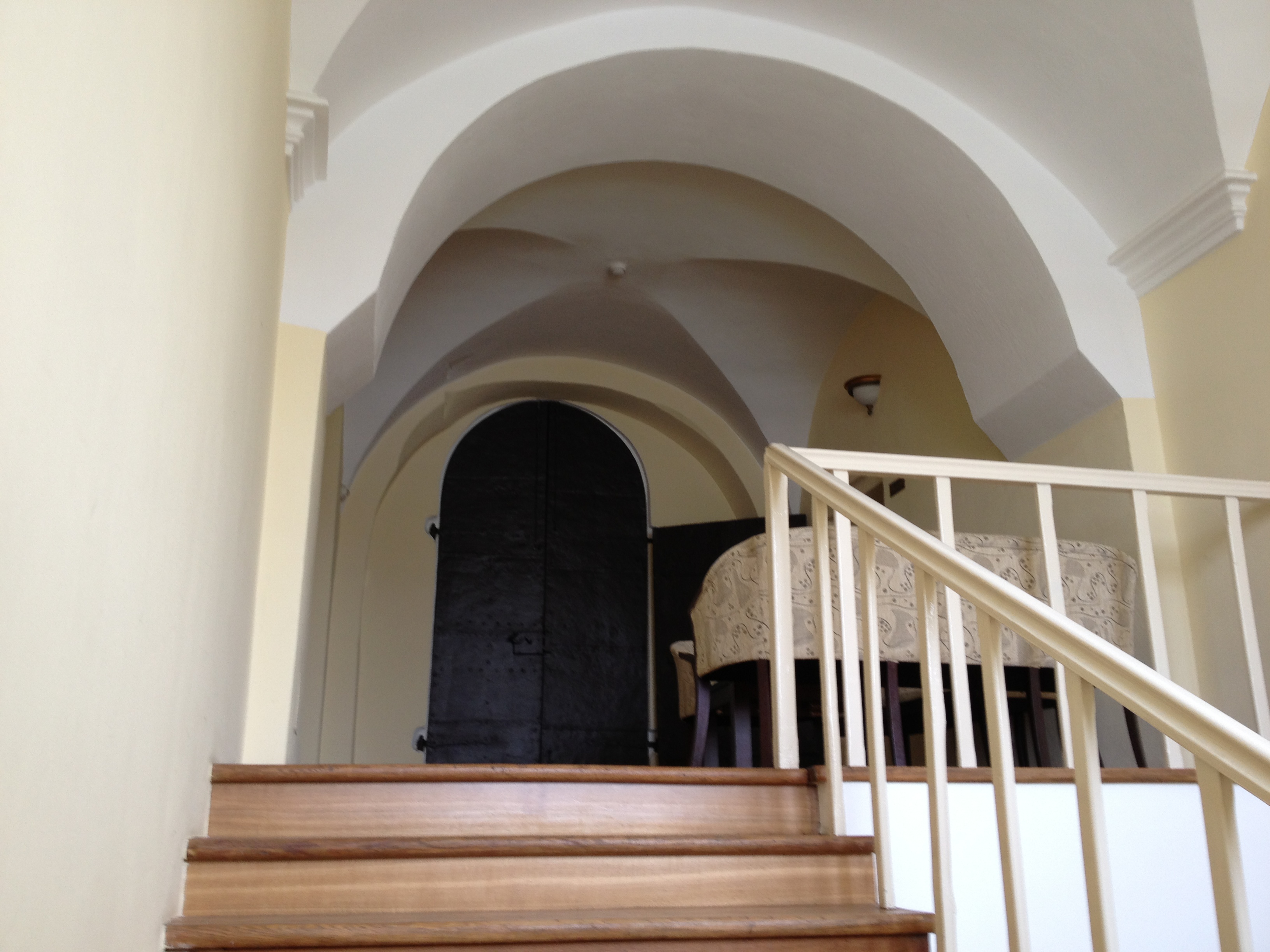
So much for the new then – what about the old? I was treated to a tour of the fabulous Vilnius Old University Library, which was established as part of Vilnius University in the late 16th century. I first visited this library about a decade ago, and it was a pleasure to see how the recent government-sponsored renovations had turned an undoubtedly gorgeous, historic city focal point into somewhere pleasant and appealing to 21st century students – without losing any of its ancient ambiance.

Vilnius Old University Library

Vilnius Old University Library

Vilnius Old University Library - Renovations

Vilnius Old University Library – Renovations

Finally to mention the current exhibition in the main library hall, “Vetera Reducta” – the past regained. I often mention to my students that the one sure way to obliterate a nation’s identity is to destroy its cultural heritage – starting with the library. Vilnius is no stranger to this process. Yet the extraordinary efforts of Levas Vladimirovas, Director General of Vilnius University Library during the 1950’s, resulted in the recovery of over 18,000 books of Vilnius Public Library, and the old University Library. Amongst these treasures was the first Lithuanian printed book from 1547 “Martynas Mažvydas’ “Catechism”. Still celebrated in today’s digital age, books then, do not entirely die, and the physical object still holds its meaning to us.

Vetera Reducta