
What’s on your mind?

Change. From LIS curricula to company mergers. From changing your password to changing your job. From who do you know to who do you trust.

These were a few of the conversational themes raised over breakfast with Sue Hill, members of her team (@suehillrec) and other IM colleagues yesterday, as we met to consider what’s prominent in the profession today and what might be round the corner.

I am always keen to hear from the world of work, and although there is much to angst about (applying for a job, getting a job, keeping a job) the feeling I came away with was one of realism, leaning towards the optimistic. Information will always need organising won’t it? Those journals will not circulate themselves. And someone has to do all those analytics. But the services we provide are continually on the front line for budget cuts and job losses, and although it’s getting old, we still need to ‘prove’ ourselves. Even when we do, it is sometimes not enough. What can we say to be convincing?

I am not the only person to ponder on the fact that the phrase ‘we are all information specialists now” is kind of true … but has a troubling undertone. Because although every baby born today looks for the Google box before crying, there seems little concern over what it all means. 30 years ago, library and information science was concerned with books, journals and newspaper articles. The avante garde dealt with images. Accurate indexing and ‘truthfulness’ were taken for granted in dealing with search and retrieve. But this is the 21st century, and its main concern is making money.

Is there any place for truth, then? Knowing what is out there to find, who wrote it, and what they really meant; an awareness of who is quietly keeping track of everything you click on, purchase or read. Let’s not forget that Google knows and remembers every time you search for your ex, or anything else burning away at the front of your mind. Do we trust them? Isn’t it creepy that every time I use a social media site I am offered an opportunity for online dating, weight loss schemes and cosmetic surgery. Yeah. All this ‘new’ personal information mining, entirely possible since everything we do is online now, and pouring ourselves into social media is as normal as breathing. As one of us said:

“As we become more free, we become more captive.”

Is trust our trump card then? Is the point not just to understand what is there and how to find it, but to highlight the risks and benefits associated with every shred of information? To tell the truth, and be trusted to do so.

If so, we can argue for information professionals. There is no need to ban Twitter, set up alternative networks, or to come off-grid entirely (some recent national responses to the power and the threat of our information society). We simply need to encourage more people to think about the concepts underlying information dissemination, its organization, storage, preservation, access and use. It is not so much that we are all information specialist now, but that we should be. Information skills are valuable and our civilization depends on them, as it always has.
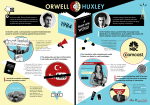

1984 and Brave New LIS

I have been describing library and information science as an understanding and study of the information communication chain for several years now. More recently, I have promoted the effusive declaration that LIS underpins civilized society; no organization and access to information, no civilization. Having the good fortune to have been working in China earlier this year, I was naively stunned when I couldn’t access twitter there – it’s so easy to take for granted that we can make our own decisions about what we read and write isn’t it?

This lovely infographic (not mine, linked to authors) Orwell vs Huxley, reminds me of why I study and teach LIS; facilitating understanding of the information communication chain at least allows us to know what is out there, even if it is not allowed.

Hot topics in Information Management #2

Persuaded to get up this morning by the thought of one of my favourite breakfast meetings, one of those regularly hosted by Sue Hill Recruitment and her team, where eight lucky information professionals from diverse environments get together to consider the contemporary professional landscape.

We started by suggesting two words that we each felt represented the biggest impact on our work today, and then added in one which we felt embodied the most significant factor for change over the last 5 years. The ensuing discussion focused on the concepts identified in this simple but effective conversation starter. I suggested information-anxiety, and mobile.

The concepts fell, for the most part, into four categories: economy, technology, skills and organizational culture.

As would be expected, everyone felt the pressure of needing to achieve more with less, and the accompanying ‘de-motivation’ as candidate ways to economise failed to materialize due to services having already been rendered maximally effective and efficient. There was a feeling that excellence in service was no longer attainable, as physical resources, dependant on human care and attention, were downsized in unison with staff numbers.

Technology affects most aspects of our lives, and so again it was not surprising that discussion turned to how mobile devices and cloud computing are changing the workplace in ways we have difficulty imagining. We need strategies for cloud computing. And what of future technology? Can we imagine it? Who would have thought of mainstream smart-phones and augmented reality 5 years ago? Possibly secret Star Trek followers – and I’m not admitting to anything – but I did happen to hear that the science behind the Romulan cloaking device was now a reality (tiny reality – just a paperclip at the moment …)

Social-media received a mixed response. Some felt it was a ‘dumbing-down’ medium, which implied that trained professionals were no longer needed. Others pointed out that many organizations ban the use of these time-wasting, potentially ruinous applications. I am a social-media advocate. Genie and bottle. Be careful what you wish for though.

My role as a masters course director means I am always soliciting first-hand views on what sort of skills employers want from prospective new team members, although balancing this with the requirements for an academic masters can be problematic – the question of vocational training versus learning how to think and develop – quick fix for now or investment in a framework for life-long-learning? As already stated, technology is a key driver for change. Nothing stays the same and the systems in place today will be superseded in increasingly shorter time-spans. Technological-literacy, flexibility and adaptability are key aspirations for prospective job applicants, but how to capture this on a cv, and to stand out from the crowd is less evident.

I was concerned to hear that recent LIS graduates were perceived to have limited abilities in using query language for bibliographic databases – this is something they should definitely take away from any LIS masters course, and most alumni will agree that search was included on the curriculum. I wonder if the Google free-text search box is somehow overriding all our carefully planned lessons in Boolean logic? Perhaps we need to focus on information literacy in schools, as by the time students reach masters level, quick and dirty keyword addiction damage is done.

It was unanimously agreed that the focus on information technology management, rather than information management, meant that the higher paid role of ‘Chief Information Officer’ invariably indicated someone with a computing, rather than LIS background. Although as an aside, the importance of ‘softer’, information related skills may be being recognized in newer courses, such as the masters in information leadership (MIL) at City University. The feeling that for higher paid jobs, business, rather than LIS skills were sought was mentioned, and I am interested in pursuing evidence for this, and indeed to identify what exactly is meant by ‘business skills’.

On the positive side, the evaluative and analytical skills of a trained information professional were perceived to be highly valued, with clients preferring to engage with those who offered ‘added-insight’ to research results. This requires subject knowledge, and adds weight to my belief that information professionals also need to be subject specialists, and that LIS needs to remain a postgraduate profession.

The failure of many IT-led implementations was noted – it is obviously helpful to ask the users and creators of content about system requirements before spending huge sums on something designed for some other purpose entirely. Never happens though – except in systems design courses.

Organizational culture is changing to interpret and work with moving technological, economic, political and social factors. With lawyers charging in ever decreasing units of time, it is essential that information and research related tasks are undertaken by lower-paid information professionals, so that clients are not overcharged. Not sure I am entirely comfortable with information workers being openly worth so much less per hour than lawyers, but its one of those unpleasant facts of life. Often, the idea is to outsource this kind of work, rather than to develop a skilled, in-house team. It’s the economy.

Other observations were that there was a demand for information-skills training from clients themselves, (i.e. a mentoring role outside the LIS profession),  that increasingly innovation came from connectivity between specializations, and that we need to ensure we have the infrastructure to cope with the landslide of information  produced from government open-data initiatives and e-science. There is just too much information. Hence I end where I started, with information-anxiety. Which is now mobile.

Many thanks to Sue for her innovative get-togethers – and just to mention that her events also raise money, this year for Macmillan Cancer Support.