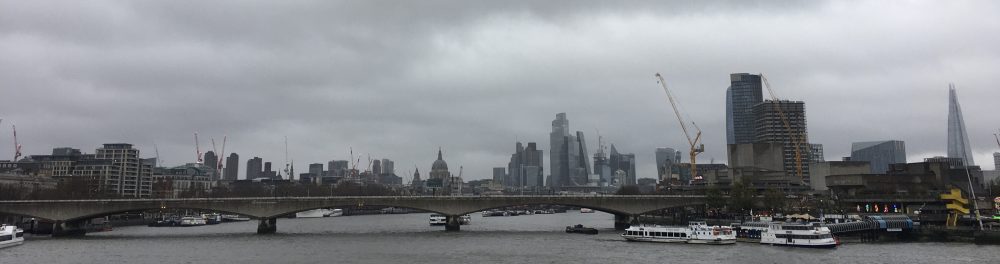

Royal Astronomical Society, London
The title of this one-day event caught my eye because of its relevance to the content of our library science masters’ course, and the sessions, arranged by the Association of Independent Libraries, did not disappoint. An added bonus was that the lectures were delivered at the very lovely Royal Astronomical Society in Mayfair – a significantly motivating factor in persuading me to attend.
The day focused on web 2.0 applications, the fate of public libraries in the face of funding cuts etc., the (apparently) idealistic aspirations of Google Books, changes in the publishing industry and the restrictions on knowledge access resulting from copyright. All topical aspects that any LIS professional, as well as masters student, should find compelling.
Gwyneth Price, Institute of Education, took us through her thoughts on web 2.0 applications and their use in the library and for information literacy. I have been long been an advocate of social media, and was interested to hear Gwyneth’s experience of introducing blogs, wikis, media-sharing, social-networking and current awareness tools to facilitate new ways for the library to engage with its users. LIS workers have been associated with the promotions of information literacy for many years, now, although I think it is something they have always done. There is a much greater recognition of the role of library professionals as teachers, these days, and Gwyneth highlighted the work of the 9 month LASSIE project (undertaken with Jane Secker, LSE, completed Jan 2008), funded by the Centre for Distance Education at the University of London. This project explored how social software (used as a synonym for web 2.0 applications) might enhance distance learners’ use of libraries. The resulting case study reports, available from the LASSIE website, suggested ways in which web 2.0 tools could be used in the broader capacity of library engagement and outreach. If you are not familiar with this project, I think it is worth taking a look at as part of any effort to both get to grips with what is meant by web 2.0 tools and to understand library related approaches to their implementation.
Outlining her experience with specific tools, Gwyneth referred to the overheads in time and effort needed to set up and maintain a library blog – her response to encourage a regular supply of postings was to create a staff blogging rota – once engaged with the blog, staff enthusiasm rose considerably. With respect to social networking software, Gwyneth felt that this was an area best covered by the VLE – as students tended to use Facebook for social contacts, and the VLE for academic ‘networking’. Mention was made of LinkedIn, for professional use. Wikis were used as a repository for library FAQs – i.e. as a way of capturing the effort made to answer queries to avoid duplication, and media sharing tools were helpful for distributing resources, especially YouTube for training videos, and Delicious for web links. Finally, Gwyneth suggested a viewpoint which I share, in observing a move away from RSS feeds to Twitter . RSS feeds and readers, although entirely workable and useful, somehow always cause the greatest number of puzzled looks in my CPD web 2.0 classes – and I concede that, I too, glean most of my current awareness from Twitter – although in their defense, feed readers are still the best solution if you follow selected blogs or websites for updates. Gwyneth did not mention Netvibes – which is good for pulling all your information sources into one – so I will do so for completeness. Finally, came a mention for TAGXEDO, a tag cloud generator, and its ability to produce tag clouds in a variety of shapes – find one to suit your mood.
Tim Coates presented his plans to secure the future of our public library service, in which he announced the formation of Library Alliance, a new, not-for-profit, non-governmental body, being launched to help improve the public library service, funded by charitable donation. (Tim’s speech). Tim is often described as ‘controversial’, and whilst it may be that his views do not always suit everyone, his consistent support for public libraries is undeniable. Tim asks the question “can libraries survive in times of austerity?” and suggests that we should consider the reasons why people use libraries. This is one of the places where differences of opinion can creep in, as the exact reasons why people do or do not use public libraries are not agreed upon anywhere (though doubtless studies aiming to elucidate these reasons exist). Tim’s suggestions as to why people use libraries include reading the books (!) and an appreciation of an inspiring space. It is not just for the technology. Tim emphasizes the need to improve stock, access and opening hours, and that it is important for public libraries to do what the public wants – but this is another area where controversial opinions enter the arena; not everyone is agreed on what the public wants. Tim emphasizes the trend to link public library services with the agendas or ambitions of local councils, and ultimately government – he counters this with the 1964 public libraries act, which says that ‘public libraries are for the benefit of those people who wish to use them’. This arguably, does not necessarily link with the ambitions of government targets. Should not public libraries address the needs of the individuals who use them, rather than the state? And whilst co-location of social (and other) services within libraries may be convenient for them, it does not improve the library service per se. Tim is a very well known speaker, and I will not attempt to digest his speech further; please see the link above to his actual words. To end with however, Tim feels that the financial management of public libraries is rather poor, and that with some improvement, libraries can indeed survive.
Michael Popham, Oxford Digital Library, talked about Oxford’s collaboration with Google Books, and the lessons learned from their combined efforts to digitize the Bodleian’s estimated 1 million holdings of out-of copyright, and mostly out-of-print 19th century material (this arrangement was different from Google’s projects with Harvard and Michigan). The project stemmed from the desire to widen access; currently 60% of those who use and work in the Bodliean Libraries have no direct connection with the university. The card catalogue offers only limited information to readers, and access would be greatly enhanced by digitizing and indexing entire books.
Michael reminded us that Oxford’s “digital library” began in the 1960s, when machine readable text was made available for scholarly research purposes. The Oxford Text Archive was founded in the 1970s.
The project built on work with Proquest to convert Early English Books Online, from microfilm images, into fully-searchable texts. This effort proved slow and expensive, so the offer from Google to assist with digitization was viewed as a chance to cut the waiting time and costs for improved access. Once digitized by Google, one copy of the item files go into Google Books, and a second into the Oxford Digital Asset Management System. There is a link from the Oxford Libraries Information Service (OLIS) catalogue to the copy in the management system.
The details of the project revealed that digitization relies on good planning and a lot of work, requiring effort from all the staff concerned. Google provides the metadata checks, the digitization, quality assurance, OCR and indexing, reprocessing, mounting of files in Google Books and preservation of the master files. Bodleian staff carriy out the item selection (33% of the items are too fragile to scan and a further 33% are the wrong size.), handling and re-shelving. Google retains the master files as the images are large, and storage requirements are onerous. Google committed to the project (commencing in 2005) for 20 years, and for now the content is free – what happens after 20 years is as yet undecided; so far 388,000 of the 1 million items have been digitized.
The process of digitization is a craft – with highly specialized equipment being used by skilled operators to obtain accurate images, whilst not damaging the original works in any way. Devices that hold pages in place using gentle air pressure for example – but still not every item is suitable for digitization.
There are some issues, one of which is that Oxford has no control over how Google uses the images; Google aims to promote the material to end-users, not just scholars. The digitization process itself can have hiccups, resulting in images of the operators hands and blank pages in odd places. There are things that cannot be digitized, including fold-out pages and missing pages. Copyright is another minefield, as laws between countries differ. Whilst the UK has the 70 year rule (i.e. copyright ends 70 years after author’s death), other parts of the world (e.g. the US) do not. For the moment Google attempts to determine where in the world a reader is situated, and to apply copyright restrictions accordingly – not always with the greatest accuracy as sometimes the date of the author’s death is not known. However, despite the drawbacks, there is now the potential to analyse texts linguistically, and to find things beyond the possibilities offered by print on paper. Michael gave the example of attempting to locate an early use of the phrase “.. beginning of the end and the end of the beginning ..”. Google’s skill at marketing also helps to draw attention to special items in the collection including first editions (Emma, Origin of the Species) which can be seen be anyone all over the world.
 Moving on to publishing, John B Thompson, Professor of Sociology at Cambridge University, considered the changes in the industry between the 1960s and the present day. Publishing has an intrinsic link with libraries; how authors disseminate their work and how users find it. LIS is concerned with both scholarly publishing and with what John Thompson refers to as ‘general trade publishing’ – i.e. book publishing in general. The talk focused on changes brought about by the dual action of the economic downturn, and the digital revolution. Both these aspects are well known as drivers for change within the LIS field too, and the consequences for the publishing industry echo throughout the information industry as a whole. The talk centered around John’s research into the book trade, detailed in his new publication “Merchants of Culture“, which I have added to my reading list for our library science masters. Whilst John’s previous book, Books in the Digital Age, (also on our reading list), considered scholarly book publishing in today’s society, Merchants of Culture considers the wider world of “general trade publishing”,
“..that is the world of general interest books that are aimed at a wider public and sold through high street bookstores”
how it is organised and how it is changing. John introduced “the logic of the field” as his model for how US/UK publishing works – emphasizing that publishing in other locations works to different rules. His fluid and engaging presentation summarized his book very well in a short space of time – starting with changes from the 1960s including A) the growth of retail chains, leading to a decrease in independent booksellers and the number of people in the trade choosing books, a shift in the way books are stocked and sold, and the hardback revolution as mass marketing increases sales, B) the rise of literary agents (not seen in Europe) and C) the emergence of publishing corporations. This has all lead to a polarization of the field, where there are no medium sized publishing houses, just very large enterprises and very small ‘indy’ presses. You either have a lot of money to fund winners, or a very small amount to fund esoteric chancers. Once a book is a success, major funding will be required to publish a second tome. We face a preoccupation with ‘big books’ – the hoped for best sellers.
“Hype is the talking up of books by those who have an interest in generating excitement about them…. buzz exists when the recipients of hype respond with affirmative talk backed up by money.”
It matters what people think. But we now have “extreme publishing” and “shrinking windows” where a book has six weeks to sell or face withdrawal. High returns though – 30% on average.
The day ended with Martyn Everett, former librarian and Chairman of Saffron Waldon Town Library Society, talking about how re-interpretation of copyright is restricting access to information.
“Knowledge is stifled by restriction and censorship”
Martyn drew a comparison between today’s knowledge commons and the historical commons where land was shared for the general good, highlighting the desire to share underlying the ethos behind many of today’s information workers. Businesses such as Amazon and Abe Books offer realistic alternatives to public libraries as books can be sourced cheaply and quickly. The “long tail” purpose of libraries is eroded by such services, as they are often quicker than ILL. Where does this leave libraries ? Furthermore, research collections are often denied to members of the public – what is the role of open access here ? And what of copyright held by organizations rather than the individual authors ? Should not publicly funded research by readily and freely available to the public? Good question and one which is regularly in the discussion forums. And what of the content of public libraries ? Martyn noted the lack of books on anthropology available on shelves for public browsing – is this true ?
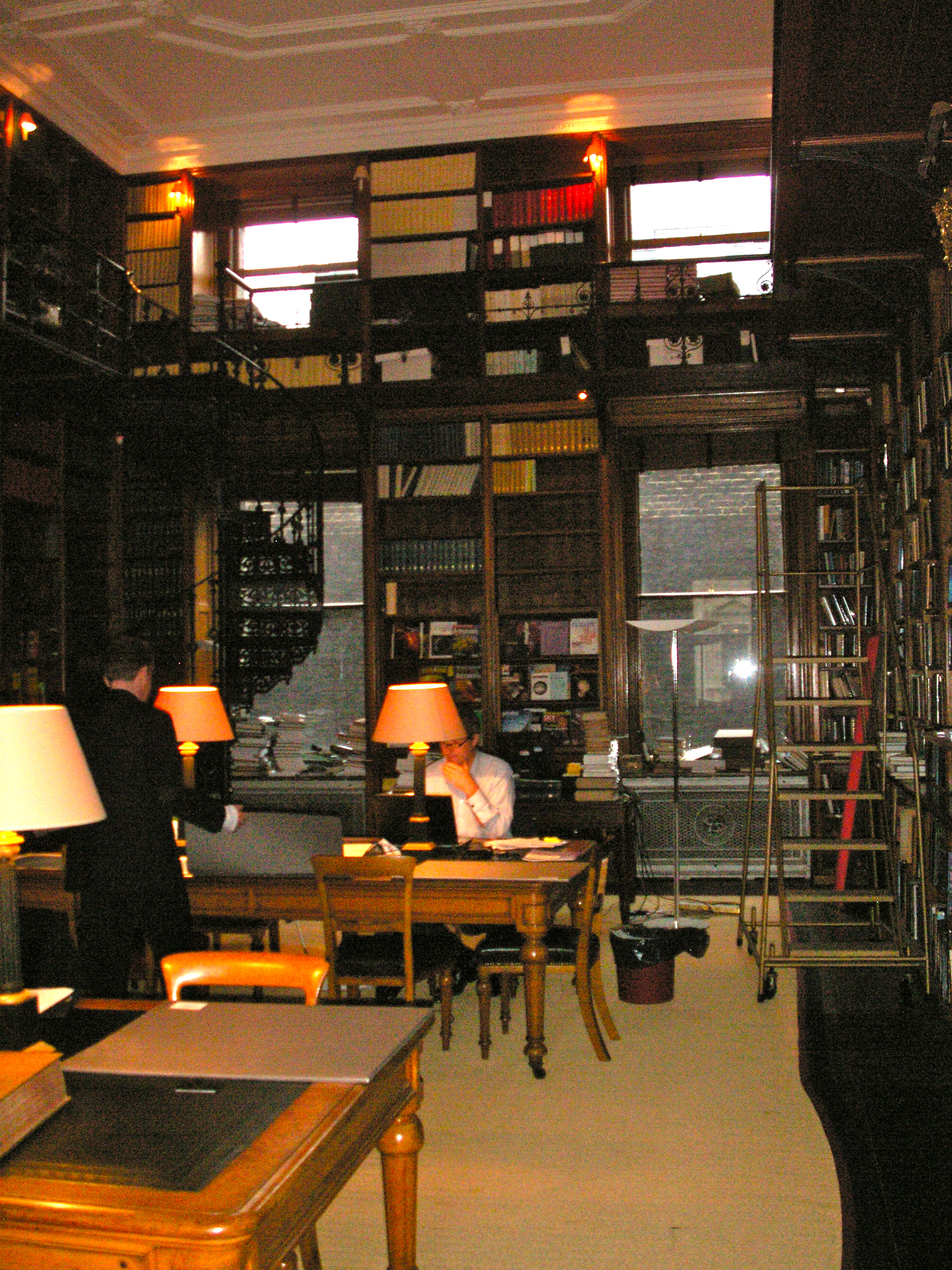
Library at the Royal Astronomical Society, London
I was fortunate to be able to have a look around the library before I left – amazing collection including star charts and paintings of comets, and very early photos of the solar eclipse.
As I was leaving, we returned to the comment that there are no anthropology books in the public libraries anymore – I suggested that dumbing down was reason – ‘no’ replied our speaker – it was a more complex issue than merely dumbing down – this issue deserves more exploration – however, I do wonder whether the public gets what the public asks for from its libraries, which is clearly not anthropology. There is a feeling that librarians should protect the public from their own failings, stocking the Times Literary Supplement recommendations just in case someone has an epiphany. (What does the public library act say?) Should they though? Do people want to chance upon something life-changing, improving, inspirational or even just useful from the library ? I hope so. I mean isn’t that why we do this?


 (ok – 49 then).
 Dr Lyn Robinson