In perfect harmony: an international standard for library and information science education.

EINFSE Homepage

Some thoughts and reflections from the recent multiplier event for the  EINFOSE project. The text is based on my presentation, and personal interpretation of discussions around  international harmonisation for library and information science, (LIS) education. Views expressed are mine, and not necessarily those of the project team.

EINFOSE: European Information Science Education: Encouraging Mobility and Learning Outcomes Harmonization [Project Number 2016-1-HR01-KA203-022180]

Multiplier Event at the Faculty of Arts, University of Ljubljana, April 12th-13th, 2018. “Policy Recommendations for the Harmonization of Entry Requirements and Learning Outcomes in Information Science”.

The ways in which library & information science (LIS) are perceived as a discipline, and how it is taught internationally, are of pivotal interest to me. I was therefore, pleased to be invited to attend, and contribute to, a multiplier event for the EINFOSE project. This project considers how LIS education could be harmonized throughout Europe, based on a shared understanding of the goals of LIS, awareness of the benefits to embracing cultural differences throughout the profession, and the desirability of mobility for the workforce.

The project is focused on alignment and harmonisation of LIS courses between the project members initially, but perhaps with wider impact over time. Harmonisation requires understanding and adjustment of several course aspects so that greater mobility for students can be encouraged, and clear routes to employment established. I recommend the project website for those interested in further details, publications and updates.

The multiplier event was held over two days at the Faculty of Arts, University of Ljubljana, and I was delighted to have the opportunity to catch up with longstanding colleagues from Slovenia, Croatia, Hungary, Germany, Sweden and the UK, and to make new acquaintances.

The programme consisted of a project update, followed by conceptual and technical presentations, and round table discussions.

Sessions identified and considered criteria for the harmonization of LIS education within Europe. Discussions arose around the disciplinary boundaries of library and information science, levels at which LIS is taught in European institutions, the ways in which content is delivered, entry requirements for admission to LIS courses, the skills acquired by LIS graduates, alignment of skills with the workforce and job opportunities, challenges to LIS education and future plans.

Summary
Library and information science is the discipline which allows humankind to record its activities and achievements; it is the foundation on which our civilized world is built, and is worth supporting, encouraging, promoting and keeping. Courses in LIS are an essential component of this infrastructure. International harmonisation of LIS courses would enhance the reputation and popularity of LIS courses, allowing graduates to study more widely, and to be eligible for employment opportunities according to demand.

Such an aim will require a closer connection with employment opportunities, which in turn will rely upon a wider understanding and promotion of how library and information skills support civilized society.

Ultimately, we could imagine an international set of LIS courses, with an excellent reputation, where employment opportunities for graduates are plentiful, based on clearly recognised and communicated skills and abilities.

What is Library & Information Science?
A fundamental issue to first address for any project such as this is how to define library and information science, and the questions it addresses. Only once an agreed understanding has been acheived, can we think sensibly about harmonisation of course content, knowledge, skills and competencies transmitted, and careers for our graduates. Beyond defining library and information science per se, sub-themes emerged, examining the relationship of library science to information science; the relationship of data science to (L)IS; the division between skills and competences for those wishing to work in a library, and those aiming for a career in information science; and the relevance of information literacy to LIS syllabi, in an increasingly digital world, tasked with ‘fake-news’ ‘post-truth’ and manipulative, algorithmic inference and profiling.

There was general agreement as to the overlap with information literacy, and with change management in as much as it involves informational processes, but a more fundamental consensus seemed needed on the core content of LIS. It seemed as though for some, LIS still faces the old accusation (1980s?) that as a discipline, it has nothing unique to offer. I am continually perplexed by the need to revisit this question, as I think LIS has been defended as a separate discipline many times, not least within my own department, CityLIS, which regards LIS as “the spectrum of activities associated with the processes of the information communication chain, and the interactions between them”.  As technological progress continues apace, it becomes increasingly difficult, and perhaps meaningless, to assign informational skills and understanding to either library science or information science, and the concepts of intention or focus are perhaps the ways in which we now understand the differencies between library science and information science. The difference between library and/or information science then, depends on the focus taken for any given process within the chain.

Information Communication Chain 2018

Robinson, L (2018)

This approach to allows us to translate LIS content into a collection of related modules which may be considered of equivalent effort and credit. The modules may be designated as either core or elective content according to the main focus of the overall programme. This is important for any moves towards harmonisation, as it allows a student to take one or more individual modules from different institutions, to make up their full qualification.

The ‘information chain’ perspective is prominent in schools of thought where LIS evolved from the documentation movement, around the start of the 20th Century (see Otlet, 1934 and ASIS&T). Our activities stem from humanities and social sciences, in contrast to the understanding of information science often found in US programmes, which align more with information theory, and are based in the mathematical underpinnings of computer science.

Information science is the quantitative study of properties of information, particularly: entropy, information theory, and communication theory; economics, value of information, information accounting; encryption, and information security; extraction of information from data; and emission and transmission techniques. This study is typically rooted in the computing and engineering disciplines.

(from the classic text of D.G.Luneberger, Information Science, Princeton; Princeton University Press, 2006).

If we try hard enough, we can see that everything is connected. Nonetheless, disciplinary boundaries, liminal areas and relationships provide a framework that helps us to understand ‘who we are’, and how what we study, practice and investigate, and the methods we use to answer questions, relates to other disciplines. The distinction helps us to understand how we approach problems, and how we can combine our perspective with those of others to bring about innovative thinking for new ideas, services and solutions.

On a more practical level, disciplinary boundaries underpin our education and research infrastructures, direct international and state funding, and define awards made by funding bodies. It is important that attempts at harmonisation take this milieu into account. Beyond the academy, disciplinary segregation can be seen in professional bodies, and the workforce. Although LIS skills tend to be applicable to many roles across sectors, in some locations, work in the library sector is seen as distinct from positions in IT, web design, information architecture or publishing, for example, although all of the latter roles could be found within a library environment.

Further to an agreed definition for LIS, we noted the need for LIS courses to proffer a clear view of the concepts/definitions fundamental to our field, those of data, information, knowledge, wisdom and understanding. There are no definitive definitions within LIS that I am aware of, although we have our own at CityLIS, but students need to have a foundation for these concepts in order to study pretty much anything else in LIS, and these foundations need to be made explicit, if courses are to be harmonized.

LIS and Data Science
There is then the question of how LIS educators should address the relationship of LIS to data science. With the rise and rise of big data, this latter discipline is seen somewhat as the golden goose to which everything sticks. Nonetheless, LIS is certainly not data science, and our reputation would suffer as badly from siting itself at the soggy end of data science, in as much as it does by peddling the softer skills of computer science as its main content.

Aspects of data science, and indeed computer science, are, without doubt, useful in engagement with the processes of the information communication chain, but we should be cautious about claiming to be data science or even data science ‘light’.

The disciplinary content of LIS can be found in text books, in overviews given by professional bodies, job descriptions, and both academic and professional course syllabi. Whilst each rendering may offer slightly different extensions and emphases, it is clear that there is a core content, around the processes of documentation and communication. See for example, the classic text by Bawden and Robinson, Introduction to Information Science, 2012.

Doubtless such examples can be found for data science too, but as a starting point from which to compare the realm of data science with that of LIS, see: The Modern Data Scientist Infographic, by Frank La Vigne. http://datadriven.tv/blog/modern-data-scientist-infographic/

At the current time, the content is quite different from that associated with LIS. There is always the possibility however, that the questions and problems addressed by LIS and its related methods, may evolve: the record of humankind may one day be a question for data science.

A member of the audience suggested that we could remind ourselves of the relationship of LIS to data science by focusing on the fact that LIS is concerned with documentation and keeping the record; the creation, dissemination, management, preservation and access to data files and associated software tools. This would include management of data files, data wrangling, or analytics.

Data science, however, is rather more about statistical analysis of, and prediction from, big data. See: Doing Data Science, by Cathy O’Neil and Rachel Schutt.

Further insight into the current extent to which data analytics relates to LIS may be gained by examining the content of coding courses such as Library Carpentry, or the Programming Historian. The skills gained by those taking these courses are arguably within the disciplinary area of LIS, especially in respect of systems librarianship, and the digital humanities.

Multi and Interdisciplinary Nature of LIS
An acknowledgement of the composite nature of LIS is essential for any process of harmonisation. If we examine this nature, it is perhaps twofold. Firstly, the processes of keeping the record are a valid concern for any subject, and thus LIS attracts students, researchers and practitioners from many backgrounds and areas of subject expertise. As the nature of each discipline will impact upon the ways in which it is communicated, we can say that LIS is multidisciplinary.

Secondly, the academic understanding and vocational practice of LIS requires us to embrace understanding and techniques from a variety of disciplines. In addition to our well-known overlap with computer science, we have from the earliest times embraced tools and techniques from the academic study of literature, languages, science, statistics, psychology, publishing, media studies, and cultural studies. The relative disciplinary newcomers of data science and the digital humanities have already made their impact on LIS felt. As LIS incorporates concepts from a range of fields, a diffusion of ideas if you like, we can understand LIS as an interdisciplinary domain.

Disciplinary edges are always moving, and a good place to begin the processes of harmonisation is with a conversation on the nature and definition of our subject, with reference to its origins, its current reach, its relationship with other disciplines, the variety of ways in which it is understood, and its anticipated future.

The Levels at which Courses are Offered
Some European institutions offer LIS qualifications at both undergraduate (UG) and postgraduate (PG) level, in contrast to the UK, where courses tend to be delivered only at postgraduate level. In the UK, LIS tends to be regarded as a meta-discipline, and only a few courses offer generic instruction at undergraduate level, without the student having gained experience in another discipline per se.

For harmonisation, there is a need to consider what it means to teach at both undergraduate and postgraduate levels, and consequently the division of content, skills and competencies between courses.

See here for a list of CILIP accredited courses at UG and PG level.

We considered the courses offered by the partner institutions, and the content that would be appropriate at each level. There was a query as to whether a master’s course should cover material that has already been presented at UG level; presumably for those who enter the course from another disciplinary background. In the partner institutions, entry to PG courses is often restricted to those who have already completed the UG course. In these instances, those taking the PG course would expect a more advanced, or extensive course content than that offered by the UG course. For students to be able to move between courses internationally, the content offered at each level needs to be clarified and agreed.

International bodies such as IFLA suggest standards and levels for LIS course content. In the UK, organisations including the Quality Assurance Agency and CILIP provide similar benchmarks, and other countries may also have reference bodies that act in an advisory capacity. Harmonisation efforts should take advantage of exisiting standards where possile, and address the need to have meaing beyond the academy.

For international mobility, the number of credits for each module, and for the course overall would also need to be standardised, along with the hours of study, and the timing of the terms within the academic year.

Entry Requirements
Entry requirements for LIS courses differed between countries, and this would need to be standardised for harmonisation. It was notable that for UK postgraduate courses, we are keen to attract a cohort comprising diverse disciplinary backgrounds, and so we accept anyone with a good first degree, equivalent qualification or experience. We do not see ourselves as gatekeepers, and believe that LIS is relevant to everyone, even those not employed in obvious LIS professional positions.

In other countries, those without an undergraduate qualification in LIS may be prohibited from studying the discipline at master’s level, or may at least need to attend, and gain enough credits from, a summer school before entering the PG course.

The benefits of opening up LIS master’s courses to graduates from other disciplines were readily agreed: enhanced subject profile, more diverse content, greater graduate mobility. The question of how to encourage applicants from a wider disciplinary background in countries where entry to the master’s level is usually via progression for those who have already completed the undergraduate qualification, was harder. The pool of students available from UG courses is limited, and the courses and the profession as a whole would gain from a wider admissions policy. This would require changes in administration at higher levels within respective universities however; it would not be merely a decision for the department offering the course. The image of the profession, potential salary and career prospects are important here.

I raised the issue of gatekeeping. I believe our admissions policies should be as broad as possible, to allow anyone who wishes to study LIS, for whatever reason, to do so. Of course, economics cannot be ignored, and whilst in the UK, postgraduate study is run according to demand, i.e. students pay the university, in other countries tuition is sponsored by the state. In this case, limits to who can enter the course may apply, and may be more firmly tied to actual or perceived employment opportunities.

Skills and Competencies
It is hard to think of any academic courses today that do not strive to ensure that their content relates to knowledge and skills required for the workplace. LIS courses are no exception, and the full benefits of harmonisation will only be realised if we have  a rigorous and explicit understanding of expected course outcomes at both UG and PG level, how these relate to the tasks carried out by the workforce, and further to the knowledge and abilities anticipated by employers.

Additionally, it is necessary to clarify the skills and competencies that an employer might expect of a master’s graduate, in comparison to someone who had studied only to undergraduate level.

An overarching issue is one of employment opportunity, and this has to be linked to our understanding of LIS as a discipline, to ensure that LIS graduates are aware of the range of positions that they could attain, given their knowledge background, and accompanying skillset.

See for the UK, CILIP’s Professional Skills and Knowledge Base.

This is hard to achieve in practice within any one course or country, and will be harder to standardise within Europe and on a further international scale.

I have encountered on previous occasions, tensions between the competencies and skills that can be reasonably expected from new LIS graduates, and those that employers would like to see from job applicants. I have noted specifically, that employers wish for skills and competencies that might be attributed to an employee after 3-5 years with the organisation – insight based on an intimate knowledge of specific organisational practice, and a significant level of what we may call personal maturity and confidence.

To solve this, educators need to work with employers within the sector, to establish a dialogue around the interconnection of academic courses with the professional knowledgebase and skills. We need to establish, regularly review and update, attainments that can be delivered over the course of an academic qualification, and that which has to happen as work experience or continual professional development, CPD. At the same time, whilst we cannot pretend that any LIS course can ever be a final aspiration for the abilities needed throughout a career, we need to clarify, communicate and promote the significant benefits to studying an academic master’s course. It should be obvious that an educated workforce underpins a prosperous organisation, but a direct connection between course content and organisational prosperity is hard to realise. In the UK, the professional body CILIP has opened this conversation, having held two annual forums for discussion between LIS educators and employers, and having scheduled a colloquium to take place at the CILIP conference in July 2018.

To promote harmonisation, it will be necessary, and should be possible, to identify core understanding and abilities offered by LIS courses, in alignment with the level at which the course is taught, at both course level, and for individual modules. Country specific, unique modules or content should be celebrated and promoted as a benefit of mobility. These should be readily communicable to employers.

There was much discussion about the skills and competencies offered for those enrolled in library related courses in comparison to those enrolled in information science courses. Many of these were overlapping. The spectrum of LIS competencies seen in the UK differed from those in Europe, (e.g. Slovenia, Croatia, Sweden and Germany) where a more distinct emphasis between library and information science syllabi was evident.

The approach at CityLIS, where skills and competencies are seen on a spectrum of activities around the processes comprising the information communication chain, was somewhat unique, as other countries emphasized the differences between course content, and subsequent job skills, for library science and information science.

In Germany for example, entry to Information Science required NLP, programming and information retrieval. In Sweden, there is a clear distinction between the library course and the information science route, which is called ‘Information Architecture’.

The collection, service related skills of the librarian, tend to be regarded throughout Europe as very different from those attributed to information science, which seems to embrace content from computer science, through data science, to information science as understood from a US perspective.

Whether it is beneficial to differentiate skills associated with working in an identifiable library post, with those employed in other areas of information work needs further discussion. As libraries become more dependent on technology, the division by the library or non-library label, rather than focus or area of personal/professional interest is perhaps limiting.

Employment
At CityLIS, we do not notice that jobs awarded to our graduates relate to whether the PG qualification held is in either library science or information science. The important factor is the degree per se, and any course work, especially the dissertation, which may pertain to the job description in some way.

This may differ in other course and in other countries – France for example, immediately springs to mind, as the difference between the librarian, and in the information specialist, or documentalist is very clear, with different routes of study, leading to different career options.

For LIS courses, an understanding of the number and nature of employment opportunities for graduates is a priority. It would clearly be advantageous if this could be administered on a national, European or international basis, to allow educators to plan courses based on up-to-date evidence, and to ensure that workplace demand is filled with appropriately skilled graduates. There are caveats here, which assume that workforce data allows for speculation and surprises, and that we cater for the unknown – not all LIS graduates enter the job market immediately; some may wish to continue to PhD study, to enter the academy, or to enter the profession with research skills and competencies.

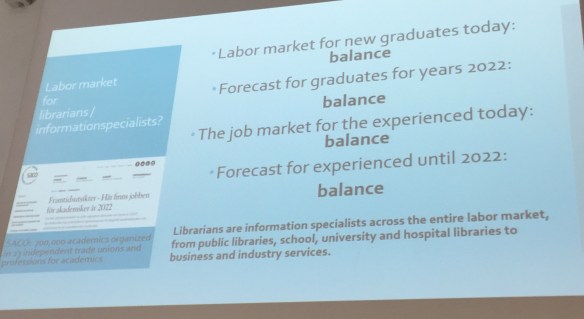
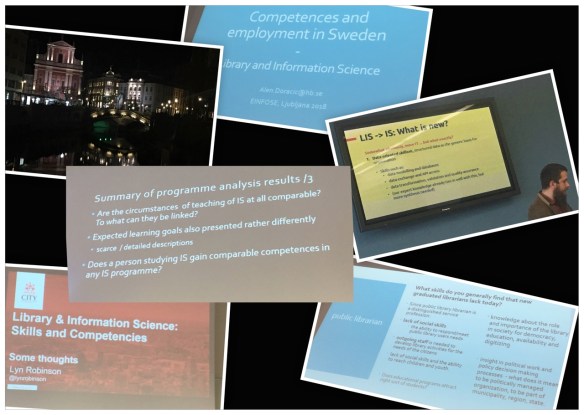
Alen Doracic reported on an analysis of the Swedish system, where the workforce in LIS institutions had been examined, and correlated with the number of graduates emerging from the Swiss LIS schools. The figures were the most encouraging that I have seen, in that supply and demand were reported as even. This assumes, however, that nothing in the sector will change.
IMG_5594

Doracic A, 2018. Slide shown at EINFOSE Multiplier Event in Slovenia, April 12th -13th.

Doracic also showed another slide, which identified the skills and abilities perceived as most lacking in LIS graduates – it makes interesting reading.

Alen 2018

Doracic A, 2018. Slide shown at EINFOSE Multipier Event in Slovenia, April 12th-13th.

Challenges
The main challenge to international harmonisation of LIS courses, between the project participants, and beyond, is the lack of a widely acknowledged understanding of our discipline, and how the knowledge, skills and competencies offered by LIS relate to the workforce.

Information related positions outside libraries and information centres are hard to define and document, and whilst it is easy to claim, probably correctly, that many jobs require information skills, it is difficult to collectively identify them all, let alone deconstruct the informational skills needed, and translate them into course content.

Further, although much speculation on the future of the workplace is readily found, precise data on future roles and the need for library and information skills is elusive. The sector changes rapidly, and at a pace beyond that which university governance procedures function, so that academic courses struggle to stay relevant.

Nonetheless, I think we can be sure that as more and more digital information pours into our world, we will need more and more human resources to deal with it. Keeping the record is not likely to become irrelevant.

Another challenge is that our discipline is not perceived as large, and hence relevant. We need to collect evidence for the size of our profession; looking at the numbers of students on LIS courses, and the numbers of people reportedly employed in the sector, and comparing these figures to those from other fields such as science, engineering, health, technology, law and business.

See, for example, CILIP’s 2015 results from a study of the UK information workforce, which suggests 86,376 people are employed within the sector.

Interestingly, in an earlier report from 2014, the workforce is estimated to be larger, 270,000.

We are also disadvanted by remuneration. Most positions initially gained by LIS graduates do not attract very high salaries, see HESA Destinations of Leavers for latest UK graduate employment and salary figures, although it is not possible to see results just for gradualtes from an individual LIS PG course. In the UK, as well as perhaps in Europe, librarianship is not regarded as a glamorous profession, although there is a strong vocational and ethical following, as exemplified by those advocating for public and school libraries. Roles regarded as being based more in the field of information, such as law, business or technology, tend to attract higher salaries and hence, higher regard. Information from employment agencies such as Sue Hill Recruitment could confirm this.

If we are advocating international harmonisation, it would be good to make explicitly clear its intended impact, with specific regard to the numbers of students on courses, and the consequence for the profession. Is the intention to fill currently unfilled positions, or is it to promote LIS graduates for positions currently taken by graduates from other disciplines?

It is likely that limitations on employment opportunities (whether perceived or actual) reflect the number of graduates wishing to study LIS. At my own institution, applications for Data Science courses are roughly three times those for LIS. More detailed insight into why graduates choose their subjects would be helpful, although it is clear that LIS would, as always, benefit from an enhanced profile as a profession. Not an easy task, but one which international harmonisation should surely take on board.

Restriction of entry to postgraduate courses to those students who have taken an undergraduate course in LIS is likely to be detrimental to growth and mobility. Issues such as modularization, and credit assignment are relatively small issues.

The situation for library related roles in the US may be different, but that is another post.

Future Plans
International harmonization of LIS education would seem a worthwhile goal for those involved in course design, development and delivery throughout Europe and beyond.

Once again, I am grateful to the organisers of the EINFOSE project, for the opportunity to participate in this discussion.
EINFOSE

References
Bawden D and Robinson L (2012). Introduction to Information Science. Facet.
Otlet P (1934). Traité de Documentation, le livre sur le livre. Mundaneum.

Related Links:
1. David Matthews (2018). Bologna Process still ‘treading water’, say critics

Nearly two decades on, reports suggest the goal of a unified higher education area in Europe is still some distance away

Times Higher Education, May 29th 2018
2. Towards a European Education Area

Curators of the Infosphere

Here is a short, personal account of our panel (27th March) at the iConference, held in Sheffield 26th-28th March 2018.

***
Curators of the Infosphere

Philosophy, in its concern with ontology, epistemology and ethics, is of fundamental relevance to library & information science (LIS). Our panel posited four provocations, from which to debate the value of Floridi’s philosphy of information (PI), as a foundational philosophy for LIS.

***
LIS can be defined as the study of the processes of the information communication chain, and the interactions between them.

I first wrote about the usefulness of the communication chain model as a framework for LIS in 2009, and over the ensuing decade, I have updated the processes to include those shown below.

Information Communication Chain 2018

Definition of Library & Information Science, Robinson 2018

The processes and associated interactions are affected by changes in society: new technologies, contemporary politics, economics, and socio-cultural behaviour. There is a need for continual study of informational processes, so that we can anticipate and understand the consquences and impact of drivers for change on how information can be accessed and used to enable a fair and prosperous society to flourish.

Within the field of LIS, we understand information as being instantiated as documents. Documents, assuming the widest possible definition, are the means by which LIS performs its stewardship of the record of humankind.

Much of our world is now living hyperhistorically (Floridi, 2014, p4), where ICTs are not only required to record and transmit our transactions, but are essential for maintenance and further growth of society, welfare and wellbeing.

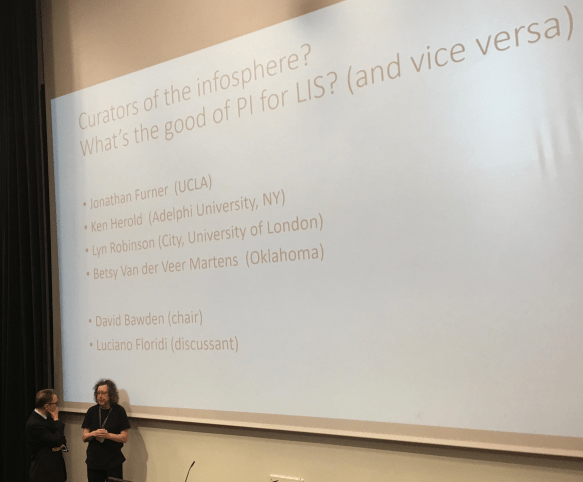
Following Floridi’s keynote presentation: “What human project should be pursued by a mature information society?”, our interactive panel, organised by David Bawden, debated the value and potential Floridi’s philosophy of information (PI) as a foundation for LIS. The panel members, of which I was one, are listed below, alongside a summary of their provocations:

David Bawden (City, University of London)
Chair

Luciano Floridi (Oxford Internet Institute)
Discussant

Jonathan Furner (UCLA)
A little bit about (what I perceive to be) a difference between philosophy of information (as a branch of philosophy, like philosophy of mind or epistemology) and Floridi’s Philosophy of Information (as a philosophical position, like realism or naturalism), and about the implications of making that distinction

Ken Herold (Adelphi University, New York)
A brief note on my own discovery of PI in 1999 and the process of deriving the PI literature within LIS through my Library Trends issues, with observations regarding an applied philosophy using the example of the philosophy of time/computation.

Lyn Robinson (City, University of London)
A short reflection on the move to on-life as a once-only transition in the life of a civilisation (Floridi 2018), and the response of LIS.

Betsy van der Veer Martens (Oklahoma) (contributing remotely)
A brief note on the concept of “ontic trust” as it might expand LIS’s remit beyond our interests in information collection (well described by Richard Fyffe, 2015) and into the collective interests of the infosphere (well described by Massimo Durante, 2017).

What is (Library &) Information Science?
The first point of discussion revisited the well known debate surrounding the relationship of information science to library & information science, and the perceived lack of agreed definition for either. The question was whether such a lack of agreement meant it was difficult to debate the value of PI.

A similar question raised the issue of if, and how, PI applied to archives and records management.

Whilst the different approaches taken between UK/Europe and the US to information science are understood, I believe that the information communication chain model offers those of us who lean towards the documentation movement to explicate and define information science, an entirely suitable framework for linking not only library and information science, but all the information sciences, including archives and records management.

All of the information sciences are concerned with the processes of information communication, which can be regarded as a spectrum of activities. Whether research and practice may be termed library science, information science, archival work or records managment, depends entirely upon from where within the communication chain the viewpoint arises. Library related activities focus on processes associated with collections and services; information science may focus on technological solutions to information retrieval, or analysis of data; whilst archival practice may focus on the authority, provenance and access for a given set of documents. All are encompassed by the categories comprising the information communication chain.

In this case, there is no difficulty in considering the value and potential of PI to the collective disciplinary range.

What Kind of Philosophy is the Philosophy of Information?
A second point of discussion considered at which level Floridi’s philosophy of information was to be understood; as a branch of philosophy, PI, at the same level as epistemology, or as a philosophical position, pi, akin to realism, for example.

Floridi responded that it was not an important distinction. My suggestion would be that it is useful to view Floridi’s philosophy of information from the principles set out below:

Floridi describes PI as a philosophia prima:

‘PI asks what is the nature of information?’ (Floridi 2011, p 14)

PI, like philosophy of mathematics, is phenomenologically biased. It is primarily concerned with the whole domain of first-order phenonema represented by the world of information, computation, and the information society, although it addresses its problems by starting from the vantage point represented by the methodologies and theories offered by ICS (information and computational sciences) and can be seen to incline towards a metatheoretical approach in so far as it is methodologically critical towards its own source.’ (Floridi 2011, p 14)

‘PI: The philosophy of information (PI) is the philosophical field concerned with a) the critical investigation of the conceptual nature and basic principles of information, including its dynamics, utilization, and sciences; and b) the elaboration and application of information-theoretic and computational methodologies to philosophical problems.’ (Floridi 2011, p 14)

Further, he goes on to elaborate that:

‘… its task is to develop …. an integrated family of theories that analyse, evaluate and explain the various principles and concepts of information, their dynamics and utilization…’ (Floridi 2011, p 14)

‘Dynamics of information’ includes:

‘information life cycles, i.e. the series of various stages in form and functional activity, through which information can pass, from its initial occurrence to its final utilization and possible disappearance;’ (Floridi 2011, p 14)

In the footnote, ‘a typical lifecycle’ is said to include the following phases:

‘occurring (discovering, designing, authoring, etc.), processing and managing (collecting, validating, modifying, organizing, indexing, classifying, filtering, updating, sorting, storing, networking, distributing, accessing, retrieving, transmitting, etc.), and using (monitoring, modelling, analysing, explaining, planning, forecasting, decision-making, instructing, educating, learning, etc.).’ (Floridi 2011, p 14)

The information lifecycle is readily recognised as a more fine-grained description of the processes of the information communication chain.

It would follow therefore, that PI is of relevance to LIS as a first philosophy, which investigates the nature of information, to subsequently address the problems of information communication.

The philosophy of information does not relate exclusively to LIS however, and PI should be understood to address the overarching nature of information and the information society.

“PI can explain and guide the purposeful construction of our intellectual environment, and provide the sytematic treatment of the conceptual foundations of contemporary society.” (Floridi 2011, p 25)

Whilst Floridi states that the task of PI is not to develop a unified theory of information, an examination of the ways in which the semantic information of LIS is understood in relation to the concepts held by different domains, is certainly of value, and in a small contribution to this wider remit, David Bawden and I have considered the ways in which different disciplines understand the concept of information, attempting to draw out unifying threads (Robinson and Bawden, 2013). For more work on information within different disciplines and domains, see also Floridi 2016).

A Retrospective Fit
The third issue acknowledged that we were applying the philosophy of information to LIS retrospectively, and asked whether this was ever really possible or appropriate. Is it a requirement for underlying philosophies to exist before the discipline for which they provide the building blocks, or is it feasible to apply a philosophical foundation after the event, as a discipline develops?

The outcome from the ensuing discussion was that it is acceptable, and often valuable to apply a philosophical position to a discipline retrospectively. Indeed this often happens in the case of recently emerged fields such as media studies, or new branches of medical science. The question of whether a given philosophical position is appropriate or valuable to a discipline still remains however.

A Response from LIS
My provocation was to give a response from LIS as to whether Floridi’s philosophy of information has value for LIS. The short answer, I believe, is that is does, furnishing us with a more holistic foundation than those offered by alternative philosophical writings such as social epistemology or Popper’s three worlds (Bawden and Robinson, 2018).

All disciplines require a philosophical foundation, although often such stances may be implicit rather than explicit in the literature. As LIS can be described as the study of information communication processes, a philosophical underpinning focused on information would seem desirable to provide the conceptual basis for our disciplinary activities.

LIS has been connected with technologies of communication since written record keeping emerged around 5.500 BCE. It is agreed within the discipline that technological development is the most significant force driving activities within the LIS field.

‘Although a very old concept, information has finally acquired the nature of a primary phenomenon only thanks to the sciences and technologies of computation and ICT.’ (Floridi 2011, p 15)

The contemporary significance of this is further described succinctly by Floridi, in drawing attention to the fact that we live in a unique time, as the more senior amonst us are what remains of the last generation which will have known a completely analogue world. (Floridi, 2018). With the move to our hybrid environment, incorporating Floridi’s concepts of the 4th revolution, the infosphere, hyperhistory and onlife, LIS transitions from stewardship of the physical record to stewardship of the infosphere.

Floridi’s philosophy of information seems to be the most helpful foundation to date, in its alignment with and consideration of concepts relation to data, information, socio-technological and ethical concerns.

A question often asked by LIS students in my classes, arises, I think, from a difficulty in relating the somewhat abstract study of the nature of information, to concrete tools that can be used to form answers to the questions which are important to LIS. At the end of my slides, I am usually asked ‘ – but what is the philosophy of information?’

Floridi sets out the central problems that the philosophy of information seeks to address, in five areas:

‘problems in the analysis of the concept of information, in semantics, in the study of intelligence, in the relation between information and nature, and in the investigation of values.’ (Floridi 2011, p 26)

LIS, regarded as the applied philosophy of information, aligns itself well with these concerns.

At the risk of oversimplification, I offer the students a list of selected ideas from Floridi’s work which we can use to build our understanding of information, and the information society,  and thus act as points of reference for the wider study of the nature of information. I would be grateful for any comments from which to further develop this answer – indeed it is likely to be of wider interest, not only to students, but also to practitioners and researchers.

4th Revolution
General Definition of Information (GDI)
Infosphere
Onlife
Ontic Trust

Conclusions
OVerall, the discussion and debate emphasised a need for more widespread agreement on the terminologies relating to philosophy, (branches of philosophy vs positions for example) and identified a gap for further work on the identification, description and examination of philosophical viewpoints as they relate to LIS. We also need a basic framework from which to critique philosophical literature as it relates to our discipline and practice.

During the panel, in addition to Floridi’s philosophy of information, Egan and Shera’s social epistemology was mentioned, as was Popper’s three worlds and open society. All have affinity with LIS, but their applicability is not as well investigated and documented as might be, so that despite its critical role within our society, LIS fails to benefit fully from a firm conceptual and philosophical basis.

The panel concluded with a show of hands, indicating a strong (25+ people) interest in further exploration of the distinctions and interrelationships between philosophies, paradigms and theories within, and as they relate to LIS – this is an area that is hard for students (and researchers) to comprehend, and one where there is little consensus of an agreed framework of understanding for the concepts themselves.

As library & information science transitions from stewardship of the record to curation of the infosphere, we look forward to further exploration and understanding of the philosophy of information, to enable our committment to ensuring that the record of humankind persists.

References:

Floridi L (2011). The Philosophy of Information. Oxford.

Floridi L (2014). The 4th Revolution: How the infosphere is reshaping human reality. Oxford.

Florid L (Editor) (2016). The Routledge Handbook of Philosophy of Information. Routledge.

Floridi L (2018). Soft ethics and the Governance of the Digital. Philos. Technol. vol 31(1) https://doi.org/10.1007/s13347-018-0303-9

Bawden D and Robinson L (2018). Curating the infosphere: Luciano Floridi’s Philosophy of Information as the foundation for Library and Information Science. Journal of Documentation, Vol 74 (1) 2-17 https://doi.org/10.1108/JD-07-2017-0096 http://openaccess.city.ac.uk/17713/

Robinson L (2009). Information Science: the information chain and domain analysis. Journal of Documentation, Vol 65(4), 578-591.

Robinson L and Bawden D (2013). Mind the gap: transitions between concepts of information in varied domains. In: Theories of information, communication and knowledge. A multidisciplinary approach. Ibekwe-SanJuan F and Dousa T. (Eds.) Springer. http://openaccess.city.ac.uk/6446/

On Information, and Digital Ethics: thoughts from International Society for Information Studies 2017 Summit

Digital Ethics Panel 2017

Digital Ethics Panel at IS4SI 2017, Gothenburg, Sweden.

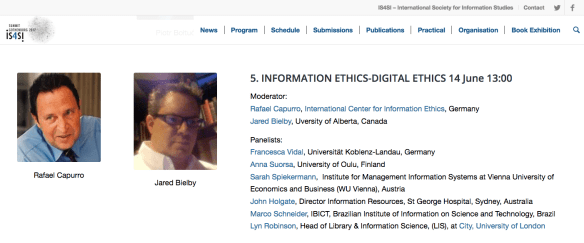
I was delighted to be invited to take part in this panel on digital ethics, lead by Rafael Capurro and Jared Bielby. The panel was part of a wider conference of The International Society for Information Studies Summit 2017, and it was wonderful to have the opportunity to meet colleages in person, and to consider Information Science from the wider, international and interdisciplinary perspective. [The conference hashtag was #is4si2017, but you can also follow @is4si_online]

Here are a few personal thoughts and recollections from some of the conversations I had at the conference. They are written mostly for my own reference for teaching, but they may be of wider interest to LIS folks. My perspective here covers only a tiny amount of the knowledge and ideas shared over the entire event. Do take a look at the overall Programme from the link above.

The encounter overall inspired me to think that we need a whole module on Digital Information Ethics for CityLIS, and that this area is one of critical importance for LIS professionals, whatever stage of their career.

Communication in the Digitised World: The role of messages and messengers

This discussion was led by Rafael Capurro, and included John Holgate and José María Díaz Nafría, Anna Suorsa, Francesca Vidal, Sarah Spiekermann, Marco Schneider, two Chinese colleagues (whose names I regrettablly did not catch), and myself. This small group took the form of an informal seminar, and I found myself wishing that I could have more time for this level of conceptual consideration, with such a highly informed group of colleagues.

This forum aims to discuss the phenomenon of messaging in our globally digitised world. Against the historical backdrop of various theories and philosophies of communication in society, the biosphere as well as in physics and mathematics, the notion of ‘message’ has emerged as a central unifying idea. The discipline of angeletics is exploring theses themes around key concepts such as angelos and angelia, interplay, dynamic messaging structure (hieronomy hereronomy and dianomy), and is examining the intrinsic relationship between information and communication in various professional spheres of cognitive social and phenomenological activity. The mediating sphere of experience is seen as language including natural languages, the ‘language’ of animals, metalanguages and artificial languages (such as mathematics and semiotics) grammar and philosophy of language.

We started from the question of whether we need a new terminology to explicate the concepts we imply when we use the term ‘information’. There was no word for information in the classical world, only words for message and messenger.

What is a message? What is a messenger? What role do they play in information as process? Is messaging a phenomenon in which information and communication are reciprocally embedded? If so, which comes first? The egg of information or the chicken of communication?

The English word information is singular, although there is the concept that information can be plural (for example, three pieces of information = information(s)). Other languages allow for this. Is information a process (becoming informed?) as suggested by Buckland in his 1991 paper, Information as Thing.

One of our Chinese colleagues drew for us the Chinese and Taiwanese characters for information. Chinese and Taiwanese characters for information have a common component, language – but differ on the respective second components. Chinese incorporates the symbol for a person, whilst Taiwanese incorporates the symbol for West. Intriguing. Our colleague was unable to tell us what was meant exactly by ‘West’ however, and this is something I would love to explore further.

Rafael drew our attention to a forthcoming book on communication in the ancient world. I think it must be this one: Mercury’s Wings: Exploring Modes of Communication in the Ancient World. Edited by Richard JA Talbert, and Fred S Naiden, the book has just been published by Oxford University Press. A glance at the contents has convinced me to add this to our reading list for my module, Foundations of Library & Information Science, not least because of the chapter by Matthew Nicholls, ‘Libraries and Communication in the Ancient World’.

***1/7/17 update – Rafael commented that the book he was referring to was a different one: ‘The book I meant was: Sian Lewis: News and Society in the Greek Polis, London 1996
See: https://www.amazon.com/Society-Greek-Studies-History-Greece/dp/080784621X‘ ***

The discussion turned to trust.

What are the ethical and moral implications of messaging for us today? Is messaging in all its forms serving to enhance human interplay and freedom, or are we in fact already living in Nietzsche’s dysangelium (bad tidings) – a world of trumpery circulating empty messages trumped up by messengers who can’t be trusted?

Paralells with today’s world of post-truth and fake-news were raised, and the question of ‘is the messenger to be trusted?’ and mechanisms and reasons for trust were explored. Do we trust someone according to how they appear? Who recommends them? Is trust based on past experience? How was trust established in the ancient world? I raised the issue of AI. Do we trust the algorithm? Does anyone understand the algorithm? There were, understandably, no definitive conclusions.

More was considered in respect of information. This time reflecting on Shannon.

Is Claude Shannon’s pervasive Mathematical Theory of Communication an adequate foundation for our contemporary messaging world? Alternative views of messaging should be considered (e.g. Flusser, MacLuhan, Wiener, Habermas).

There is still confusion in teaching and the literature, around Shannon’s use of the term ‘information’, even though his original work was titled ‘Mathematical Theory of Communication’, and Shannon did not imply his theory was about semantic information, as understood by LIS. We talked about the influence of Weaver in respect of the term ‘information’, and the debate and misunderstanding that has flourished ever since.

We also talked about the implications of understanding information as ‘a difference’ (I mentioned the library analogy, where ordered books intuitively imply more information – but as there is no difference, or ‘surprise’ they actually offer less information, according to Shannon. The probability of a random event is low. We compare the ordered library with a random pile of books where the ‘message’ may be surprising, the probability of a random event is high. In this case there is more information. Entropy vs negentropy, as suggested by Wiener.

For a fuller discussion of information as a difference, see my paper with @david_bawden from 2015 ‘A Few Exciting Words.’

José María Díaz Nafría talked about the need to collect, understand, and perhaps even  reconcile, differing intra- and interdisciplinary definitions of information. He has been working on a tool to pull together these theories and concepts of information, Glossarium BITri. This site is definitely worth taking time to browse, and the project is ambitious and welcome.

For more on the understanding of  information across disciplines, see my 2013 paper with @david_bawden ‘Mind the Gap‘.

Information Ethics – Digital Ethics

Information Ethics – Digital Ethics. IS4SI 2017, Gothenburg, Sweden

Marco Schneider introduced the classical and more recent philosophical background to information and ethics, suggesting that we need to pay attention to the changes implied by digital entities such as the bots and algorithms which are now commonplace within the infosphere. The panel members, named on the slide, each portrayed varied, yet equally important interests in digital information ethics. I explained my interest was twofold. Firstly from the viewpoint of information professionals as gatekeepers; those trusted to input to, explain, review or recommend resources and services. Secondly, from the viewpoint of information literacy. Information professionals are expected not only to be information literate themselves, but to promote and lead the discussion on how we define information literacy, and we can best communicate and promote skills and understanding in this increasingly important arena. Insight to and understanding of what consitutes ethical behaviour is implicit within an information literate population. Everyone deserves to engage within an ethical information environment, and in turn should be able and willing to make their own contribution to ensuring ethical information behaviour and practices within the digital sphere. Information professionals have a key role to play in ensuring that the infosphere, our digital habitat, remains ethical, and for the good of the many.

An hour was nowhere near enough to do justice to such a wide topic. The audience for our session, to the credit of Rafael and Jared, was large, and time did not allow us to hear from everyone who wanted to speak.

We touched on what is different about digital information ethics, over and above information ethics. Surely, ethical behaviour is a baseline, irrespective of whether one is in an analogue or a digital environment. Are not ethics, ethics?

I suggested that one difference brought about by digital was a question of scale. Network technology, including smartphones, have brought much more information, much more frequently, into the hands of far more people than, say, a decade ago. Whilst it is fair to argue that all types of information are more readily available, although to varying degrees, we can perhaps with justification suggest that the major change has been in the availability of, and access to global media and news.

A member of the audience suggested that we should also consider value. Ethics implies values. I agree with this. Especially from the viewpoint of the information professional; we are concerned with value, as in relevance, reputation, validity, truthfulness, evidence.

I think a major change, linked with the rise of the world wide web, is that provenance and reputation have become harder to establish as the traditional signals of publication status (i.e editorial/peer control) have faded away. The web made everything look homogenious, and therefore of the same quality. It is no longer always clear who is the author or the editor. A mere quarter of a century since the inception of Web 1.0, it is almost impossible to differentiate between truthful reportage, and fiction. Information, misinformation and disinformation, it all looks the same. Even a high degree of information literacy cannot always spot ‘fake news’. Personal and political agendas, spin and deliberate manipulation succeed as most of us do not possess the means to detect nor prevent them. I have read some suggestion that readers prefer ‘fake news’ if it confirms a personal viewpoint.

The need to be ethical in provision of information and reporting of events is no longer paramount to many. The game is now far more subtle, and usually focuses on securing an advantage. Primarily economic. It may be too late to insist on or ensure ethical rules for the digital realm, even if we finally determine what these might be. The news, for example, is increasingly controlled by algorithms, (see for example, NYT) and content provision has shifted from news providers to social media/technology companies. The demise of named editors is perhaps to be lamented. They had, one might hope, at least a small investment in their professional reputation.

Again, bots and algorithms. How can we trust what we do not understand? How can we understand these entities in order to create and promote an ethical framework?

I had a wonderful earlier conversation with panelist Sarah Spiekermann, during which she reminded me of the likely relevance of Habermas’s writing on civil discourse, to our concerns for ethical behaviour in the digital world. We are not facing new problems, just a new environment.

Reflecting on the format of our panel, it was notable that time for discussion was too limited to achieve much more than introductions and one or two comments. Whilst this was valuable in itself, I wondered if an alternative format would be possible, in order to take the discussions forward, into something more concrete.

It seemed to me that before we could discuss digital ethics, we first needed to establish amongst the panel and the audience, what was different about the digital realm. This, perhaps, could form an initial focus for future events, in order to provide a foundation for further, sturctured discussion.

I declare here, my scientific background, and thus my personal preference for structured debate. I concede that others enjoy a different approach.

Overall, I was reminded of the importance of face-to-face connection in the digital world. Meeting and talking to new colleagues was a pleasure, and highly informative. Even in the age of Skype and Google Hangouts, the physical presence is still somehow, a superior mode of communication.

It was fantastic to meet Jared Bielby, who together with Matthew Kelly, worked tirelessly to co-edit our Festschrift for Rafael: Information Cultures in the Digital Age.

See: Bawden D and Robinson L (2016). Super-science, fundamental dimension, way of being: Library and information science in an age of messages. In: Information cultures in the digital age: a festschrift in honor of Rafael Capurro, Kelly M and Bielby J (ed.), Springer, 31-43.

A modified version of my contribution, co-authored with @david_bawden, can be found here: https://hcommons.org/deposits/item/hc:11609/

Finally, it was my very great pleasure to meet Rafael Capurro, who has made such a significant contribution to the literature of information science. I found him to be warm and generous in nature, and I hope we will meet again.

Links used in the text:

(Accessed June 19th 2017).

Angeletics.net

Buckland M. (1991). Information as Thing. http://people.ischool.berkeley.edu/~buckland/thing.html

Claude Shannon. https://www.bell-labs.com/claude-shannon/

Glossarium BITri. http://glossarium.bitrum.unileon.es/glossary

How Alphabet’s AI Robot is helping the New York Times Replace its Pubic Editor. https://www.fastcompany.com/40430603/alphabet-jigsaw-new-york-times-comments-robot-ai-machine-learning

Facebook’s officially a media company. Time to act like one. https://www.wired.com/2017/03/facebooks-officially-media-company-time-act-like-one/

Stanford Encyclopedia of Philosophy: Jurgen Habermas. https://plato.stanford.edu/entries/habermas/