21st Century Library and Information Science

Time .. always changing things ..

Time .. always changing things ..

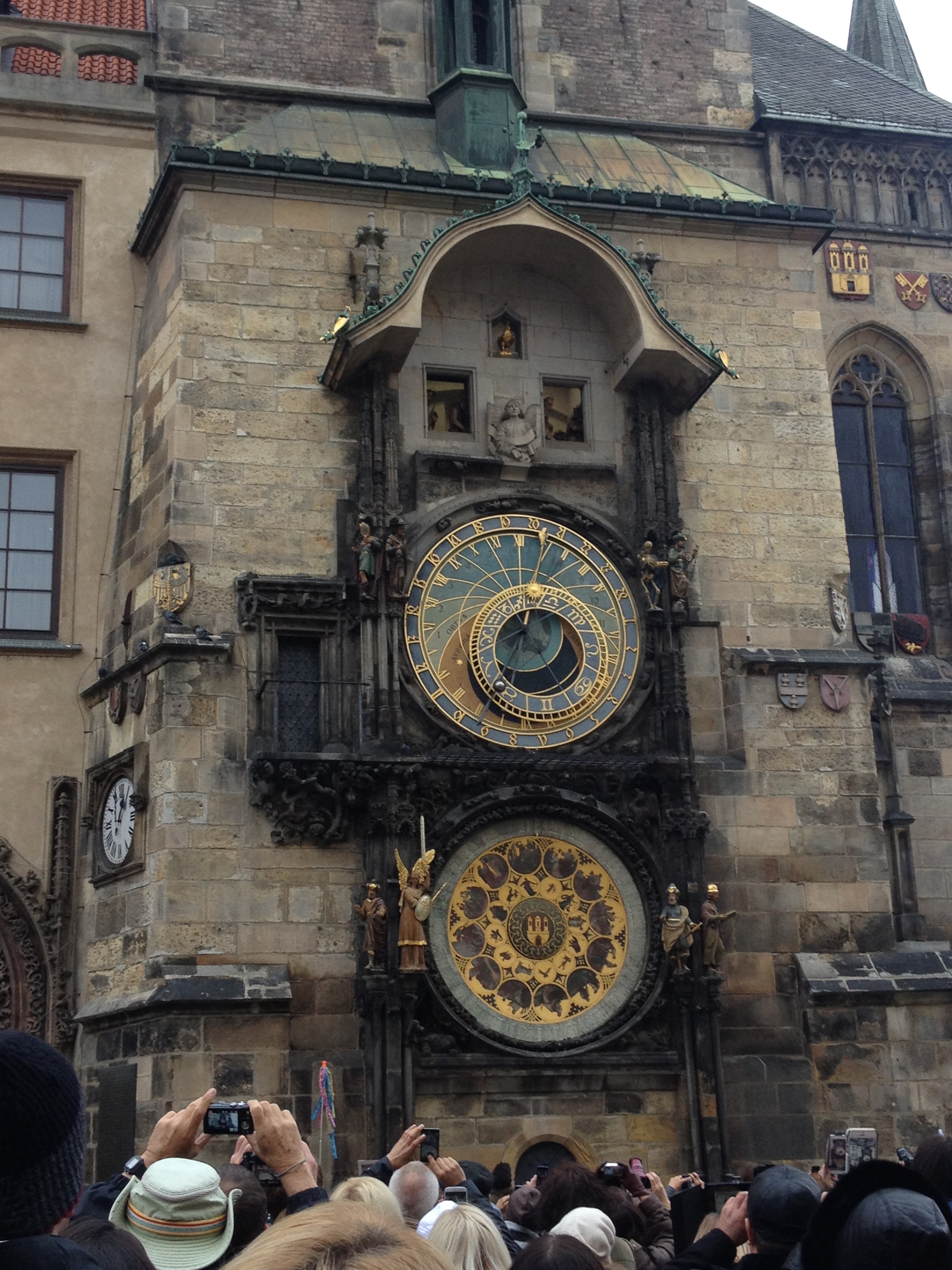
Some thoughts based on my recent presentation to the INFODAYS14 conference held at Charles University, Prague, Czech Republic 5-7th November 2014.

The future of library and information science (LIS), is inextricably linked to the future of the document. Leaving aside for the moment, the question of exactly “what is a document?” this comes as no surprise to those of us working in this area, as we know that civilization owes its existence to recorded knowledge. For the time being also, let us allow ourselves to consider knowledge and information to be interchangeable terms, and within our LIS discipline, we will assume that for the purposes of communication, such knowledge or information must be instantiated as a document of some kind.

We can further understand that documents contain, and therefore allow access to, ‘formal’ information – i.e. something that is published, and therefore subject to the processes of the information communication chain, [Popper’s World III, instantiated in World I, physical objects]. This is in contrast to ‘informal’ information, which remains inside someone’s head – although developments in telepathic communication are starting to enter the research literature, we are still some way away from being able to intercept and understanding the thought processes of another being, [Popper’s World II].

I am often called on to comment on the nature of library and information science. To reiterate, here at City University London, we consider the discipline of library and information science to be the study of documents, on their journey through the information communication chain.

The realm of library and information science then, is the realm of the document. We, as researchers and practitioners within this field, are concerned with the activities surrounding the creation, dissemination, management, organisation and retrieval, and use of documents. We study these processes of documentation through the lens of Hjørland’s concept of domain analysis, invoking study and praxis within facets such as knowledge organisation, information retrieval, document preservation, historical studies, and research into information behaviour.

The changes in this chain of events, are driven largely by technology, although factors such as economics, politics and social tastes are all able to impact on the business of recorded knowledge.

Let us take a look at some of the developments that can be seen to be influencing the nature and definition of documents, as 2014 draws to a close.

Information Theory

A quick scan of the literature on the definition of information, reveals the troubled history of the concept central to our discipline. To-date, there is no single, satisfactory explanation of what information actually is. There are many attempts at definition, and indeed theories, both within the field of LIS and within other, seemingly unrelated disciplines. Resurgence in interest in information communications theory, can be seen to have heralded interest in information physics, philosophy of information and information biology. To some, the concept of information in these fields remains unconnected to the social discipline of library and information science, but to others, there is an interest in looking for connections and a possible theory of unification. See Bawden and Robinson papers below, for further reading in this latter area.

Data Science

The jump to prominence of data science and related areas (big data, data analytics, data visualisation) can be seen in the number of recent university courses being introduced (we have introduced one this year at City University), and reflected in the required skills listed in many job advertisements. One of the top skills sets required by employers across the sectors is the ability to collect, analyse and interpret data. Data handling and communication are now sitting alongside the more traditional ‘verbal and written communication skills’ that professional level work demands. These skills are becoming essential to practitioners within library and information science as e-science and the digital humanities pour more and more data sets into our sphere of influence. These digital data files are one example of the new forms of document that require the attention and understanding of members of our discipline. The move to open data, and the expectation that data will be published alongside findings are changing the way library and information professionals support scholarly communication. Indeed the move towards digital scholarship heralds a new era for partnerships between librarians and researchers.

Digital Humanities

The mass digitization of literature, poetry, art and music has led to an increase in materials and methods available for humanities based studies. There is a movement towards situating digital humanities research within the library and information environment, which seems to many, to be its natural home. Again, as with e-science, the availability of large data sets and multi-media files is fuelling new growth areas for understanding patterns and trends (text mining), and for facilitating the final convergence of the GLAM sector, where digital renderings of text, image, sounds or even objects bring the previously separate collection disciplines into a melting pot of new services and interpretations. We are witnessing new roles redefining library and information science as a producer of new content, understanding and insight, supporter of new forms of scholarship, and a leader in scholarly communications.

Publishing

Library and information science has always had an intimate relationship with the processes of publishing and dissemination. Changes in both scholarly and trade publishing are well documented, driven by the open access movement and the demand for new models of consumption respectively. The rapid growth of mobile devices and social media has revolutionised what it means to be an author and what it means to be a disseminator or a reader. It is probably fair to say that anyone with access to technology (not everyone) can be both an author and a publisher. New mechanisms for content creation (image/media capture devices, writing for transmedia) allow new forms of documents (interactive narratives) to flourish, and we are seeing a move towards content marketing, an increase in the use of images or video over text, and in data mashups. New tools to help us understand the reach and potential impact of new publishing formats, referred to as altmetrics, are entering the armoury of library and information science alongside existing bibliometric and informetric analyses. What it means to publish is changing alongside the development of the document.

Computer Science/Technology

Technological advances undoubtedly drive the most significant changes in the form and nature of documents.

I have written previously in this blog, that developments in pervasive computing, multisensory network technologies and participatory human computer interfaces will allow new forms of documents to emerge, specifically ‘immersive’ documents, where unreality can be perceived as reality. News of current developments in virtual reality headsets and roomscape projection abounds, and consumer versions of games, narratives and training scenarios appear to be just around the corner timewise, rather than siting themselves somewhere in the mid to long term future. Before we arrive at the availability of completely immersive documents, we will see a range of lesser, participatory experiences, such as the interactive, transmedia narratives mentioned in the previous section. In these narratives, the story reaches out beyond the imaginary world, into the reality of the reader, with texts, phone calls and connections, seemingly coming from characters within the plot. The way the narrative plays out can be influenced by the reader, as can the ending.

The blurring of boundaries between a game, a learning experience or pure fiction with this type of document is evident. There will also be ethical implications with regard to how these documents are used.

Implications for Library and Information Science

As documents evolve, so then will the scope and processes of what we understand as library and information science. New forms of document will require extensions and adaptations to our current tools for knowledge organisation, new information architectures and new understandings of human information behaviours. Most interestingly perhaps, for the LIS profession, will be the need to engage with and promote ‘immersive literacy’, possibly in a similar way to which Gilster suggested for digital literacy less than two decades ago.

Further Reading

Bawden D and Robinson L (2013). “Deep down things”: in what ways is information physical, and why does it matter for LIS? Information Research 18(3), paper C03 [online], available at http://InformationR.net/ir/18-3/colis/paperC03.html

Gilster P (1997). Digital Literacy. New York NY: Wiley, New York.

Hjørland B (2002). Domain Analysis in Information Science: Eleven approaches – traditional as well as innovative. Journal of Documentation, vol 58(4), 422-462.

Robinson L (2009). Information Science: the communication chain and domain analysis. Journal of Documentation, vol 65(4), 578-591.

Robinson L and Bawden D (2013). Mind the gap: transitions between concepts of information in varied domains. In: Theories of information, communication and knowledge. A multidisciplinary approach. Eds. Ibekwe-SanJuan F and Dousa T. Springer.

Robinson L (2014a). Multisensory, Pervasive, Immersive: towards a new generation of documents. Journal of the Association for Information Science and Technology, in press.

Robinson L (2014b). Immersive information behaviour; using the documents of the future. New Library World, in press.
From Interactive to Participatory

The emergence of immersive documents, wherein unreality is perceived as reality by the ‘reader’, is a consequence of three converging technologies:

  • networked/mobile computing becoming pervasive
  • multimedia becoming multisensory
  • interactive becoming participatory

Alongside this synthesis, we can identify five tangential areas of interest, in which developments contribute to the facilitation of immersive documents. These are:

  • enabling technologies such as virtual reality, made popular by devices such as Oculus Rift
  • developments in graphic art and design ( see Diagon Alley brought to life for the immersive Harry Potter theme park)
  • new understanding of creative writing techniques underpinned by research into transmedia, literary/narrative theory, scriptwriting and game design
  • the desire by people (players/audience/readers) to participate, evidenced by activities such as cosplay, interactive gaming, web 2.0, participatory theatre, films, e-books and exhibitions.
  • a small but growing interest from the library and information science community on the implications of ‘immersive’ documents for our profession (collecting, indexing, retrieving, preserving, making available to readers or users)

The usual definition of the term ‘reader’ is expanded here to encompass the person or persons experiencing, or participating in, the unreal, immersive document. This may be by engaging with a transmedia story, by joining the audience of an immersive play, or by interfacing with virtual reality technology to enter a virtual world. The activity of ‘reading’ thus becomes participatory, so that the reader perceives the documented world as a reality, and posseses the ability to make choices in the story, and influence the eventual outcome.

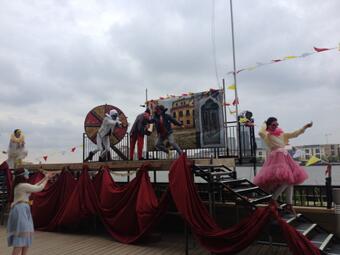
The image above shows the cast from immersive theatre play “Venice Preserv’d” in action; drawing the audience into a timeless world filled with contemporary meaning. There are an increasing number of participatory theatre experiences on offer to those willing to suspend reality and join the cast (if only at the superficial level of donning a robe and singing along) but the number of attendees at such events demonstrates the lure of participation.

In talking about participation we are obliged to mention the whole spectrum of video games – hardly a new phenomenon, but one which is becoming increasingly sophisticated and to some extent, perhaps merging with immersive, transmedia e-books, so that the boundary between what is a game, and what is participating in a story becomes blurred. The educational opportunity for immersive games is already evident, in prototype products including: In Ulysses: Proteus and Dolus: Finding the Journal of Odysseus.

On the boundary between what is a game and what is a participatory ‘story’, writer Mike Jones offers the clarification that

“A Game does not need, nor have to have, a Story.”

He uses the phrase ‘interactive narrative‘ to further distinguish between immersive games and immersive stories:

“Interactive Narrative.. a term which can encompass a broad range of experiences where the audience is asked to play a role, to participate or to engage directly with character and plot through action. An experience that involves game-play but does so in the context and service of telling a story.”

Old Dramatic Principles in New, Interactive Narratives. Mike Jones 11/08/2014. http://www.mikejones.tv/journal/2014/8/11/old-dramatic-principles-in-new-interactive-narratives.html [accessed 16/10/2014]

I think this is helpful in attempting to understand what sort of things could be immersive documents, and the differences between them.

Immersive documents do not yet exist. Today’s emergent versions are still reliant on the suspension of disbelief – but technological advances fuelled by the popular desire to participate are moving us towards documents that allow us to perceive an unreal story as reality.

Below is a list of resources supporting the move from interaction (where the computer generated world is separate from the user) to participation (where the experience is more believable). They emphasize the strong desire in many people to escape reality and engage with a scripted world. This listing is in its early stages, and it will develop over time.

Further proof: our lovely #citylis student @MeganWaples, participating in “Venice Preserv’d”.

Venice Preserv'd + Meghan

Immersive Plays/Theatre

The Kindness of Strangers

Thomas Otway’s Venice Preserv’d

Punchdrunk’s The Drowned Man – London

Punchdrunk’s Sleep No More – New York

Immersive Films

What it’s like to shoot a feature film for Oculus Rift

Immersive Books/Texts

The Craftsman

Immersive Games

Blood and Laurels

In Ulysses: Proteus

Dolus: Finding the Journal of Odysseus

Immersive Exhibitions

David Bowie is

Tomorrow

Diagon Alley Theme Park at the Wizarding World of Harry Potter

Cosplay

At Hyper Japan

Japanese ‘Cosplay’ craze becoming popular in London

Immersive/Transmedia Writing

Will virtual reality reshape documentary journalism?

The Writing Platform

Marie-Laure Ryan on Narrative Theory

Mike Jones: Old Dramatic Principles in New Interactive Narratives

Enabling Technologies

Julian McCrea from Portal Entertainment talks about how audience’s facial data can be used in immersive entertainment.

Stretchable electronics could lead to robotic skin, computerised clothes.

On telling immersive stories

Neil Gaiman

I joined a packed house at the Barbican last Friday, to listen to the words and voice of Neil Gaiman [@neilhimself]. The audience sat in rapture for several hours, listening as he read his stories out loud, and I was reminded that storytelling is not only a powerful art, it is a furiously popular one. Gaiman’s darkish genre is not immediately appealing to me, but his performance, billed as ‘A revolutionary new concept of multi-media storytelling’, certainly was.

The multi-media component of the evening comprised a blending of the author’s mellifluous narrative, with projected drawings by the artist Eddie Campbell, and the ethereal acoustics of string quartet FourPlay. This seems rather low key when we are bombarded with announcements of increasingly realistic virtual reality applications all day, but it was effective enough to draw me into the world inhabited by the characters within the story ‘The truth is a cave in the black mountains’.

Good stories have always been immersive. Whilst the grading of a story as good or not is somewhat subjective, the aim of the writer is surely to draw the reader as close as possible to perceiving the tale as reality; to suspend disbelief, if only for a while.

I often refer to JK Rowling’s Harry Potter series to illustrate what is meant by ‘immersive’, as many readers easily agree the world depicted in the mind solely by the text persuades the reader that Harry and his chums really exist. Artwork pushes this further, giving the reader something concrete to imagine. Many stories, have achieved this, possibly since the earliest narratives were written down. It is arguable that even earlier, oral documents, stories told by telling or singing, are an effective mechanism by which to deliver the feeling of immersion.

The level of immersion offered by oral documents, or those consisting of text and drawings, is limited, however. The reader takes the role of a passive observer in the fictional world. The cinematic experience, film and video, provides a richer environment from which to fuel our feeling of immersion – but still we are unable to participate in any way.

If we add contemporary interactive technology to multimedia’s sound and vision, we are granted permission to enter the unreal world and perform actions which influence the outcome. With video games for example, we are able to contribute in some way to the world loaded into computer memory.

I have written previously, that the combination of pervasive networked computing, multi-sensory, rather than merely multimedia communication, plus participatory interaction, will eventually allow us to experience unreality as reality – to experience a story, a game, a film or any other scripted device as reality. Our disbelief will be suspended to the extent that we cannot distinguish between reality and the virtual world. Documents will offer us truly immersive experiences.

Immersive documents then, are the containers for a story, experience, fantasy, game, memory or idea, which allow the reader to perceive unreality as reality. As technology progresses, we creep closer and closer to the worlds portrayed in science fiction. The world of the holosuite for example.

It is not however, merely the enabling technologies which carry us along on the quest for ever more believable stories. It is something also of human nature. The desire to suspend reality, the willingness to enter fully into the unreal world is popular. We, as readers or users of immersive documents,  wish to participate in, or interact with the story, often in a way which allows us to  influence the sequence of events or the final outcome. In unreality, we may be offered a level of control unimaginable in real life.

The legacy of immersive documents undoubtedly stems from the pleasure of reading a good book. Before the spread of digital technologies some authors attempted to allow the reader a modicum of interactivity – to choose an ending to the story, either by selecting from pre-written options, or by voting by post. As technology advanced, more realistic interaction has been supported by interactive video or online gaming and by web 2.0 technologies leading to dynamic web pages and applications such as Second Life. In the cultural sector we witness the popularity of immersive exhibitions such as the recent David Bowie is shown at the V & A, immersive theatre, 3D cinema and the astonishing outpouring of content created by cultmedia fans, including simulated worlds and real-life cosplay.

The possibilities here are endless, and immersive stories can move beyond fiction and entertainment to include teaching and learning in realistic, yet safe environments. There is a dark side too, though. The unreal world may be somewhere we prefer to stay. Whilst Neil Gaiman came to end of his excellent dark reading and we all went home, the immersive documents just around the corner may be harder to switch off.