At the start of a rainy February, it seems fitting to write about escaping into the unreal worlds of the mind, and the pleasing indulgence afforded by the inner flights of fancy conjured up by words on a page, a favourite memory, or simply the imagination. But what if we had some means by which these ‘unreal’ experiences could be perceived as real? A way in which we could experience fantasy worlds with the same sensory perception as that which we have when we engage with reality.
Developments in pervasive and multisensory computer technologies are leading us in just that direction, so that in the future, ‘reading’ a good book may deliver an entirely realistic experience, where the ‘reader’ participates in a simulated version of the story, and may be able to influence the final outcome.
These computer generated experiences could well be the next generation of documents, and library and information professionals should consider how they might fit within the information communication chain processes of creation, dissemination, management, indexing and use. It is entirely possible that we will see radical changes in information behaviour as documents become more immersive and pervasive.
Most of us enjoy becoming drawn in to a good story; the more vivid the text the more we enjoy the fantasy. I first came across the phrase ‘immersive text’ in relation to the Harry Potter series of books. Whether or not you are a fan, the popularity of the world of the school for witches and wizards drawn into the mind by JK Rowling’s words is undeniable. On watching the movies, I found myself wishing for a study like Dumbledore’s but I didn’t feel that I wanted to be any of the characters, and when I read about the Harry Potter Studio Tour, I didn’t feel compelled to visit a theatre set Diagon Alley. But it seems a lot of people do. Many fans want to drink in the world of Harry Potter, they want large doses of unreality.
But there is nothing really new here. We are all ‘fans’ of something, and there are, of course, fictions, films, plays and games that tempt even the most dedicated of us all into unreal fantasy when we engage with them. One of the richest arenas for keen advocates of unrealism is provided by cult-tv and its close relation, cult-fiction. The exact characteristics which identify a television program as ‘cult’ are nebulous, but examples come readily to mind. Star Trek, as long ago as the late ‘60s early 70’s, spawned followers who afforded much time and effort in writing and distributing works of fiction related to the show (fanfiction). Unwilling to leave their engagement with the show alone until next week’s episode, they augmented their experience with fictions, poems, art work, songs and in recent years videos and conferences. As much as they could, they made (and still make) their imaginary world real.
Early cult-tv progams themselves encouraged the concept of unreal reality, by anticipating the technology which would make this happen. In the popular 1970’s children’s series TimeSlip, we see a ‘fantasy room’ which contained a tubular device (rather comical by today’s technological standards) which when placed on the user’s forehead allowed their dreams to be experienced as a reality. (Series 01, Episode 07 pt 2)
Wim Wenders’s film ‘Until the End of the World‘ (1991) depicted a more modern looking headset device, which again, allowed the wearer to experience dreams as a reality.
Whilst contemporary 3D films allow members of the audience to perceive objects as real visually by donning rather flimsy plastic glasses, a more convincing sensory experience remains elusive – within the realms of science fiction rather than science fact.
Ironically, it is science fiction cult-tv that shows us how this might work, and the holosuite – a concept popularised on Star Trek – The Next Generation is perhaps the most widely known portrayal of unreality tech. The holosuite is a space in which people engage within a computer generated unreality that is indistinguishable from reality. Fans of the show will be able to recall with ease, and in detail, all the best holosuite episodes but to summarise the holosuite could be used for shared experiences of entertainment (taking part in a crime novel or a going to a jazz bar), and also for examining historical incidents, or for training.
This unreality comes with issues however. Most centre around aspects of sensory stimulation – eating and drinking for example. Do you get drunk if you drink holosuite wine, and do you get fat if you eat all the computer generated cakes? But there are deeper issues: if you die in the unreality are you dead in the real world? If you fall in love is it ‘real’? More philosophically though, do characters generated in the holoworld have the right to existence? Once they have been created, do we have the right to turn them off by shutting down the program? One poignant episode considered whether a computer generated hologram had the right to leave the holosuite environment to persue his life elsewhere.
Fast forward to the 21st century and fandoms for newer television shows such as Buffy or BBC’s Sherlock enjoy even greater forays into unreality supported by developments in computing technology and social media. Crucially, the latter makes the distribution of fan-related works easy, and essentially, social media allows fans to find each other and to arrange shared activities such as cosplay, where fans dress -up to ‘become’ characters in their favourite unreality. Unreality is more ‘real’ if it is shared.
Cult-tv then, allows us to understand from one perspective, how far fans will go to make their unreality seem real.
But there is more. The ‘immersive’ adjective has moved beyond its association with traditional texts. Fuelled by the progress in networks and mobile computing platforms, electronic ‘immersive’ texts are emerging, which combine aspects of the traditional printed book, and televisual experiences. These documents reach beyond what most of us understand by the term e-book, in that the story follows the reader into the real world. Boundaries between reality and unreality become blurred.
In this new type of document, exemplified by ‘The Craftsman’ (Portal Entertainment), events unfold in real time, and engage their readers as part of the fiction. Readers receive texts, emails, calendar updates and ‘phone messages from other characters within the plot. The text plays out across a range of devices (transmedia), and can be put down and picked up again when convenient. Although we have the technology, the creative writing techniques to support this sort of fiction are in an early stage, and such immersive fictions are few in number. They are also expensive to produce, and reviews so far are mixed, with some commentators suggesting that action is limited and takes too long to update. These criticisms could be addressed in time, with more initiatives like “The Immersive Writing Lab”.
Yet the rise of ‘immersive’ doesn’t end with texts, electronic or otherwise. In recent months I have encountered ‘immersive-plays’ (Punchdrunk’s The Drowned Man), ‘immersive-exhibitions’ (David Bowie is) and ‘immersive-installations’ (Tomorrow )
The unique selling point of each of the above is participation. The viewer is invited to step into the unreality and live as part of the fiction; although each still requires suspension of disbelief on the part of the ‘reader’ or ‘participant’.
So at the time of writing then, none of this is really real. In spite of the popularity of engaging with highly elaborate fantasies, demonstrated by cult fandom, transmedia specialists, theatres and museums, there is room for improvement when it comes to delivering experiences which cannot be distinguished from the real thing.
The emergence of multisensory computing and network technologies does however, bring the promise of applications which offer us a more realistic fantasy than those which play out in our imaginations.
In order for unreality to work, we need technology that allows us to sense everything in the same way as we do if it is real. This goes beyond seeing and hearing, to include touch, taste and smell. Recent work on this type of multisensory communication so far leaves us with rather clunky, physical devices, which go only part way to evoking a sense of reality. Wearable tech is hardly a lightweight experience and even though some of the demonstrations help us engage with a plausible world, it is still impossible to forget the simulation whilst wearing a headset, gloves and other unappealing apparel. (see this demo from UCL)
Participants in the holosuite are clearly perceiving the computer generated world as real, via all of their senses, by some, as yet,fictional neurological mechanism (photons?). Whilst we can speculate on how to stimulate areas of our brains without visible means of support, experimental work in this area flags up a few ethical issues to say the least. Nonetheless, work such as that of @AdrianCheok, shows us how much progress has been made in haptics, and the multisensory internet, and suggests that the rendering of unreality as reality may not be so much science fiction as we may think.
In his book, ‘Beyond the Library of the Future’ written in 1997, Bruce Schuman speculates on what will become of the library. He presents several scenarios for the near future, and in one of these he suggests that the library in the year 2022 will curate ‘experiences’ – rather than just physical works. The experiences are envisaged as computer programs which allow a ‘reader’ to engage with a recording of a real experience (memory), so that they perceive it as real for themselves.
If we allow ourselves to extrapolate beyond our current technological boundaries for a moment, there is no reason to suppose that these experiences could not be fictional, an extension of the ‘immersive texts’ suggested by ‘The Craftsman’, or indeed, entirely imaginary.
Whilst it is easy to comprehend the lure of fantasy, allowing us to enjoy something in unreality which we could never experience in real life, such immersive encounters could also support training and development in areas such as emergency response, surgery, piloting a plane or dealing with difficult customers.
Immersive experiences will undoubtedly have an effect on information behaviour. The use of Google Glass and smart watches are already instigating questions of ‘information etiquette’. There is certainly an interesting future for library and information professions then, in trying to organise not just everything we know, but everything we can imagine. Every unreality.
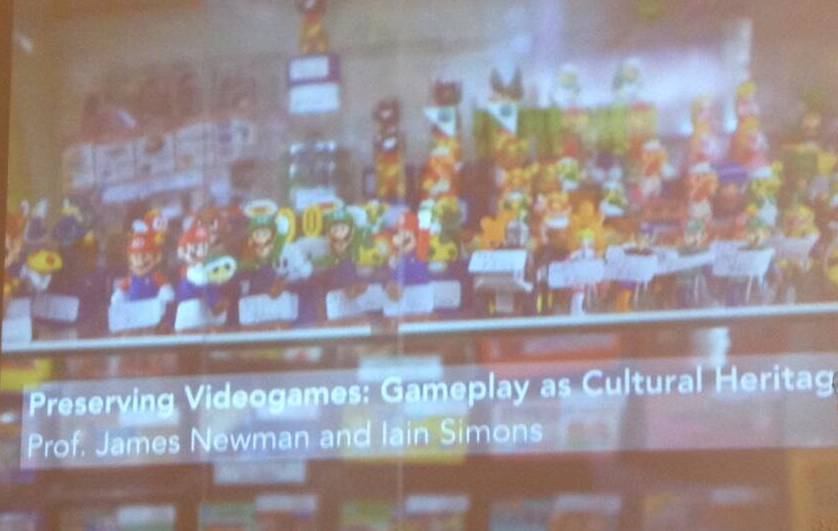 An engaging seminar at the Daiwa Foundation on 3/6/14, allowed games experts and enthusiasts James Newman and Iain Simons to treat us to an entertaining and thought provoking romp through the history of videogames. Their relaxed style kept our attention for around 90 minutes, which still wasn’t really enough time to cover all aspects of the questions ‘are videogames a part of cultural heritage, and if so, should they be preserved?’
 Dr Lyn Robinson