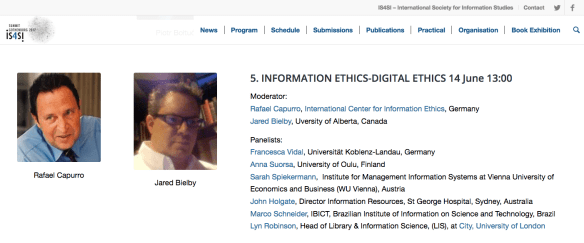
Digital Ethics Panel at IS4SI 2017, Gothenburg, Sweden.
I was delighted to be invited to take part in this panel on digital ethics, lead by Rafael Capurro and Jared Bielby. The panel was part of a wider conference of The International Society for Information Studies Summit 2017, and it was wonderful to have the opportunity to meet colleages in person, and to consider Information Science from the wider, international and interdisciplinary perspective. [The conference hashtag was #is4si2017, but you can also follow @is4si_online]
Here are a few personal thoughts and recollections from some of the conversations I had at the conference. They are written mostly for my own reference for teaching, but they may be of wider interest to LIS folks. My perspective here covers only a tiny amount of the knowledge and ideas shared over the entire event. Do take a look at the overall Programme from the link above.
The encounter overall inspired me to think that we need a whole module on Digital Information Ethics for CityLIS, and that this area is one of critical importance for LIS professionals, whatever stage of their career.
Communication in the Digitised World: The role of messages and messengers
This discussion was led by Rafael Capurro, and included John Holgate and José María Díaz Nafría, Anna Suorsa, Francesca Vidal, Sarah Spiekermann, Marco Schneider, two Chinese colleagues (whose names I regrettablly did not catch), and myself. This small group took the form of an informal seminar, and I found myself wishing that I could have more time for this level of conceptual consideration, with such a highly informed group of colleagues.
This forum aims to discuss the phenomenon of messaging in our globally digitised world. Against the historical backdrop of various theories and philosophies of communication in society, the biosphere as well as in physics and mathematics, the notion of ‘message’ has emerged as a central unifying idea. The discipline of angeletics is exploring theses themes around key concepts such as angelos and angelia, interplay, dynamic messaging structure (hieronomy hereronomy and dianomy), and is examining the intrinsic relationship between information and communication in various professional spheres of cognitive social and phenomenological activity. The mediating sphere of experience is seen as language including natural languages, the ‘language’ of animals, metalanguages and artificial languages (such as mathematics and semiotics) grammar and philosophy of language.
We started from the question of whether we need a new terminology to explicate the concepts we imply when we use the term ‘information’. There was no word for information in the classical world, only words for message and messenger.
What is a message? What is a messenger? What role do they play in information as process? Is messaging a phenomenon in which information and communication are reciprocally embedded? If so, which comes first? The egg of information or the chicken of communication?
The English word information is singular, although there is the concept that information can be plural (for example, three pieces of information = information(s)). Other languages allow for this. Is information a process (becoming informed?) as suggested by Buckland in his 1991 paper, Information as Thing.
One of our Chinese colleagues drew for us the Chinese and Taiwanese characters for information. Chinese and Taiwanese characters for information have a common component, language – but differ on the respective second components. Chinese incorporates the symbol for a person, whilst Taiwanese incorporates the symbol for West. Intriguing. Our colleague was unable to tell us what was meant exactly by ‘West’ however, and this is something I would love to explore further.
Rafael drew our attention to a forthcoming book on communication in the ancient world. I think it must be this one: Mercury’s Wings: Exploring Modes of Communication in the Ancient World. Edited by Richard JA Talbert, and Fred S Naiden, the book has just been published by Oxford University Press. A glance at the contents has convinced me to add this to our reading list for my module, Foundations of Library & Information Science, not least because of the chapter by Matthew Nicholls, ‘Libraries and Communication in the Ancient World’.
***1/7/17 update – Rafael commented that the book he was referring to was a different one: ‘The book I meant was: Sian Lewis: News and Society in the Greek Polis, London 1996
See: https://www.amazon.com/Society-Greek-Studies-History-Greece/dp/080784621X‘ ***
The discussion turned to trust.
What are the ethical and moral implications of messaging for us today? Is messaging in all its forms serving to enhance human interplay and freedom, or are we in fact already living in Nietzsche’s dysangelium (bad tidings) – a world of trumpery circulating empty messages trumped up by messengers who can’t be trusted?
Paralells with today’s world of post-truth and fake-news were raised, and the question of ‘is the messenger to be trusted?’ and mechanisms and reasons for trust were explored. Do we trust someone according to how they appear? Who recommends them? Is trust based on past experience? How was trust established in the ancient world? I raised the issue of AI. Do we trust the algorithm? Does anyone understand the algorithm? There were, understandably, no definitive conclusions.
More was considered in respect of information. This time reflecting on Shannon.
Is Claude Shannon’s pervasive Mathematical Theory of Communication an adequate foundation for our contemporary messaging world? Alternative views of messaging should be considered (e.g. Flusser, MacLuhan, Wiener, Habermas).
There is still confusion in teaching and the literature, around Shannon’s use of the term ‘information’, even though his original work was titled ‘Mathematical Theory of Communication’, and Shannon did not imply his theory was about semantic information, as understood by LIS. We talked about the influence of Weaver in respect of the term ‘information’, and the debate and misunderstanding that has flourished ever since.
We also talked about the implications of understanding information as ‘a difference’ (I mentioned the library analogy, where ordered books intuitively imply more information – but as there is no difference, or ‘surprise’ they actually offer less information, according to Shannon. The probability of a random event is low. We compare the ordered library with a random pile of books where the ‘message’ may be surprising, the probability of a random event is high. In this case there is more information. Entropy vs negentropy, as suggested by Wiener.
For a fuller discussion of information as a difference, see my paper with @david_bawden from 2015 ‘A Few Exciting Words.’
José María Díaz Nafría talked about the need to collect, understand, and perhaps even reconcile, differing intra- and interdisciplinary definitions of information. He has been working on a tool to pull together these theories and concepts of information, Glossarium BITri. This site is definitely worth taking time to browse, and the project is ambitious and welcome.
For more on the understanding of information across disciplines, see my 2013 paper with @david_bawden ‘Mind the Gap‘.
Information Ethics – Digital Ethics
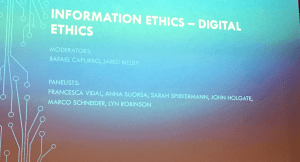
Information Ethics – Digital Ethics. IS4SI 2017, Gothenburg, Sweden
Marco Schneider introduced the classical and more recent philosophical background to information and ethics, suggesting that we need to pay attention to the changes implied by digital entities such as the bots and algorithms which are now commonplace within the infosphere. The panel members, named on the slide, each portrayed varied, yet equally important interests in digital information ethics. I explained my interest was twofold. Firstly from the viewpoint of information professionals as gatekeepers; those trusted to input to, explain, review or recommend resources and services. Secondly, from the viewpoint of information literacy. Information professionals are expected not only to be information literate themselves, but to promote and lead the discussion on how we define information literacy, and we can best communicate and promote skills and understanding in this increasingly important arena. Insight to and understanding of what consitutes ethical behaviour is implicit within an information literate population. Everyone deserves to engage within an ethical information environment, and in turn should be able and willing to make their own contribution to ensuring ethical information behaviour and practices within the digital sphere. Information professionals have a key role to play in ensuring that the infosphere, our digital habitat, remains ethical, and for the good of the many.
An hour was nowhere near enough to do justice to such a wide topic. The audience for our session, to the credit of Rafael and Jared, was large, and time did not allow us to hear from everyone who wanted to speak.
We touched on what is different about digital information ethics, over and above information ethics. Surely, ethical behaviour is a baseline, irrespective of whether one is in an analogue or a digital environment. Are not ethics, ethics?
I suggested that one difference brought about by digital was a question of scale. Network technology, including smartphones, have brought much more information, much more frequently, into the hands of far more people than, say, a decade ago. Whilst it is fair to argue that all types of information are more readily available, although to varying degrees, we can perhaps with justification suggest that the major change has been in the availability of, and access to global media and news.
A member of the audience suggested that we should also consider value. Ethics implies values. I agree with this. Especially from the viewpoint of the information professional; we are concerned with value, as in relevance, reputation, validity, truthfulness, evidence.
I think a major change, linked with the rise of the world wide web, is that provenance and reputation have become harder to establish as the traditional signals of publication status (i.e editorial/peer control) have faded away. The web made everything look homogenious, and therefore of the same quality. It is no longer always clear who is the author or the editor. A mere quarter of a century since the inception of Web 1.0, it is almost impossible to differentiate between truthful reportage, and fiction. Information, misinformation and disinformation, it all looks the same. Even a high degree of information literacy cannot always spot ‘fake news’. Personal and political agendas, spin and deliberate manipulation succeed as most of us do not possess the means to detect nor prevent them. I have read some suggestion that readers prefer ‘fake news’ if it confirms a personal viewpoint.
The need to be ethical in provision of information and reporting of events is no longer paramount to many. The game is now far more subtle, and usually focuses on securing an advantage. Primarily economic. It may be too late to insist on or ensure ethical rules for the digital realm, even if we finally determine what these might be. The news, for example, is increasingly controlled by algorithms, (see for example, NYT) and content provision has shifted from news providers to social media/technology companies. The demise of named editors is perhaps to be lamented. They had, one might hope, at least a small investment in their professional reputation.
Again, bots and algorithms. How can we trust what we do not understand? How can we understand these entities in order to create and promote an ethical framework?
I had a wonderful earlier conversation with panelist Sarah Spiekermann, during which she reminded me of the likely relevance of Habermas’s writing on civil discourse, to our concerns for ethical behaviour in the digital world. We are not facing new problems, just a new environment.
Reflecting on the format of our panel, it was notable that time for discussion was too limited to achieve much more than introductions and one or two comments. Whilst this was valuable in itself, I wondered if an alternative format would be possible, in order to take the discussions forward, into something more concrete.
It seemed to me that before we could discuss digital ethics, we first needed to establish amongst the panel and the audience, what was different about the digital realm. This, perhaps, could form an initial focus for future events, in order to provide a foundation for further, sturctured discussion.
I declare here, my scientific background, and thus my personal preference for structured debate. I concede that others enjoy a different approach.
Overall, I was reminded of the importance of face-to-face connection in the digital world. Meeting and talking to new colleagues was a pleasure, and highly informative. Even in the age of Skype and Google Hangouts, the physical presence is still somehow, a superior mode of communication.
It was fantastic to meet Jared Bielby, who together with Matthew Kelly, worked tirelessly to co-edit our Festschrift for Rafael: Information Cultures in the Digital Age.
See: Bawden D and Robinson L (2016). Super-science, fundamental dimension, way of being: Library and information science in an age of messages. In: Information cultures in the digital age: a festschrift in honor of Rafael Capurro, Kelly M and Bielby J (ed.), Springer, 31-43.
A modified version of my contribution, co-authored with @david_bawden, can be found here: https://hcommons.org/deposits/item/hc:11609/
Finally, it was my very great pleasure to meet Rafael Capurro, who has made such a significant contribution to the literature of information science. I found him to be warm and generous in nature, and I hope we will meet again.
Links used in the text:
(Accessed June 19th 2017).
Angeletics.net
Buckland M. (1991). Information as Thing. http://people.ischool.berkeley.edu/~buckland/thing.html
Claude Shannon. https://www.bell-labs.com/claude-shannon/
Glossarium BITri. http://glossarium.bitrum.unileon.es/glossary
How Alphabet’s AI Robot is helping the New York Times Replace its Pubic Editor. https://www.fastcompany.com/40430603/alphabet-jigsaw-new-york-times-comments-robot-ai-machine-learning
Facebook’s officially a media company. Time to act like one. https://www.wired.com/2017/03/facebooks-officially-media-company-time-act-like-one/
Stanford Encyclopedia of Philosophy: Jurgen Habermas. https://plato.stanford.edu/entries/habermas/

 The concept of the artist-in-residence has no exact definition, but is generally taken to mean the introduction of an artist (e.g. painter, sculptor, dramatist, choreographer, musician, poet, writer), into a novel, previously unexplored environment, either on a permanent or a fixed-term basis.
 The unique achievement of the DocPerform project to date has been in bringing together, for the first time, artists, creators, archivists, librarians, researchers and teachers from a variety of sectors to consider the documentation of performance, and to establish commonalities in respective understanding of performance as a document.
 Dr Lyn Robinson