
 I have been grappling over the summer with not only the meaning of “French theory”, but the specific relevance of Deleuze and Guattari’s “rhizome model” to information organisation – the point of which is that I can never be more than 2cm away from the dictionary because I get stuck on every single word – it is like learning to read all over again. This is really another story as this post is about “socialnomics” – this word came to me from a tweet, posted by a celebrity chef, referencing a video – “Social Media Revolution“. It is rather good – telling us in a succinct 4.23 minutes what most of us feel in our bones – that stuff finds us now, and that there is increasingly nowhere to hide – stuff has a purpose – it wants us to buy it. Like it or not, social media communications make up the better part of the air that we breathe, and we cannot pretend that they will go away. As information professionals we need to work with how people communicate – which has implications for our courses, and for the sort of skills today’s information professionals need. Sooooo – what is “socialnomics” ? Try “How social media transforms our lives and the way we do business” – from Erik Qualman’s blog socialnomics.net, which describes his new book, on errr – socialnomics.. The word is not in my 1993 (eek!) edition of Chambers Dictionary, and if you search Wikipedia, it returns Erik Qualman’s page, with a reference to his book. So perhaps today, I am not so far behind for my vocabulary test. … although a Google search dumped 37,800 hits on to my screen. A small aside is that there is a very similar term “socionomics” which appears to refer to the “science of history and social prediction” “correlating social mood trends to music, sports, corporate culture, peace, war and macroeconomic trends” (www.socionomics.net). So many new words. So little time before next semester …
Tag Archives: book
Information Science in Transition
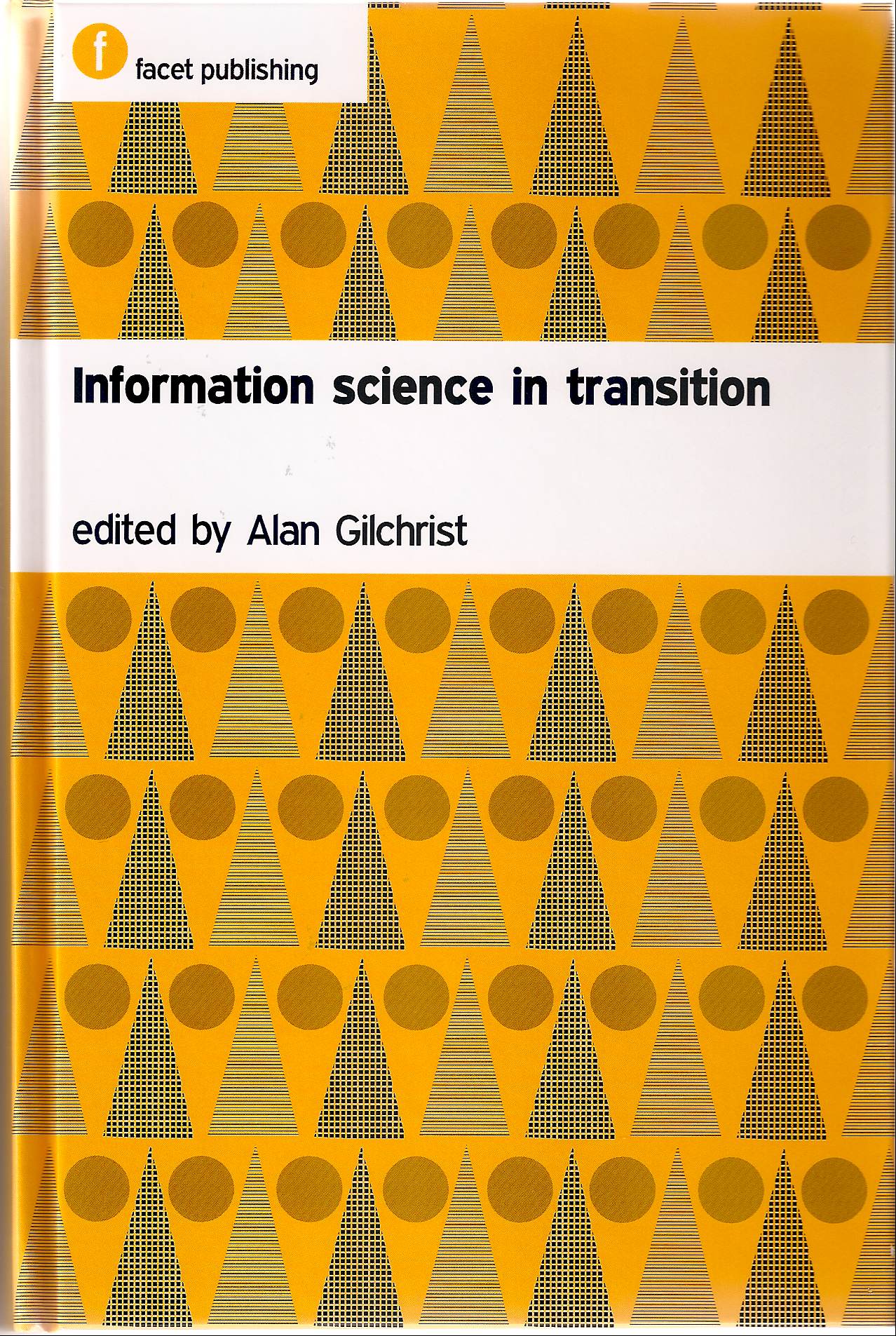
Information Science in Transition, Edited by Alan Gilchrist, Facet, 2009
This monograph, recently published by Facet, previously appeared as a special issue of the Journal of Information Science. The book serves as an excellent, contemporary text for Information Science, and we will be using it as a key work on our courses from the next autumn semester. Edited by Alan Gilchrist, the chapters are written by some of the most significant writers, researchers and thinkers within the field today, with the aim of documenting highlights from 50 years of ideas in information science.
 Dr Lyn Robinson