#HASlibcamp: a health and science library & information unconference

HASlibcamp

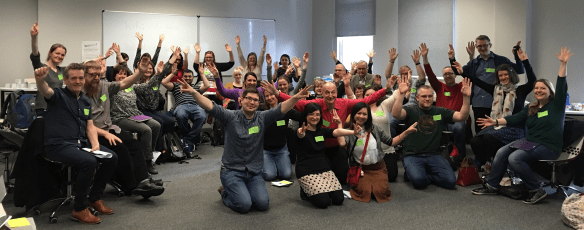
#HASlibcamp 2016 hosted by #citylis: photo by @lynrobinson cc-by

On 23rd April 2016, #citylis was delighted to host HASlibcamp, an unconference for health and science library information professionals. The day provided a unique, informal forum where over 40 colleagues from public, academic, NHS, charity and other library and information services came together to discuss current issues and catch up with each other. I was especially pleased to see so many #citylis former and current students at the event.

I am a huge fan of unconferences. The benefit to attendees of being able to suggest issues to discuss (pitch a session), rather than being faced with a ready-made agenda is enormous, especially for new professionals, and for anyone who feels their ideas and opinions get overlooked in times of management frenzy. Even for more established professionals, there is always much to learn by listening to what is of current interest amongst colleagues. From the point of view of a course director, I felt very lucky to be treated to such up-to-date ideas, which will certainly help with our quest for innovative content at #citylis!

This is not to say that conferences with fixed agendas are a bad thing in any way, but that the unconference format offers a great compliment to more formal outlets for professional conversations. In a session led by Gary Green (@ggnewed), on how public libraries can support health and well being, participants observed that there was not currently a forum where public library practitioners could meet with NHS or other health library staff to share good practice. A possible role for @CILIPHLG?

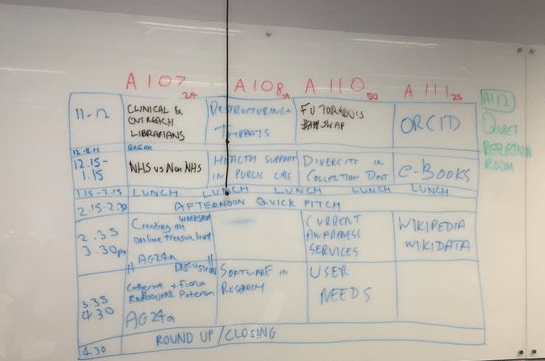
At HASlibcamp, I think we were able to accommodate all the sessions that were pitched, and I would certainly recommend that unconference organisers allow for as many physical spaces as possible, so that everyone’s ideas can be accommodated. Sometimes, it can be daunting to suggest or pitch an idea, incase no-one is interested, but the supportive atmosphere at HASlibcamp meant that everyone’s ideas gained an audience. Overall, the approach led to a marvelously diverse range of topics, shown on the image below. This range of topics highlighted the breadth of interests held by health and science LIS professionals, and is a fantastic testimony to the value of a career in LIS.
Session board

Session Board for #HASlibcamp 2016: photo by @lynrobinson cc-by

It occurred to me that in this kind of environment, it was easy to realize that none of us are the only person to face particular concerns –the feeling of not being alone is a significant factor in raising morale, and at a time when most LIS services face negative news about cuts in funding, de-skilling of staff members and devaluing of the qualified professional, this is very important.

Medical Information Resources

I have a longstanding interest in health and medical information, and I pitched a session on the ‘future’ of medical information resources. My focus was on ‘human documents’ or the quantified self. What does the proliferation of apps collating human data mean for LIS professionals? My wonderful colleague Ka-Ming Pang (@AgentK23) had the brilliant idea of talking about App Swap (#Appswap) – where libraries encourage sharing and exchange of ideas on health and medical related apps. We decided to combine our sessions, which resulted in a lively debate on how to stay up-to-date with new apps, understanding and promoting privacy, evaluating apps and the issues of who should recommend apps. Apps are used by many people, including students, and the library is rarely included in the choice of apps, or their evaluation. There is clearly a need for at least a framework of the issues this involves. Medical and healthcare apps collect personal information, and users need to be aware of not only what interpretation of the data means, but also of what happens to the information and who might benefit – insurance companies for example, might be very interested in blood glucose levels, fitness or sexual health indicators. Network security is rarely considered and many app users may be unaware of the amount of personal data that is being ‘leaked’ to third parties. A suggestion of using CASP like indicators to evaluate apps fed into a later session during the day.

[The idea of App Swap originated from the University of Brighton, which uses the same hashtage. Review of apps can be found on the St George’s University of London Library’s Guide to Mobile Resources.]

Sessions were allocated an hour for discussion, and it was a good sign that several sessions overran due to exuberant engagement and interest . Many more aspects could have been discussed and I think that HASlibcamp could have been extended to the whole weekend with no loss of interest. With regard to medical information resources, other topics which could easily have pervaded the whole day included genetic information, big data, neurological data, virtual reality and psychology. A huge field waiting to be explored. I am biased, I know :).

Other Pitches

There were many other topics of interest including diversity (@tashasuri), information literacy, the importance of software as a research output and the issues of adding approprite metadata (@biostew), current awareness, design of library induction session (Pirates!), preservation and access of games, and user needs. Those of you who need more should have joined us (!), but you can check out other blog postings and @HASlibcamp on Twitter.

Ambience

A short but significant mention should go to the amazing food sharing – the input from all attendees who brought food to share cannot be overstated. The food created a party atmosphere – it was great to see so many talented chefs strut their stuff. More. Food is a good thing! The need for a warm and positive atmosphere in the workplace is overlooked these days – this is a bad thing.

photo credit Andy Mabbett @pigsonthewing

Photo by Andy Mabbett @pigsonthewing

Organisers

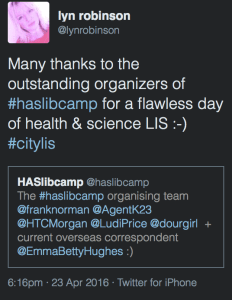
I would like to conclude with a massive thank you to the organizing team who made all this possible – events look like they emerge into the forest like mushrooms – they don’t. This event was down to:
Screen Shot 2016-04-25 at 21.50.46

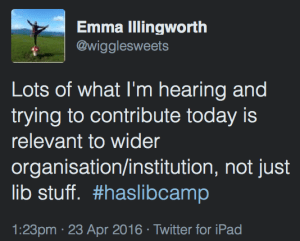
And finally – the value of HASlibcamp:
Screen Shot 2016-04-25 at 16.49.17

Last year #citylis hosted #citymash; you can read about it from Ludi Price (@ludiprice) and Kathryn Drumm (@dourgirl).

Here are more accounts of #HASlibcamp:
Lyn Robinson’s Storify

Emma Illingworth

thelibrarianerrant

Suzanna Bridge

HASlibcamp site list of write-ups and summaries

Waving Not Drowning

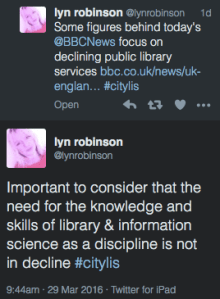
lyn's tweet feed from 29/03/16Unusually, libraries have been making the news this week. The publicity surrounding the BBC’s investigation into public library closures has generated much controversy about the – admittedly not new – phenomenon of the alleged decline of libraries and librarians.

Two responses come naturally to a provider of library/information education, concerned at the implication that we are educating students for a terminally declining profession. We can rebuke the sloppy journalism that writes of the decline of ‘libraries’ and ‘librarians’, when what is meant is the much more limited, though still important, context of the public library service in the UK. We can deplore the shallow voices that proclaim, as they have been doing for nearly two decades now, that we don’t need libraries any more, now that we have Google/Wikipedia/smartphones.

This though, isn’t really enough. Complain though we might about the limitations of reporting, and the ignorance of some commentators, we cannot ignore the dramatically changing library/information landscape, and we need to be continually reconsidering what we offer to meet changing demands. Not that we haven’t already been doing so; a post I wrote almost a year ago [Time for the Blue Whale] outlined our thinking of that time about the way library/information education needed to adapt. But, in view of the current bruhaha, it’s worth setting out how #citylis sees itself adapting to meet the challenges.

The five points here are really an elaboration of the ideas in my earlier post, not a replacement for them.

Wide horizons

We support public libraries, of course we do, and we object strongly to many of the more stupid attitudes being expressed at the moment. We cover public library issues on our courses, and will continue to do so. But only a minority of students will ever be professionally active in the public library sector. Along with many others commenting on the current controversy, we remind ourselves that the library/information sector is much bigger than this one aspect. Even if all public libraries in the country went out of business, which is unthinkable, there would still be a vibrant library profession, and a need for library education.

Wider horizons

As I pointed out in my earlier post, and as many others have reiterated, library/information skills are relevant, indeed increasingly relevant, way beyond the wider bounds of any conception of the library/information sector. Our subject is the whole communication chain of information recorded in documents. We will continue to emphasise these wider implications in our courses; both to cater for the increasing proportion of our students who do not see themselves as library/information professionals, and to help those who do prepare to support this wider application of our perspectives and skills.

We’ve been here before, but it’s different now

While it is idiotic to say that library are obsolescent because of Google and smartphones, we cannot, and do not, ignore the changes brought about by technology. We are unashamedly digital, and want all of our students to leave with a good appreciation of the possibilities of technology. For those who want it, we will be offering more opportunities for gaining skills in metadata, coding, data analysis, social media, and the like. But this has to be balanced by a continued interest in the historical core, and development of our subject; if we don’t know where we’ve come from, we can’t really understand where we are, still less where we’re going. New technologies and resources often do not bring new issues and behaviours; just a new variant on what’s gone before.

Making friends

Another thing that we have said before, but which is very relevant in thinking how library/information education can flourish in difficult times, is that we are a meta-discipline. Our concern is information and documents, but that gives us an overlap with several other disciplines. It is well-known that LIS has no unique place within the academic landscape, shown by the varied range of faculties in which the subject is placed in different universities. In our case, we overlap City University’s Schools of Technology and of Arts/Social Sciences. This could be seen a weakness, but we intend to turn it into a strength in our course provision, by involving the whole range of information interests, from performance art to robots, and from philosophy to cult media fans. Information is central to many conversations and domains.

Theory and practice

Something else we have emphasised in the past, but which will stand statement, is that we try to strike a balance between theory and practice in LIS education. If we were focused just on training our students for immediate practice, then we would rightly be concerned about the ‘decline of a profession’ headlines that we are now seeing (inaccurate though they may be). But we don’t do that. On the contrary, we focus very firmly on the body of theory, concepts and principles that will allow our students to thrive in the future information environment, however it develops and changes. That doesn’t mean that we neglect skills; on the contrary we are putting more emphasis on directly linking conceptual and skills-based materials, partly though curriculum changes and partly through addition of more optional workshops, seminars, etc.

So, it would be tempting to simply rail against those who wrongly report that all libraries are in decline, and that library/information professionals are no longer needed. But we prefer to acknowledge that, wrong-headed as many of their pronouncements are, there is a sea-change in the sector taking place. #citylis will change, and is changing, to meet the need for graduates with a thorough understanding of the world of information, and an ability to impact it. And the need for those people is increasing, not declining.

Don’t go to Library School: you won’t learn anything useful

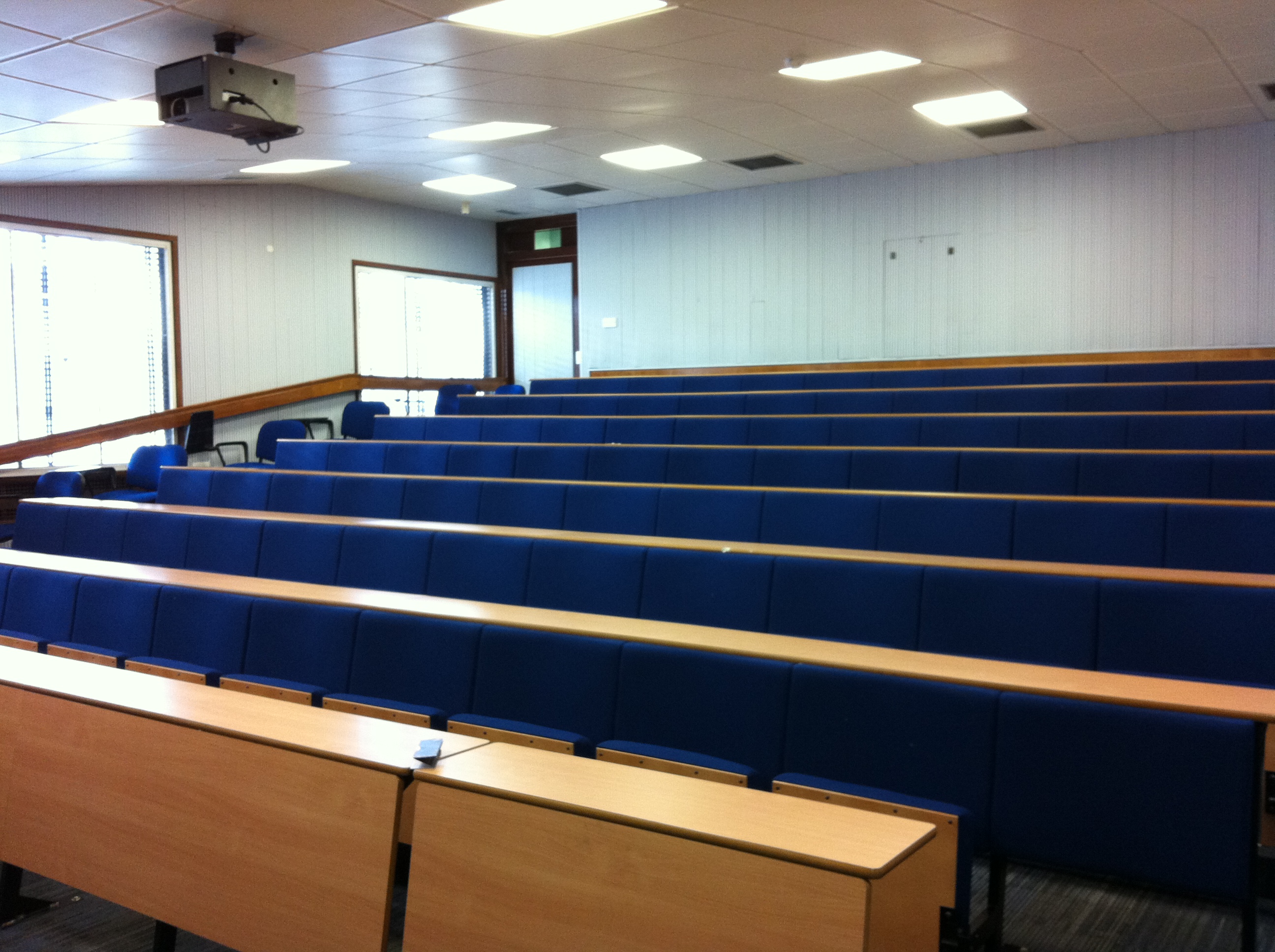
empty lecture theatre

photo by @lynrobinson cc-by


I keep hearing this, in a variety of guises. The dismissive certainty that library schools are out-dated in their understanding of how digital information has changed the modern world and its management of humanity’s record beyond recognition, and that LIS masters programmes produce graduates who are unemployable.

Having directed masters programmes in LIS for nearly a decade, I take a different view, and offer my firm belief that our library school, #citylis, delivers a sound contemporary understanding of today’s information landscape, and fosters a wide range of highly desirable professional and personal skills in our students. I doubt I am the only library school advocate, I know several colleagues from other schools who are equally passionate about their curriculum. At #citylis, we enjoy a constant dialogue with practitioner colleagues, our professional body (CILIP), employment agencies (Sue Hill, TFPL), alumni and current students, which allows us to elicit trends in technology, services, economics, user needs and other aspects of current practice. We are also avid horizon scanners, keeping an eye on the literature beyond the boundaries of our LIS discipline, to ensure we understand the wider context of what library and information science is trying to say. These combined activities result in a constant need to update our classes and materials, but we think our relevant, contemporary syllabus is worth it.

That is not to say that we offer everything to everybody. In the first instance, we work from a UK perspective, although within an international context, and secondly, our content is driven by the interests and backgrounds of our staff, and available resources, together with the primarily London-based collection institutions to which we defer for practitioner context. I don’t think any library school does, can, or even needs to offer an exhaustively comprehensive curriculum. Some variation between specializations of individual courses is perfectly acceptable, and even advantageous.

Our #citylis students are enthused, engaged and positive about their chosen discipline and profession, and the majority readily find employment, not only in the traditional areas of librarianship and information work, but across a wider range of information centred activities, such as publishing, information policy and governance, data management, information architecture, web-design, customer relations, training, user-support, and educational technology to mention just a few. All businesses rely on sound information management, so the future should be bright for well qualified graduates from LIS schools.

And yet, there are still doubters in the back channels. I recently read Deanna Marcum’s clearheaded report “Educating the Research Librarian: are we falling short?” Within the scope of research libraries, and with a US focus, this well written report of a conference aiming to use design techniques to map the future of library education, suggests that the problems stem from the broad scope of LIS itself:

“Perhaps the diverse backgrounds of the participants guaranteed the utter impossibility of developing a general curriculum that will meet all needs. For many of the younger representatives, technology was the main concern. How do we prepare new professionals to take full advantage of social media and emerging technologies to deliver information services to all who need them? Library buildings, legacy collections, and preservation— these were all topics that hardly registered on their list of interests. Nicholas Negroponte of MIT’s Media Lab argued passionately that the purpose of a library and information school is to produce a cadre of individuals devoted to the universal right to access to information. Public librarians at the conference believe that new librarians must be trained as community activists focused on civic discourse. With no common vision for the library’s role, there could be no agreement on how library schools should prepare the next generation of students.”

I have also read posts from library school curriculum dissenters on Twitter, in blog posts, and have verbally heard discontent from potential employers working in the sector. In response, I have informally attempted a wider conversation to solicit the actual knowledge, skills, understanding or abilities that library schools fail to provide. Responses to my question “what knowledge and skills do LIS graduates need that they don’t get from library school?”, are often vague, but some are highly sensible and relevant, including: a clearer focus on the implications of the transformation of information communication pathways brought about by digital, the subsequent changing expectations of users of library services, designing systems and processes for information management, information architecture and research data management.

Unsurprisingly, the majority of these specific suggestions have a technological focus, and I am in complete agreement with the necessity for LIS courses to acknowledge the significant changes affected by digital advancement. Indeed, over the last two years, colleagues and I have already gone a long way to enhance our library technology focus, via curriculum design and out-of-hours workshops and seminars.

A significant number of dissenters cite a lack of emphasis on more generic skills such as how to use a spreadsheet, marketing and promotion, design of promotional material, and communication skills. Communication skills covers many areas; ability to write well, ability to make a convincing case/argument (advocacy), ability to lead, to work in a team, ability to analyse, interpret, present and communicate data, ability to teach, ability to attract funding, and all-round social know-how. Knowledge of the company and its ways of working, was a favourite request, but here there was agreement that this could only be attained once a graduate was employed by the specific company. The generic skills outlined above, are all valid and important. The question here is which of them should be included in the LIS curriculum. Most (UK) masters programmes are a year long, and the schedules are already tight. Inclusion of more generic skills invariably means something else must be excluded. And, of course, there are other aspects of LIS to be fitted in, in addition to the purely technical aspects, and the generic.

At #citylis, we are keen to get this right, and would be willing to host a forum/meet-up where employers, professional bodies, students and programme directors can meet to discuss the role of LIS courses in preparing new professionals for work in our sector. Students, I am sure, would welcome this dialogue. Such a discussion is likely to stir up the longstanding tension between the demands of an academic masters course to cover theory and concepts, research methods and ideas found at the edge of our literature, versus the demands of employers for graduates who are ready to go from day one. But, a debate could surely only aid the smoothing of joins between the two halves of the whole. If anything it would allow us to re-examine ‘essential’ knowledge and skills, which need to be explored in the masters programme, alongside areas which could be covered by continual professional development, or in-house training.

To conclude, here are a few of the areas we feel are presing at #citylis. Some of them are newish, some of them of longstanding centrality to our work:

  • communication – traditiona/social media
  • research skills
  • information literacy
  • digital culture
  • scholarly communication
  • data analysis and presentation
  • digital curation and research data management
  • information resources – documentation
  • information organisaton – metadata
  • human information behaviour
  • information law, policy and management
  • information and communication technologies
  • role of library and information services in the 21st century

#citylis logo

Thanks to Dave Thompson (@d_n_t) for ideas.