Growing Knowledge – views please

Growing Knowledge: The Evolution of Research

My colleague, Pete Williams, at UCL, is evaluating this British Library exhibition, which runs between 12 October 2010 – 16 July 2011. Please go along and support the future of research!

The Growing Knowledge exhibition will demonstrate the vision for future digital research services at the British Library, and provide a test bed for the evaluation of digital research tools and services that have the potential to support researchers’ needs. The exhibition will consist of a number of features including digital signage, video demonstrations, interactive welcome animations and a prototype “Researcher’s Desktop” application.

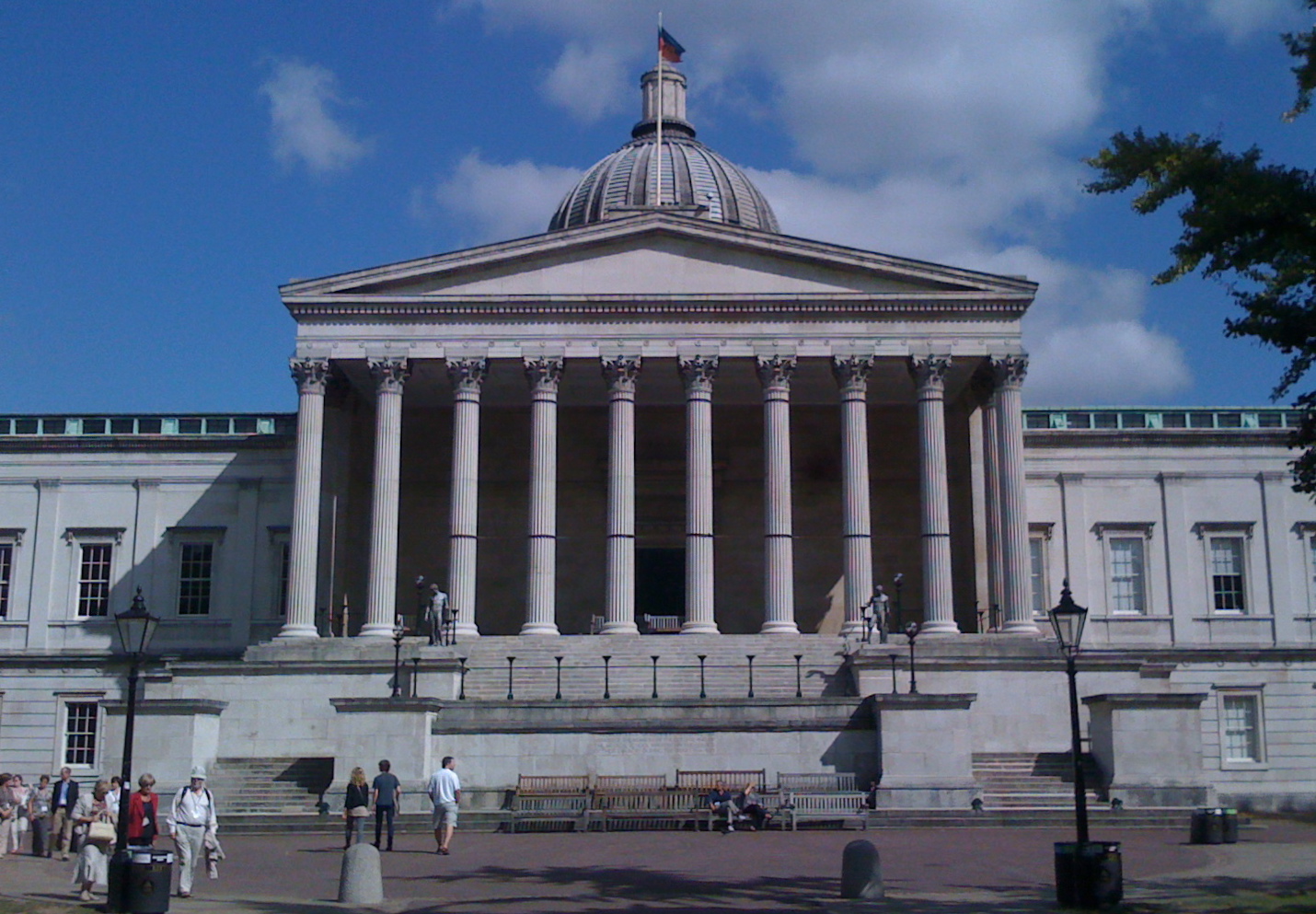
We at University College London are evaluating the exhibition, and would like to invite you to visit it and to give us your views. Your visit will allow you to sample each of these components. A researcher will be at the exhibition, and we hope that you will be able to talk to him briefly to tell him what you think of the exhibition.

The programme for each event will be as follows:

11.00: One of the curators will give an introductory talk about the exhibition
11.15: There will be an opportunity for you to explore the exhibition and try out the digital facilities. Our researcher may wish to talk to you about your views on the various exhibits.
12.30: Event closes.

A link to a short questionnaire will be sent to you very soon about your views on the exhibition and the issues raised.

Please register at: http://blgrowingknowledge.eventbrite.com/

For further information please contact us at: growingknowledge@bl.uk or peter.williams@ucl.ac.uk

Digital Native or Digitally Naive: Library and Information Services for the Next Generation #2

I spoke at this meeting, organised with considerable flair and efficiency by the East of England Information Services Group of CILIP, earlier this week. It was good to see that the many delegates were such enthusiastic futurists, that the scope for creative library services is still yet to be exhausted, and that the concept of the ‘google generation’ was largely regarded to be a myth.

I talked around the concept of ‘influences’; the idea being that in order to say something about the services which will be needed in the future, we should consider factors influencing the information communication chain in the present. I usually suggest we pay attention to issues within the realms of technology, society, politics and economics, although others may hold that alternative or additional forces are at work.

Whilst it is holistic to consider each aspect of the communication chain, [authorship, publication/dissemination, organisation, indexing/retrieval and use], it is perhaps not unexpected for library services to prioritize their users; what sort of characteristics are engendered by exposure to technology, politics, economics and society ? This query is embedded in concept of ‘generations’, currently a popular field of writing and research within library and information science.

The ‘generations’ theme purports that we are products of the influences to which we were exposed in our formative years (I would take this to mean from childhood to mid-twenties, but again, others may have their own understanding and I have not found a definitive answer yet). The well known phrase ‘baby-boomers’ has been joined with categories including ‘veterans’, ‘generation X’, ‘generation Y’, millenials, and ‘generation Z’ or the ‘Google Generation’, and there are others. These time-related slots are intended to contain people whose formative years occurred at a particular point in time, and thus whose influences would have been similar. Alas, like any attempt to organize, there are problems, in that there is considerable variation in the definition of the categories and their time limits, and that there are people whose ‘formative years’ extend well beyond the boundaries of decency. Whilst many of us were exposed to glam rock idols such as T-Rex and Sweet once a week on the telly, (ha ! look them up …) – we are nevertheless content to download the angsty Kings of Leon onto our iPods any time we want, 30 years later. In spite of their early years, people can adapt. We can all be classed as members of the ‘Google Generation’ as we all use Google to our benefit. However, the advent of services such as StreetView and Google Books raise important questions, and not just those of privacy and copyright. We have to consider the impact of access to just about anything and everything in digital format – by anyone, from anywhere. What role will the library have when books can be downloaded to ebook readers – when social networks such as those offered by LibraryThing replace so much of what we offer ?

But – if we take a broader look, the concept of generations can be helpful. Not everyone adapts to technological changes, menu hierarchies rather than analogue choice. There are still those who search out books. At the other end of the spectrum, those used to instant, often non-contextualised answers and virtual worlds may require something different. It is easy to imagine that differences are dictated by ‘technological’ age – but there are other influences on both users and on the information communication chain which we can also take into account.

Economics affects us all; broadband is easy but expensive. Borrowing books saves money and communities fight bitterly to keep their public libraries. Academics publish in their own repositories rather than via commercial journals. Changes in society such as increasing isolation, limited income, the need for inspiration, affect the design and provision of public spaces, many of us drawn to buildings with a particular atmosphere and ambiance. Government policies such as increasing use of web technology to communicate with the populace and increasing the numbers in higher education, also effect the needs of users and consequently the services that our libraries should offer.

I concluded with Library 2.0 – a term I resisted at first, but one which now I think summarises how we could behave, even if it is not, as many have said, a new paradigm, and even if it only tells us how to discover services for the next generation, rather than telling us what they are.

Library 2.0 then :

– continually and purposefully changing the way libraries do things
– giving better service to existing users and attracting new ones
– improving communication between the library and its users
– encouraging users to participate in the design and delivery of services
– making good use of technology and digital information
What is the Library of the Future ?

I was a last minute attendee at this debate this afternoon, held at the Martin Wood Lecture Theatre at the University of Oxford. The webpage can be accessed here: Libraries of the Future

The event was organised jointly by JISC and the Bodleian Library, and was well worth my temporal effort not only for the content, which was highly relevant for my current module, libraries and publishing in the information society, (LAPIS, INM380), but for its exemplary use of web 2.0 technology as a communication tool. I was treated to a clear demonstration of what we all suspect is possible but never have the time to do – although you do need the resources of Oxford University to pull it off.

Firstly, streaming video. Worked really well, and shy people were able to watch remotely from behind their computer screens, whilst the rest of us sat under the glare of the cameras from every angle. I could start about privacy here, in that it is now impossible to even attend a professional meeting without being captured on camera, irrespective of whether or not it is a bad hair day.

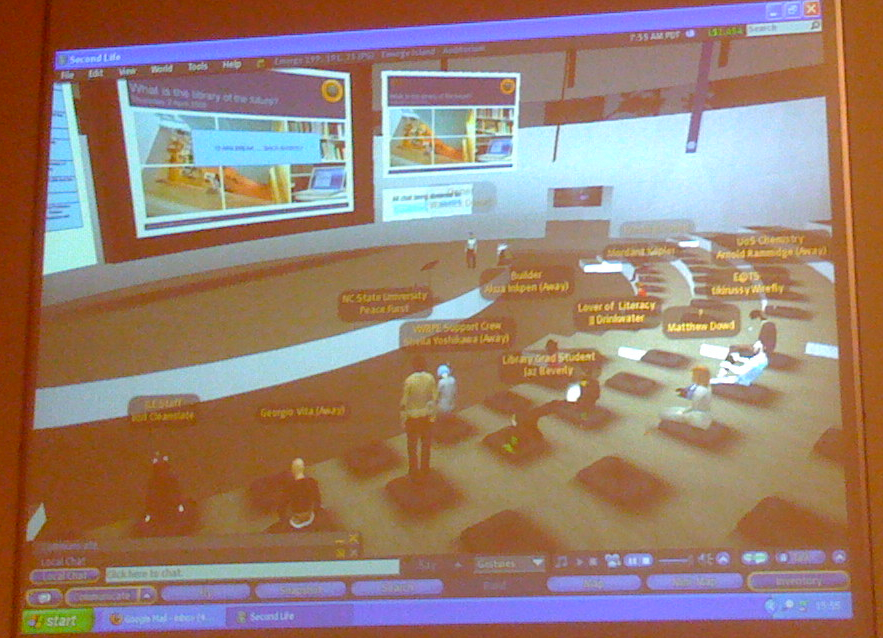
Nontheless, in addition to the video, virtual attenders could comment to the blog, tweet, or chirup from second life. There were about 30 second lifers and this was my first view of the cartoon world on the big screen. Brilliant – especially the guy with the glowing mohican hair who sat on the edge of the stage and the guy who I guess was smoking in a blissfully virtual audience. Masses to distract me from the actual presentations, which I believe will be added to the JISC event archive (videos, podcasts, ppts and pdfs). Good thing too as keeping one eye on the one liners from the stay at home commentators meant I kept losing track of what the speakers were saying – this stuff would really suit the attention deficit generation.

librariesofthefuture

librariesofthefuture

I overheard someone complaining that twitter was just an outlet for adolescent rantings and un-funny wisecracks. Surprisingly I found myself silently coming down on the side of the one-liners – twitter at least gets people involved and honestly we cannot encourage the chat police – but I wonder if these endless viewpoints distract more attention away from the talks than they contribute?

Anyway – back to the future. In essence it seems that libraries have to keep up with the expectations of their users or the users will vote with their feet.

However, many users already rarely use their feet and remain firmly welded to their desktop keyboards when searching for information. There was some sense that users don’t know what is good for them, and that libraries must show them the way to search properly – but honestly, I have an idea that quite a few users do pretty well on their own. Peter Murray Rust gave a lively presentation (tweeter: “this guy is passionate..”) which demonstrated how users of scientific, technical and medical information were doing it for themselves by designing the information services they really wanted. This was backed up by a demonstration of several chemistry related services, and the excellent openstreetmap.org. Peter used his blog to showcase his presentation, rather than powerpoint, to good effect, so here is the link.

Santiago de la Mora explained that Google was busy digitizing the contents of lots of libraries anyway, (“to improve search”), and that Google Books would open up new things for us to do with electronic texts of out-of-copyright books. A link in WorldCat alerts us to Googlised items, and an option to “buy now”. I did agree that this would open up access to the ‘longtail‘ of many customers wanting idiosyncratic items though.

An excellent summary of the Librarian Perspective was given by the Director of the Bodleian, Sarah Thomas: “A guy opens his door to find the grim reaper standing there. Ashen faced, he calls his wife over. She says ‘don’t look so worried dear, change is good….'”

The Public Sector Perspective was given by Chris Batt (ex MLA Council) – a podcast of his views (recorded before the event) can be listened to here.

There was lots more – but have a look at the JISC site for the actual presentations. But before you start thinking the future is now, today’s Times runs an article by David Rowan entitled “The suits come to Second Life. Now its dying“. Essentially, the avatar with the mohican is likely to be your lecturer. Time for the next big thing.