Documentation in the post-factual society; or what LIS did next (after Brexit)

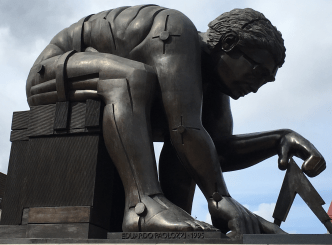
Newton

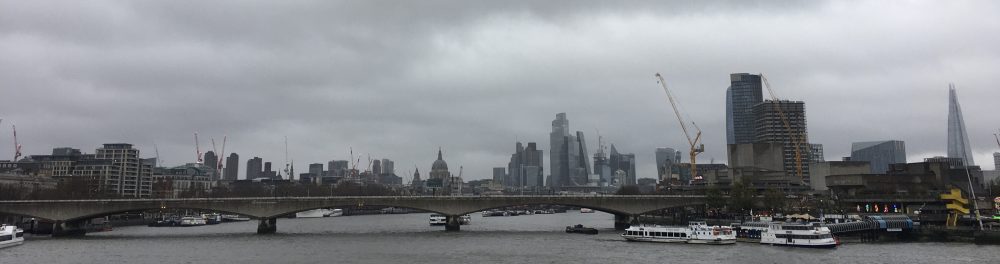
Photo by @lynrobinson cc-by

It has become something of a truism that LIS has rather lost its way. The importance of the information professional role is generally believed to have been diminished by the ready availability of digital information, particularly through Google, Wikipedia and social media, while news from the formal library sector is increasingly of closures and mergers. Not surprisingly, the underlying library/information discipline wonders what its purpose is, what it is educating for, and researching about. This is not new, but the concerns have now become more pressing.

One response, with which we identify, has been to suggest that we return to our turn-of-the-twentieth-century roots, and focus on documentation; the study of the varied forms and genres of documents which carry recorded information. This seems particularly apposite in light of the novel forms of complex digital documents now emerging, which traditional LIS is ill-equipped to handle, both in theory and in practice.

More broadly, we might see this movement framed within a wider set of social issues and problems, which we might categorise as those of the post-factual society.

The phrase “post-factual democracy”, now in wide circulation, seems to have risen to prominence in 2013, apropos of the ‘infostorm’ phenomenon, the multiple repetition of an idea on social media:

“Infostorms may be generating a new type of politics, the post-factual democracy. Facts are replaced by opportune narratives and the definition of a good story is one that has gone viral”

V.F. Hendricks, All these likes and upvotes are bad news for democracy

It has come into more frequent use in 2016, particularly in conjunction with Donald Trump’s candidacy for the US presidency, and the referendum decision for Britain to leave the European Union.

However, other variants are older. The term ‘post-factual age’ appears in 1999 (C Bybee, Can democracy survive in the post-factual age? ), and ‘post-factual era’ in 2007 (D. Sirota, Welcome to the post-factual era.)

The phrase “post-factual society” has contemporary popularity, used, for example, in an MTV report in July 2016,  although “post fact society” was used in the title of a 2008 book.

While all these terms seem to have much the same import, “post-factual society” seems most appropriate for the perspective of LIS, with its emphasis on making accessible the (at least partly factual) records of society.

What this means was shown in sharp relief in the political campaign which culminated in the referendum on Britain’s membership of the European Union in June 2016. It is generally agreed that the information available to the public during the campaign was accompanied, on both sides of the issue, by a great deal of misinformation (unintentionally false and/or misleading) and disinformation (deliberately false and/or misleading). Two widely publicised events threw light on the post-factual nature of the debate. One was the suggestion by Michael Gove, a leader of the Leave campaign that the public had had enough of experts. The second, the revelation that many British internet users searched for “what is the European Union” in the the days after the vote. Social media also played a major, and, in the views of many a malign, part in the campaign.

There are other, perhaps less dramatic, observations supporting the idea of the post-factual environment. One is the decline in fact-based news reporting, replaced by comment and supposition around a small amount of information (or misinformation, often) spread through the multiple reproduction of an initial report or press release, and lacking fact-checking or research in relevant information sources (K Schopflin and K Stoddard, The news librarian, CILIP Update June 2016, pp 28-30). Another is the reliance on social media for information of all kinds; while undoubtedly rapid, easy to consume, and able to be filtered according to taste, this works against the need for considered rational material, with an openness to views outside one’s filter bubble. Finally, there might be mentioned the inarguable move to a generally shallow, light or distant reading of materials of all kind, exemplified by a reliance on headlines, tweets, updates, snippets in internet news, and on abstracts for professional materials.

What might the response of LIS be to this complex of issues and problems? The problem is certainly not one of a lack of information; arguably the reverse. The response of the library community in particular over the past decade to information overload has been the enthusiastic advocacy of information literacy, with a focus on the selection of ‘good’ sources, and the evaluation of information. While this is no doubt of value, particularly in the educational settings where it is most strongly espoused, it seems too limited an approach to make much headway in a wider post-factual context.

We have argued that LIS should take as a major task, indeed perhaps as its main role, the promotion of understanding, as a replacement for the previous task of the provision of information. Understanding is, ironically enough, a poorly understood concept, and there is scholarly work to be done in capturing exactly what it means, from a documentation perspective, and hence how it may best be promoted. However, it seems likely that it will certainly involve two aspects. First is the development of information fluency: the conceptual grasp of the world of information, in its new digital environment with its new forms of document. Second is the complementary development of digital literacy; the set of skills necessary to navigate, to access and contribute to, the new information environment. These need to be studied and taught within LIS academic departments, and then promulgated through society generally by practitioners. This is certainly not a matter of attempting to go back to some golden age of universal deep reading of the kind of documents familiar in the pre-Internet age; the world has moved on from that, and will not go back. Rather, it is an attempt to help society to regain the fluent and effective dealing with information which has, to a significant extent, been lost in these post-factual days.

But together with these conceptual and practical concerns should go a specific ethical, and arguably political, commitment to oppose and to counteract the post-factual tendency and its proponents. The latter include much of the media, and some highly placed political figures, as well as the section of the population which prefers not to have to engage in rational fact-based debate.

It may reasonably be said that these are not wholly new tasks or perspectives for LIS; and indeed one may find analogies going back to the origins of the public library movement in the nineteenth century, if not before. But the social transformations which we are now seeing lend a new urgency. The transformation of LIS into a subject based around the principles of documentation, and with the primary aim of promoting rational understanding in society, is a necessary response.

——-

Note: The nature of LIS as a discipline and its relevance to practice is one of my research interests, and I often write and speak about the content and boundaries of the subject, and the design of LIS curricula.

Here are some of my previous posts around this topic:

30/03/16 Waving not Drowning

10/05/15 Don’t go to Library School, you won’t learn anything useful

08/03/2015 Time for the blue whale

17/11/2014 21st Centruy Library & Information Science

18/03/2014 My name is Lynxi, I am an academic

——-

If you are interested in studying for your masters in LIS, I give regular presentations on the discipline, careers and our course content at our #citylis open evenings, which are held in November, April and June at City University London as part of their postgraduate open evenings. Check the website for the next date – free but you need to register.

Fanfiction in the Library

LR:LP title slide #fsn2016

Image of title slide, created by @ludiprice

Here is a brief synopsis of the paper which @ludiprice and I presented at the Fan Studies Network Conference, University of East Anglia, 25th-26th June 2016. We are hoping to publish the full paper in the conference proceedings. Further information about the conference can be found on the Fanstudies Network site, and on Twitter #fsn2016 .

In our 20 min session, we outlined and discussed the results of a small study that aimed to take a snapshot of the extent to which libraries within the UK collect fanfiction, and to gain some insight into the reasons behind this.

The study is part of a wider investigation into the information behaviour of cult-media fans. The first two stages of this three-part research project are described in:

Price L  and Robinson L (2016). “Being in a knowledge space”: information behaviour of cult media fan communities. Journal of Information Science (in press). http://openaccess.city.ac.uk/14906/

Background

The question of fanfiction in the library arose from a somewhat anecdotal feeling that general knowledge of, and interest in, fanworks has increased significantly over the past five years. This time period is notable to us as the timeframe during which we have discussed and collaborated on communication of fanworks. Over this time, there has been an increase in reporting of fanwork related news and issues in the media, doubtless fuelled by the encroaching of a previously niche domain into mainstream concerns including copyright and publishing, media industry interest, education, and policy development.

Additionally, conversations with Library School masters students over the years revealed increasing awareness of, and active participation in fandom, although we have no hard data to enable us to compare cohort awareness and involvement over the past 5 years.

Despite the expanding reportage, discussion and engagement with fanworks, collections and collection policies for fanfiction, perhaps the most notable subset of fanworks, within memory institutions in the UK seemed scant, although we were aware of  notable zine collections in the US, and the zine/fanzine collections at the London College of Communication, and at the British Library.

In order to gather some empirical evidence about the extent to which fanfiction is considered by the library and information (LIS) sector, we carried out a small investigation comprising a literature review, examination of a sample of collection policies, and a survey of members of our Library School cohort.

Findings

Our survey of both the LIS and fanstudies literature found very little on the generic concepts of collecting fanfiction, confirming our view that formal collection of fanfiction, let alone fanworks, is somehow overlooked by the mainstream LIS sector, and that there is little dialog between the LIS discipline and the community associated with fanworks. We did find some papers concerned with the specific zine collections that we were aware of, (Sandy Hereld, University of Iowa) and we also encountered reference to the ‘anti-collection’, where archives and collections are maintained by those outside the main memory institutions; in this case, the fans themselves. Indeed, fans do an excellent job of collecting and organising fanworks; some collections, such as Archive of Our Own rival professional digital archives. Nonetheless, most such collections rely on ad hoc funding and resources, often personal, and can disappear overnight.

The literature gave us several indications as to why fanfiction is largely ignored by libraries:

  • Not proper books
  • Does not fit library processes
    • No ISBN
    • No standard metadata
    • Not available through standard acquisition processes
  • Concerns about intellectual property

Nonetheless, despite the lack of representation of fanfiction collecting or collections in either the LIS or fanstudies literature, there was evidence that libraries are showing an increasing interest in catering for fans as library users: recommending sources and examples of fanfiction, using fanfiction as literary instruction, and running in-house fan events.

Examination of a representative sample of of UK library collection policy documents confirmed what we found from the literature, that fanfiction is not formally collected. The main fan-related collections in libraries are fanzines.

In order to understand the reasons behind this paradoxical situation, where there is a noticeable body of work and interest in fanfiction, and yet a limited interest from the LIS community, we invited our current library school students, and alumni to complete a short, online questionnaire. The idea here being that our cohort represents the next generation of library and information professionals, and their views on fanfiction would therefore be likely to be representative of future collection policy.

The survey showed that although 88% of the 25 respondents had heard of fanfiction before joining the course, and 59% read or had read fanfiction, only 52% felt that memory institutions such as libraries should collect fanfiction.

Thus, despite a high awareness and engagement with fanfiction, opinion on its value as cultural heritage was mixed. Reasons for this correlated with the reasons ascertained from the literature review. One participant suggested:

 I’m torn on the subject. On the one hand it is an important cultural institution at this point, and provides wonderful insight for those studying fanworks, feminism, LGBT issues among other subjects. On the other hand, part of the reason fanfiction is so diverse and weird and sprawling is its inherent illegality and not-for-profit status.

Conclusions

There are no national plans or policies for the collection of fanfiction within the UK. At institutional level, some collections of fanzines exist, but the limited collection, indexing, archiving and preservation of a wider selection of works leaves a black hole in our cultural heritage. Fanfiction, and indeed all fanworks, instantiate a significant body of creative talent across a wide variety of disciplines including art, creating writing, poetry and music. The technical skills needed to create fanworks can be considerable, involving sound, video, animation and a high degree of internet, web and social media savvy. It is perhaps worth considering whether more should be done to comprehend the scope of fanworks, and to at least understand what we are not collecting.

The issues associated with collection of fanfiction and fanworks are inarguably complex. The body of work is enormous, and institutions are pressed for resources. Funding for this type of research and practice is minimal to non-existent. There are not just digital works to consider, many works exist only in printed, analogue format, often in limited quantities.

Two main areas for further investigation arise from this study.

First is the set of questions regarding copyright and publishing. Although fanworks are challenging restrictive limitations on creativity, distribution, and commercial activity, little seems to be changing in reality, and the issues surrounding the rights of canonical authors are important and valid.

Secondly, is the question of how we define documents. Although memory institutions include analogue and digital media, such as images, audio and video, in addition to printed documents in their collections, the rapid escalation of digital resource formats is challenging how we define a ‘document’, and hence what we collect. Many fanworks are multimodal texts, and others can include art installations, performance art and performances. The increasing availability of technologies associated with virtual and augmented reality offer yet more possible media formats for fanworks. The question is not only should we collect and preserve these works, but how.

The initial question of fanfiction in libraries is deceptively simple, and not one which will be answered by either the LIS or fanstudies disciplines alone. We suggest that it is a conversation that we should have together.

FSN2016

Photos by @lynrobinson cc-by


Waving Not Drowning

lyn's tweet feed from 29/03/16Unusually, libraries have been making the news this week. The publicity surrounding the BBC’s investigation into public library closures has generated much controversy about the – admittedly not new – phenomenon of the alleged decline of libraries and librarians.

Two responses come naturally to a provider of library/information education, concerned at the implication that we are educating students for a terminally declining profession. We can rebuke the sloppy journalism that writes of the decline of ‘libraries’ and ‘librarians’, when what is meant is the much more limited, though still important, context of the public library service in the UK. We can deplore the shallow voices that proclaim, as they have been doing for nearly two decades now, that we don’t need libraries any more, now that we have Google/Wikipedia/smartphones.

This though, isn’t really enough. Complain though we might about the limitations of reporting, and the ignorance of some commentators, we cannot ignore the dramatically changing library/information landscape, and we need to be continually reconsidering what we offer to meet changing demands. Not that we haven’t already been doing so; a post I wrote almost a year ago [Time for the Blue Whale] outlined our thinking of that time about the way library/information education needed to adapt. But, in view of the current bruhaha, it’s worth setting out how #citylis sees itself adapting to meet the challenges.

The five points here are really an elaboration of the ideas in my earlier post, not a replacement for them.

Wide horizons

We support public libraries, of course we do, and we object strongly to many of the more stupid attitudes being expressed at the moment. We cover public library issues on our courses, and will continue to do so. But only a minority of students will ever be professionally active in the public library sector. Along with many others commenting on the current controversy, we remind ourselves that the library/information sector is much bigger than this one aspect. Even if all public libraries in the country went out of business, which is unthinkable, there would still be a vibrant library profession, and a need for library education.

Wider horizons

As I pointed out in my earlier post, and as many others have reiterated, library/information skills are relevant, indeed increasingly relevant, way beyond the wider bounds of any conception of the library/information sector. Our subject is the whole communication chain of information recorded in documents. We will continue to emphasise these wider implications in our courses; both to cater for the increasing proportion of our students who do not see themselves as library/information professionals, and to help those who do prepare to support this wider application of our perspectives and skills.

We’ve been here before, but it’s different now

While it is idiotic to say that library are obsolescent because of Google and smartphones, we cannot, and do not, ignore the changes brought about by technology. We are unashamedly digital, and want all of our students to leave with a good appreciation of the possibilities of technology. For those who want it, we will be offering more opportunities for gaining skills in metadata, coding, data analysis, social media, and the like. But this has to be balanced by a continued interest in the historical core, and development of our subject; if we don’t know where we’ve come from, we can’t really understand where we are, still less where we’re going. New technologies and resources often do not bring new issues and behaviours; just a new variant on what’s gone before.

Making friends

Another thing that we have said before, but which is very relevant in thinking how library/information education can flourish in difficult times, is that we are a meta-discipline. Our concern is information and documents, but that gives us an overlap with several other disciplines. It is well-known that LIS has no unique place within the academic landscape, shown by the varied range of faculties in which the subject is placed in different universities. In our case, we overlap City University’s Schools of Technology and of Arts/Social Sciences. This could be seen a weakness, but we intend to turn it into a strength in our course provision, by involving the whole range of information interests, from performance art to robots, and from philosophy to cult media fans. Information is central to many conversations and domains.

Theory and practice

Something else we have emphasised in the past, but which will stand statement, is that we try to strike a balance between theory and practice in LIS education. If we were focused just on training our students for immediate practice, then we would rightly be concerned about the ‘decline of a profession’ headlines that we are now seeing (inaccurate though they may be). But we don’t do that. On the contrary, we focus very firmly on the body of theory, concepts and principles that will allow our students to thrive in the future information environment, however it develops and changes. That doesn’t mean that we neglect skills; on the contrary we are putting more emphasis on directly linking conceptual and skills-based materials, partly though curriculum changes and partly through addition of more optional workshops, seminars, etc.

So, it would be tempting to simply rail against those who wrongly report that all libraries are in decline, and that library/information professionals are no longer needed. But we prefer to acknowledge that, wrong-headed as many of their pronouncements are, there is a sea-change in the sector taking place. #citylis will change, and is changing, to meet the need for graduates with a thorough understanding of the world of information, and an ability to impact it. And the need for those people is increasing, not declining.