
On Background Reading for Library and Information Science

Introduction
There is never less to read – only more. I sometimes use those historical quotes in my lectures which show how famous people throughout time also felt they lived with too much information, and that our concerns about there just being too many books are hardly new. I offer the usual advice of the need to be selective, and emphasise that the ability to choose reading materials is a fundamental skill for the information worker. I would go further, and argue that it is a fundamental skill for all – but already I am veering off into the waters of information literacy, when all I want to do is to say something brief and informative about background reading for library and information science.

This post is for those of you who are joining one of our LIS masters courses this September, or those who are interested in learning a bit more about library and information science as a subject. I don’t mind if you are going to study LIS at a different institution – these personal recommendations should still work.

The most important book
Obviously our own “Introduction to Information Science”. I am a shamelessselfpromoter, and will often wear sequins to get attention. But, the book has emerged from around 60 (combined!) years of thinking and writing about information science; what it is, how it relates to library science (and other related subjects), its main components, protagonists, its past, present and future, and how it can be presented within the context of an academic masters course.

Neither DB nor myself imagine our book to be the last word in information science. It is not the first either! Rather we set out a contemporary landscape, and signpost many other resources and references. Since we signed off on the text, vowing ‘never again etc.’, we have thought of far more to add – there may be a second edition – but at least for the forthcoming academic year this will do for starters. The chapters do not correspond exactly with modules offered on the City courses – there are more modules than topics we cover. The content (listed below) does however, reflect what we believe to be the current core of Library and Information Science, and it should therefore be of interest to anyone who, for whatever reason, finds themselves concerned with LIS:

1: What is information science? Disciplines and professions
2: History of information: the story of documents
3: Philosophies and paradigms of information science
4: Basic concepts of information science
5: Domain analysis
6: Information organisation
7: Information technologies: creation, dissemination and retrieval
8: Informetrics
9: Information behaviour
10: Communicating information: changing contexts
11: Information society
12: Information management and policy
13: Digital literacy
14: Information science research: what and how?
15: The future of the information sciences

I should add that we are privileged to have a collection of forewords to the book, all written by internationally famous LIS professionals, and obviously friends of ours.

Other background reading
I am often asked to recommend background reading, or ‘summer reading’. I love making these suggestions as it gives me a chance to enthuse about things I have read in the past, or just come across recently. I enthused about James Gleick’s “ The Information” for about a year before it was published.

My short-list of four for this summer is shown below – although I am always changing my mind according to what comes to my attention. Ours is not a dull subject, nor one that is short of lovely new volumes. I have a lot of books. I think one of the key attractions of LIS for me is that information communication spans each and every subject, so there is usually something tempting, even if you are into cult fanfiction and rarely step away from  Archive of Our Own. The task here is to be brief yet inclusive – although anyone else will give you a different selection. And you are completely free to undertake your own voyage around the catalogues and byways to fit your own intellectual preferences once you get started.

I haven’t included journals, conferences, great bloggers or folks to stalk on twitter – wait until you get the course reading lists for those.

  • Briggs A and Burke P (2009). A Social History of the Media: from Gutenberg to the Internet. 3rd Edition. Polity: Cambridge.

This will get you thinking about how information communication works in society, and its tenacious relationship with publishing.

  • Chowdhury G G et al. (2008). Librarianship: an introduction. Facet: London.

This is the book to start with if you would like to compare our view of LIS with another one. Gobinda Chowdhury is an excellent writer of textbooks and you can add anything of his to your bookshelf with confidence.

  • Floridi L (2010). Information: a very short introduction. OUP: Oxford.

The philosophy of information informs our decisions and work with the field of library and information science. This book is the best introduction to the concept that I have read.

The ‘very short introduction’ series from OUP is addictive and it is likely that you will come away with a small collection. Here is another:

  • Ince D (2011). The Computer: a very short introduction. OUP: Oxford.

If you are nervous about having to understand how a computer works – this will reassure you – and this is more than enough for now. Remember, computers are pervasive. There is nowhere to hide from technology, especially in LIS.

Do you want more? My collection on LibraryThing
There is always more.  If you are joining us in just over a month then you can simply wait for your reading lists and lecture notes, but if you are impatient and greedy for books then you may wish to take a look at my LIS collection on LibraryThing.

http://www.librarything.com/catalog/lynrobinson and http://www.librarything.com/profile/lynrobinson

LibraryThing is an application which allows you to create a catalogue for your own personal use, or perhaps for a small business, library or information unit. It is also ‘social’, in that it allows you to connect with like minded souls in a variety of ways; you can share your catalogue with others, you can in turn share theirs, and find out for example, more about a particular work, who has also added it to their collection, how to order a copy, swap a copy, discuss a copy etc. There is plenty of information on the LibraryThing website, so I won’t reproduce it all here, and indeed, although I would never want to live without my personal catalogue, I have to say I probably don’t use as many features as I could.

The link to my profile on LibraryThing above, takes you to a page explaining the background to my collection – i.e. that it contains the LIS books I am familiar with and use. I tag those which I use in class, so if you are in the right frame of mind, you can search for a course code to see what’s coming up … I list the course codes in my profile.

(Limit course-code searches to the comments field if you understand field limiting)

When using the search function, remember to enter terms into the lower box, to search my catalogue, rather than the upper box, which searches the whole LibraryThing universe.

Try also searching for “library-science” or “information-science” (limit to the tag field if you know what this means). This will bring up some relevant books to fill in your free time.

The catalogue is again a personal view of LIS – other documentalists will have a different selection – but many of the books will be found in any good LIS collection.

I started out with the intention of creating a LIS catalogue to accompany the modules which I teach – but then the addiction took hold and I began to add all the other books in my house. This is an ongoing pursuit. If you like book-stalking, you can browse through all my other stuff – but there is no need to if all you want is a masters in library science.
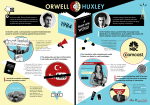
1984 and Brave New LIS

I have been describing library and information science as an understanding and study of the information communication chain for several years now. More recently, I have promoted the effusive declaration that LIS underpins civilized society; no organization and access to information, no civilization. Having the good fortune to have been working in China earlier this year, I was naively stunned when I couldn’t access twitter there – it’s so easy to take for granted that we can make our own decisions about what we read and write isn’t it?

This lovely infographic (not mine, linked to authors) Orwell vs Huxley, reminds me of why I study and teach LIS; facilitating understanding of the information communication chain at least allows us to know what is out there, even if it is not allowed.

The British Origins of Information Science

I was very happy to be invited to talk about the British origins of information science at a celebration of the 75th anniversary of ASIST last week – especially as it meant nipping over to Croatia and spending a day in the sunshine (v short stay due to other commitments alas ..).

The celebration concluded this year’s very popular LIDA conference, and attracted an audience ranging from legends such as Tefco Saracevic and Nick Belkin, to bright, beautiful students at the start of their careers.

The theme was Information Science in Europe, and the papers presented alongside ours were a pleasant reminder of how much interest for our subject exists internationally – I was also heartened to meet others who feel that disciplinary history is essential for understanding how we define ourselves today, and for giving any kind of intellectual basis to our speculation on our future. I am always excusing myself for caring about the past and it was good to perform for fellow history fans – although not all the presentations took the storytelling angle – German and Nordic colleagues presented a history through scientometrics, detailing counts of institutions, courses and papers in every which way.

Colleagues talking about the origins of information science in Italy and Croatia offered new names and insights that I was previously unaware of; always good to get new material.

The origins of information science in Britain is a story which has already been written about, in depth, and with an eloquence which comes with a lifetime of involvement – authors such as W Boyd Rayward, Michael Buckland, Jack Meadows and indeed my co-author David Bawden all stacked up across my desk as we attempted to add something meaningful, representative of our current day interpretation and understanding of our discipline.

The starting point for us, writing from City University London, has of course to be Jason Farradane, credited with coining the phrase “information-scientist” around 1955. For those new to the story, Farradane established the first information science course “Collecting and Communicating Scientific Knowledge” at the Northampton College of Advanced Technology. The College became City University London; Farradane established the Centre for Information Science (we are his direct descendants… ), and the course became our MSc in Information Science. See:

Robinson L and Bawden D (2010). Information (and library) science at City University London; fifty years of educational development. Journal of Information Science vol 36, 631-654.

Farradane’s original course was vocational, designed to train those handling scientific and technical documents in practice. An obvious, and still largely unanswered question is to consider how the course seeded a new academic discipline. Still further, how we came to our present day definition of information science as the study of the information communication chain, through the techniques of domain analysis, paying attention to factors for change including technology, economics, politics and social mores. There are many papers on this, and there will undoubtedly be more in the future, but try:

Robinson L (2009). Information Science: the information chain and domain analysis. Journal of Documentation, vol 65(4), 578-591.

The story of information science in Britain is intertwined with the development of the subject in the US, as well as in Europe, and most accounts agree that although the 1950s provided the right societal, technological and economical environment for the new subject, the issues surrounding the processes of information organization and retrieval were hardly new. Those championing information organisation and access have always endured an impossible torrent of new materials, and the cry of “too much information” can be traced back to biblical times.

As the 1950s heralded a new, post-war, industrial optimism, the accompanying flood of scientific publications brought attention back to the need to harness new knowledge in a way which facilitated its use; a way which promoted the prosperity presumed to arise from exploitation of information and intelligence. This movement centred on information within documents, reports and papers, as a crude division from librarianship and/or library science, which concerned itself primarily with whole “books” and the services associated with organising, storing, preserving and lending specific items.

This rather coarse difference between librarianship and information science, in terms of the level of indexing they dealt with, was certainly still evident in the mid-1980s, and is used to argue in favour of separate library and information science disciplines. However, a closer look at work undertaken at the turn of the nineteenth century reveals that our contemporary understanding of a document and the processes of the information communication chain, i.e. the idea that library science and information science are part of a single disciplinary spectrum, are Victorian in origin – although the main protagonists of these insights, (Otlet and la Fountain in 1895), used the term “documentation” rather than library or information science.

Information science as we understand it today is pretty much agreed internationally to have its origins in the Belgian/European documentation movement. The role of special libraries – well documented and represented in both the UK and US schools – is also acknowledged, but the relationship between the two movements, and their separate influences remains largely uncharted territory, (a question posed by Michael Buckland in 1998) and it may stay that way if, as seems to be the case, no particular records exist as to how the two movements came together. It is important to note that ‘history’ is just what we make out from memory or surviving records. If it was never recorded, we may never know.

The point at which documentation and/or special librarianship became “information science” is still open to consideration, and will be the focus of our next paper. The question of the extent to which the UK origins of information science differ from those of the US was also something we though worth highlighting – a brief glance at the contents of any US text or information science course content will reveal a much heavier computer science bias – and whilst it is easy to dismiss US information science as UK computer science, the overlap is more complex and it would be of interest to explore this in historical context in order to understand more completely how the discipline is regarded in different geographical locations. For anyone who cares, we do not consider information science to be part of computer science, although the disciplines undoubtedly have areas of overlap, especially, as is already well known, within the area of information retrieval.

In addition to the variance in emphasis on technology, our US colleagues did not focus so much on the intellectual tools associated with the documentation movement – although in the UK the information retrieval, or systems paradigm certainly had its day in the history of what is information science.

Nick Belkin reminded me of all the names I had not mentioned (enough!) during my 30 minute romp through our underpinnings – those names associated with classification (Ranganathan, Mills, Foskett), information retrieval (Spark-Jones, Robertson) and user behaviour (Wilson) – all subjects traditionally regarded as comprising the core of information science. Quite so– but constrained by time I attempted to focus on the origins of our endeavours, which (although Belgian rather than British), still describe with startling prescience, our 21st century mandate, and of necessity, left out much of the middle.

Several colleagues at the ASIST 75 event raised their own questions, and we were collectively convinced that a publication drawing together the national origins, similarities and points of departure for information science would make a good read – let’s hope it happens. For now, with respect to the origins of information science then, there is always more to add to the story.