
Hot topics in Information Management #2

Persuaded to get up this morning by the thought of one of my favourite breakfast meetings, one of those regularly hosted by Sue Hill Recruitment and her team, where eight lucky information professionals from diverse environments get together to consider the contemporary professional landscape.

We started by suggesting two words that we each felt represented the biggest impact on our work today, and then added in one which we felt embodied the most significant factor for change over the last 5 years. The ensuing discussion focused on the concepts identified in this simple but effective conversation starter. I suggested information-anxiety, and mobile.

The concepts fell, for the most part, into four categories: economy, technology, skills and organizational culture.

As would be expected, everyone felt the pressure of needing to achieve more with less, and the accompanying ‘de-motivation’ as candidate ways to economise failed to materialize due to services having already been rendered maximally effective and efficient. There was a feeling that excellence in service was no longer attainable, as physical resources, dependant on human care and attention, were downsized in unison with staff numbers.

Technology affects most aspects of our lives, and so again it was not surprising that discussion turned to how mobile devices and cloud computing are changing the workplace in ways we have difficulty imagining. We need strategies for cloud computing. And what of future technology? Can we imagine it? Who would have thought of mainstream smart-phones and augmented reality 5 years ago? Possibly secret Star Trek followers – and I’m not admitting to anything – but I did happen to hear that the science behind the Romulan cloaking device was now a reality (tiny reality – just a paperclip at the moment …)

Social-media received a mixed response. Some felt it was a ‘dumbing-down’ medium, which implied that trained professionals were no longer needed. Others pointed out that many organizations ban the use of these time-wasting, potentially ruinous applications. I am a social-media advocate. Genie and bottle. Be careful what you wish for though.

My role as a masters course director means I am always soliciting first-hand views on what sort of skills employers want from prospective new team members, although balancing this with the requirements for an academic masters can be problematic – the question of vocational training versus learning how to think and develop – quick fix for now or investment in a framework for life-long-learning? As already stated, technology is a key driver for change. Nothing stays the same and the systems in place today will be superseded in increasingly shorter time-spans. Technological-literacy, flexibility and adaptability are key aspirations for prospective job applicants, but how to capture this on a cv, and to stand out from the crowd is less evident.

I was concerned to hear that recent LIS graduates were perceived to have limited abilities in using query language for bibliographic databases – this is something they should definitely take away from any LIS masters course, and most alumni will agree that search was included on the curriculum. I wonder if the Google free-text search box is somehow overriding all our carefully planned lessons in Boolean logic? Perhaps we need to focus on information literacy in schools, as by the time students reach masters level, quick and dirty keyword addiction damage is done.

It was unanimously agreed that the focus on information technology management, rather than information management, meant that the higher paid role of ‘Chief Information Officer’ invariably indicated someone with a computing, rather than LIS background. Although as an aside, the importance of ‘softer’, information related skills may be being recognized in newer courses, such as the masters in information leadership (MIL) at City University. The feeling that for higher paid jobs, business, rather than LIS skills were sought was mentioned, and I am interested in pursuing evidence for this, and indeed to identify what exactly is meant by ‘business skills’.

On the positive side, the evaluative and analytical skills of a trained information professional were perceived to be highly valued, with clients preferring to engage with those who offered ‘added-insight’ to research results. This requires subject knowledge, and adds weight to my belief that information professionals also need to be subject specialists, and that LIS needs to remain a postgraduate profession.

The failure of many IT-led implementations was noted – it is obviously helpful to ask the users and creators of content about system requirements before spending huge sums on something designed for some other purpose entirely. Never happens though – except in systems design courses.

Organizational culture is changing to interpret and work with moving technological, economic, political and social factors. With lawyers charging in ever decreasing units of time, it is essential that information and research related tasks are undertaken by lower-paid information professionals, so that clients are not overcharged. Not sure I am entirely comfortable with information workers being openly worth so much less per hour than lawyers, but its one of those unpleasant facts of life. Often, the idea is to outsource this kind of work, rather than to develop a skilled, in-house team. It’s the economy.

Other observations were that there was a demand for information-skills training from clients themselves, (i.e. a mentoring role outside the LIS profession),  that increasingly innovation came from connectivity between specializations, and that we need to ensure we have the infrastructure to cope with the landslide of information  produced from government open-data initiatives and e-science. There is just too much information. Hence I end where I started, with information-anxiety. Which is now mobile.

Many thanks to Sue for her innovative get-togethers – and just to mention that her events also raise money, this year for Macmillan Cancer Support.


Growing Knowledge – views please

Growing Knowledge: The Evolution of Research

My colleague, Pete Williams, at UCL, is evaluating this British Library exhibition, which runs between 12 October 2010 – 16 July 2011. Please go along and support the future of research!

The Growing Knowledge exhibition will demonstrate the vision for future digital research services at the British Library, and provide a test bed for the evaluation of digital research tools and services that have the potential to support researchers’ needs. The exhibition will consist of a number of features including digital signage, video demonstrations, interactive welcome animations and a prototype “Researcher’s Desktop” application.

We at University College London are evaluating the exhibition, and would like to invite you to visit it and to give us your views. Your visit will allow you to sample each of these components. A researcher will be at the exhibition, and we hope that you will be able to talk to him briefly to tell him what you think of the exhibition.

The programme for each event will be as follows:

11.00: One of the curators will give an introductory talk about the exhibition
11.15: There will be an opportunity for you to explore the exhibition and try out the digital facilities. Our researcher may wish to talk to you about your views on the various exhibits.
12.30: Event closes.

A link to a short questionnaire will be sent to you very soon about your views on the exhibition and the issues raised.

Please register at: http://blgrowingknowledge.eventbrite.com/

For further information please contact us at: growingknowledge@bl.uk or peter.williams@ucl.ac.uk

Core Collections

Collections are anarchic, they exist for and are defined entirely by their own purpose, they have their own identity and exude individuality.

Collecting is not just about acquiring everything. Collections can be very small, representative (core) rather than comprehensive. Collecting is about making connections, considering relationships and rearranging until the collected items sit in the ‘right’ order – this latter being open to interpretation. When looking at a collection, it is possible to gauge how one thing relates to another, to see where there is duplication, and where there are omissions. Good examples make themselves known, as do poorer contributors. Collections are aesthetically pleasing to behold, and they exude a calming stability in a world of dizzying change. Although as living entities, collections may have to be restructured and reinterpreted over time, at least at any one moment, collections are finite and thus comprehensible. I have made collections from just about all of the things I possess. I seek out items I gave away years ago in order to ease the pain of the ‘gap in the collection’. Books, of course, but also old magazines, items of glass, crockery and anything from Liberty’s. I am immediately interested in someone who has a collection of their own. The whole is always greater than the sum of the parts, and collections tell us things that isolated items cannot.

Which leads me to core listings, and resource lists. These surrogate collections furnish us with a manageable format via which to comprehend the real thing – they are often used to facilitate assembly of an actual collection, and they have traditionally been valued for their integrity and the effort expended over their construction.

The creation of resource listings is one of the fundamental areas within library and information science, (one of Hjorland’s1 eleven aspects of domain analysis) and yet very little is written about their construction – there is no definitive way for them to be produced. Nor, I am rather sorry to say, is it entirely clear today that listings of any sort are valued in the face of ‘go google’ – the land of instant lists.

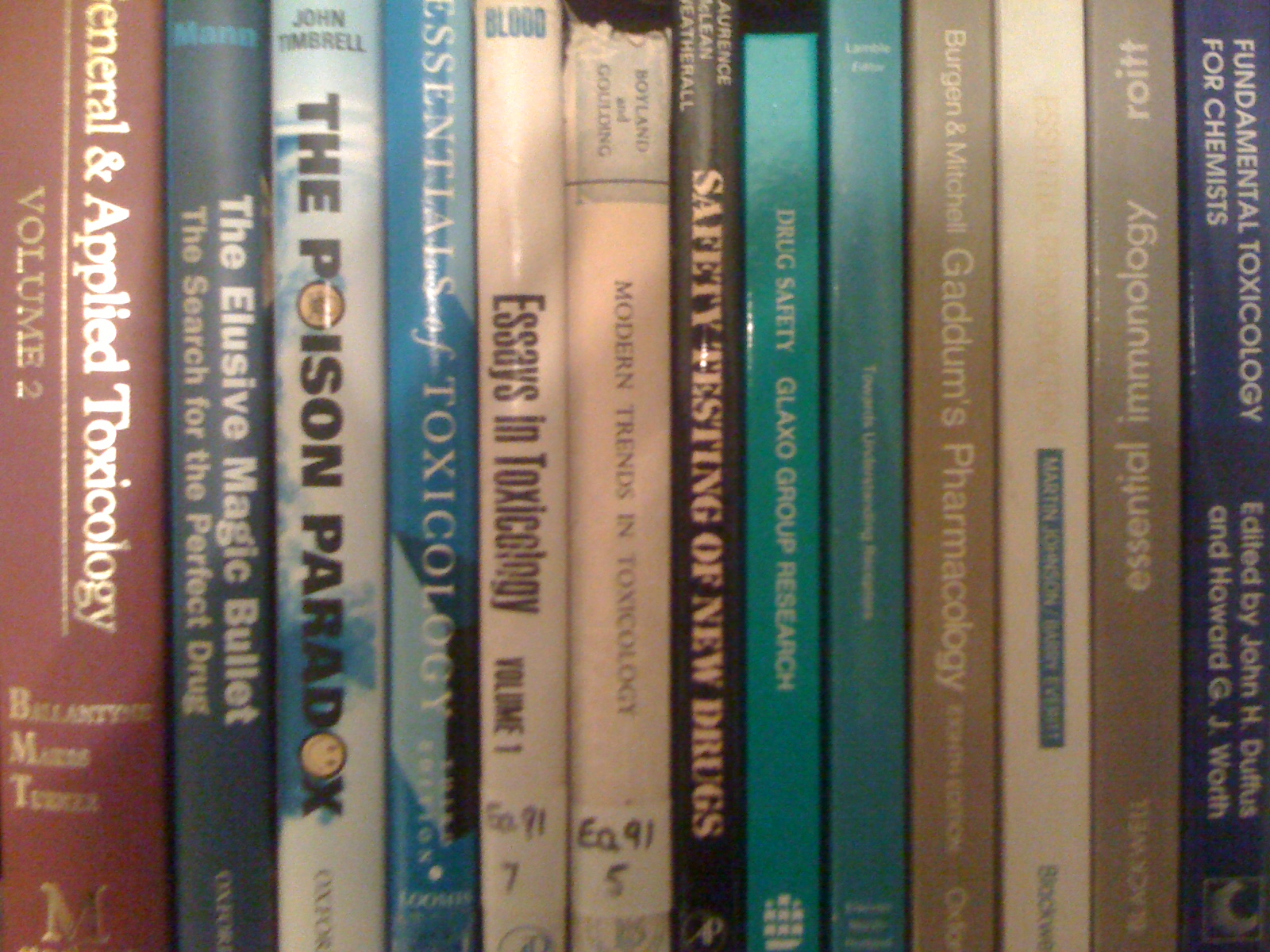
I have a longstanding interest in listings. I started my career thinking about the ideal (comprehensive) listing of toxicology resources, at a time when it was feasible to contemplate such a thing. Once the Internet rendered our world global instead of local, any hope of a comprehensive resource listing within any subject area vanished. Instead we were left with the representative listing, the expert listing, the popular listing or the ‘here are some resources you could try’ listing.

As part of my doctoral research, I scoured the literature for methodologies relating to the compilation of resource lists and subject guides. As a response to the void I postulated (Robinson2) that ideal resource lists could be created by locating items via a cascade style of hierarchical searching; one would search first for lists of lists (quaternary resources), then for lists (tertiary resources), then for value added (secondary resources) and finally for the first instantiation of a work within the literature (primary resources). I called this hierarchy the ‘fundamental framework of resources’

The idea was academic, because in the real world resource creators do not adhere to my framework. They often create hybrid resources (a list containing other tertiary as well as secondary items for example), and not all resources are entered into a higher resource (not all lists are listed in a list of lists, not every article is indexed in a database …) which make a systematic cascade impossible to follow. It would be great if we had a single world list of lists for every subject – a bit like the gopher system – alas a distant memory. Nonetheless, I concluded that searching systematically, across databases, the internet and within ‘level specific’ resources, for resources within each of the four categories, would result in a representative listing of resources within any area.

The problem, as exemplified by my attempt to create a toxicology listing, was one of overload. There were simply too many resources to make even the term ‘representative’ an obvious way to go on its own. It thus became necessary to apply some selection criteria, whereby an item was included in the listing if it was the only one of its kind, or it was exemplary in some way. Me-toos were cut out, so that the list offered good examples of resources from categories such as books, journals, library collections and databases. This particular piece of work was carried out a decade ago; today we are faced with many more modes of dissemination. And a much bigger task.

So how then, to create resource listings in 2010? My interest has been stirred by joining the working group behind the creation of an updated edition of the Core Collection of Medical Books, under the auspices of CILIP’s Health Libraries Group. The last Core Collection3 was published by Tomlinsons in 2006.

The idea is to stick to a listing that just covers books, in order to bring the project within a manageable framework, but even then we come up against the issue of e-books and electronic access. The group favours including only works available in print, although some of these may be available as electronic editions, and in time, it may be that some works are missed if they are only available in electronic format. It was thought that this decision could be revised for a future edition.

Other considerations were the intended audience, previously stated as small to medium libraries, and the level of texts to include. It was considered that any constraints on potential audience should be removed, and that even though the listing would have a UK focus, it may be helpful to libraries internationally. The size of the listing was considered, currently around 1000 items, and the method of publication – another printed edition was favoured unanimously, but the group are using LibraryThing to solicit new items to be considered for inclusion, and comments on items in the existing list. It was suggested that if items received no comments, that they should be removed, but this was undecided as ‘no comment’ may not mean that an item should no longer be considered core. A date of no earlier than 2005 was mooted as a limit for publication date, as medicine progresses rapidly and texts date quickly. It was thought that this would be waived in a few cases where older texts are still believed to be valid (in psychotherapy for example).

Finally, the methodology for creating the listing, which for now is constructed from the last listing, plus any additions sent in by volunteer LIS workers contacted largely via lis-medical. This method was agreed to be limited, and an extension to the deadline for comments/submission was proposed so that more LIS professionals could be asked to contribute (CHILL and UHMLG members). The group also conceded that input from clinicians would be valuable, although probably time consuming to extract. I raised the issue of systematic searching by expert LIS staff within each category, but this was perhaps expecting too much time and effort from already time-poor staff. It was felt that an expert eye (LIS professional in our group) should assess the entire list in order to identify any obvious gluts or gaps; this highlights the strong desire of the group to bring the core collection into being as this is quite an onerous task. The third part of the methodology would be editorial, checking the text for publication etc.

The final aspect for consideration was the categorization used, or tags (the latter used with LibraryThing). The current tag list has been copied from the last edition, and the group will consider whether any changes should be made in the form of new tags or division of older joint tags such as ‘pharmacology and toxicology’ into separate headings. The tags have not been taken from any existing medical vocabularies, and the group has no plans to change this at the moment. It was decided, however, that we would not encourage free tagging, and that anyone suggesting an item for the list should use an existing tag.

The ease with which LibraryThing can be updated and maintained raises the question of whether the list needs to be finite – as theoretically new suggestions can be added in at an time – there is then the question of a mechanism for editorial control though.

So, the group intends to make a final call for comments and additions, whilst the group lead will look over all the entries to identify subjects (tags) where input is needed. We will meet again in the new year to consider our final material, and our options for producing a printed version, which despite the ready availability of the core collection on LibraryThing, was felt to be highly desirable.

Two companion works are already available; the Nursing Core Collection4 and the Mental Health Core Collection5. Further details can be found on the CILIP HLG website, from the link above.

It was my pleasure to meet a group of like-minded collection and resource list lovers, and I wholeheartedly admire their dedication to this project.

References

1) Hjorland B (2002). Domain Analysis in Information Science: eleven approaches, traditional as well as innovative. Journal of Documentation, vol 58 (4) 422-462

2) Robinson L (2000). A Strategic Approach to Research using Internet Tools and Resources. ASLIB Proceedings, vol 52 (1), 11-19

3) CILIP Health Libraries Group (2006). Core Collection of Medical Books 2006 5th edition. Tomlinsons

4) CILIP Health Libraries Group (2010). Nursing Core Collection 2010 4th edition. Tomlinsons.

5) CILIP Health Libraries Group (2009). Mental Health Core Collection 2009 2nd edition. Tomlinsons